
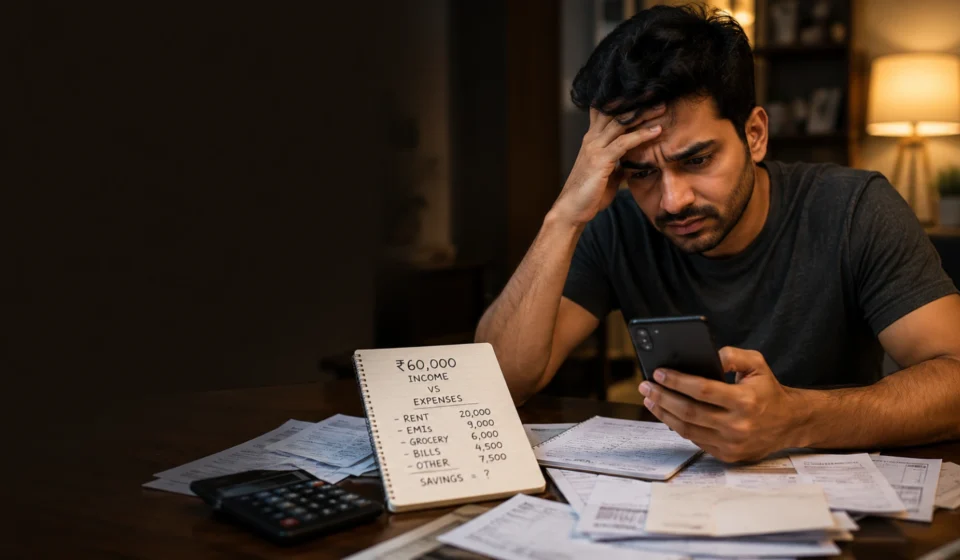
Earning ₹60,000 a month should feel stable—but if you still feel broke by the end of every month, something isn’t adding up.
I’ve worked with many people in the same situation, and the truth is simple: it’s not just about income—it’s about your lifestyle choices and spending habits.
The good news? A few smart lifestyle changes can instantly free up your money without making your life boring.
Let’s break it down like I would explain it to a friend.
Why Do You Still Feel Broke Even at ₹60,000?
The issue isn’t your salary—it’s your financial behavior.
Here’s where most money disappears:
- Lifestyle inflation (spending increases with income)
- No clear monthly budget
- Impulse purchases
- High fixed expenses (rent, EMIs)
Typical ₹60,000 Salary Breakdown
| Category | Average Spend (₹) |
|---|---|
| Rent & Utilities | 20,000 |
| Food & Groceries | 12,000 |
| Transport | 5,000 |
| EMIs | 8,000 |
| Lifestyle | 10,000 |
| Savings | 5,000 or less |
If your savings are under ₹10,000, it’s time to rethink your system.
What Lifestyle Changes Can Actually Free Up Your Money?
These are practical, realistic shifts—not extreme sacrifices.
1. Are You Living Above Your Means Without Realizing It?
Many people upgrade their lifestyle too fast.
Fix it by:
- Choosing needs over status
- Delaying big purchases
- Avoiding unnecessary EMIs
Result: You instantly reduce financial pressure.
2. Can You Reduce Your Fixed Expenses First?
This is the fastest way to free up your money.
Try:
- Sharing rent or moving to a slightly cheaper area
- Switching to affordable internet/mobile plans
- Refinancing high-interest loans
Even saving ₹3,000/month = ₹36,000/year.
3. Are Your Daily Habits Quietly Draining Your Budget?
Small expenses add up fast.
Watch out for:
- Daily food delivery
- Frequent café visits
- Subscription overload
Quick Action Plan:
- Limit eating out to weekends
- Cancel unused subscriptions
- Set a weekly spending cap
4. Do You Track Where Your Money Actually Goes?
If you don’t track it, you can’t fix it.
Start simple:
- Track expenses for 7 days
- Categorize spending
You’ll quickly notice patterns like overspending on food or shopping.
5. Can You Automate Savings Before Spending?
This is a game-changer.
Instead of saving what’s left, do this:
- Automatically transfer money to savings/investments
- Start SIPs in mutual funds
Treat savings as a fixed expense, not an afterthought.
6. Are You Relying Only on Salary?
Here’s the truth—budgeting alone has limits.
To truly free up your money, increase income:
- Freelancing (writing, design, coding)
- Side hustles
- Upskilling for a better salary
Even an extra ₹5,000/month changes everything.
What Is the Best Way to Balance Spending and Saving?
Use a simple structure:
- Needs: 50%
- Wants: 30%
- Savings: 20% (or more)
Ideal Allocation Example
| Category | % | Amount (₹) |
| Needs | 50 | 30,000 |
| Wants | 25 | 15,000 |
| Savings | 25 | 15,000 |
Focus on consistency, not perfection.
How Quickly Can You See Results?
If you apply even 3 of these lifestyle changes:
- Week 1: Awareness improves
- Month 1: ₹3K–₹8K savings increase
- 3 Months: Noticeable financial stability
The key is discipline + consistency.
Conclusion
Feeling broke at ₹60,000 isn’t a salary problem—it’s a system problem.
With the right lifestyle changes, you can free up your money, build savings, and finally feel in control of your finances.
Start small. Stay consistent. And remember—financial freedom is built one habit at a time.
FAQs
Q. Is ₹60,000 a good salary in India?
- Yes, it’s a decent middle-class salary, but proper budgeting is essential to build savings.
Q. What is the fastest way to free up money?
- Reduce fixed expenses and cut unnecessary lifestyle spending.
Q. How much should I save every month?
- Aim for at least 20–25% of your income (₹12,000–₹15,000).
Q. Should I focus on saving or earning more?
- Both. Start saving immediately while working on increasing income.
Q. Can lifestyle changes really improve finances?
- Absolutely. Small, consistent changes can save thousands every month.
Credible Sources for Further Reading
- Reserve Bank of India (RBI): https://www.rbi.org.in
- SEBI Investor Education: https://www.sebi.gov.in
- Investopedia Budgeting Guide: https://www.investopedia.com

Abhishek Kandir is the founder and lead writer at Paisewaise, a personal
finance publication covering Indian markets, budgeting, and investing since 2023.
Abhishek’s work focuses on making complex financial topics — from RBI
Interventions to SIP strategies — understandable for everyday Indian readers
without a financial background.