
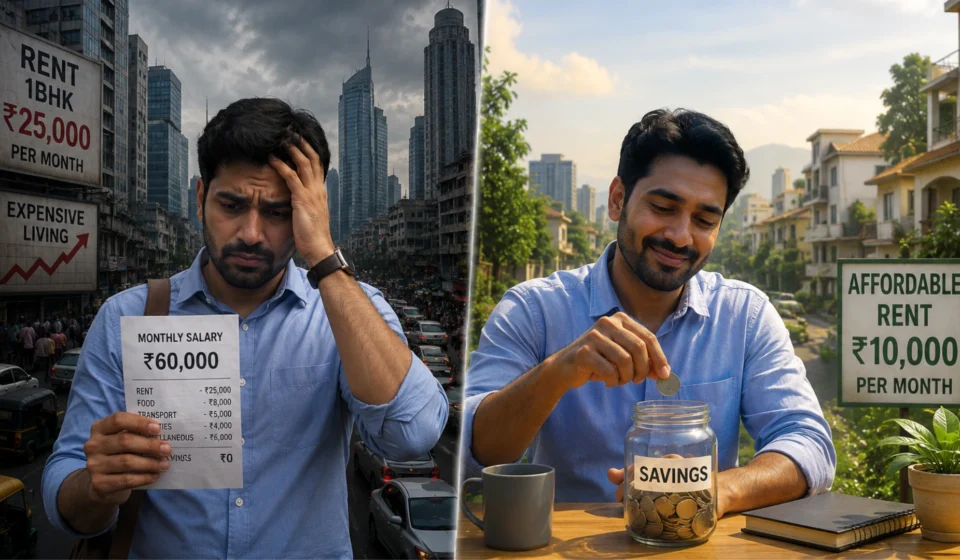
₹60,000 Feels Poor in Cities? 4 Location Hacks That Stretch Your Salary Like Never Before

If you’re earning ₹60,000 a month, on paper, it sounds decent. But the moment you start living in a metro city, your salary suddenly feels… small.
Rent eats a big chunk, groceries feel expensive, and savings? Almost non-existent.
The truth is, it’s not always about how much you earn—it’s about where and how you live. Let’s break down how you can stretch your salary smarter without feeling deprived.
Why Does ₹60,000 Feel Poor in Metro Cities?
Living in cities like Mumbai, Bangalore, or Delhi comes with a hidden price tag—the cost of living inflation.
According to Reserve Bank of India and global cost comparisons on Numbeo Cost of Living Index, urban expenses have been rising faster than salaries.
Here’s a simple breakdown:
| Expense Category | Average Monthly Cost (Metro) |
|---|---|
| Rent | ₹20,000 – ₹35,000 |
| Food | ₹8,000 – ₹12,000 |
| Transport | ₹3,000 – ₹6,000 |
| Utilities | ₹2,000 – ₹4,000 |
| Miscellaneous | ₹5,000 – ₹10,000 |
👉 That’s why your ₹60,000 salary feels tight—it’s being stretched across high fixed expenses.
How Can Location Alone Save You ₹10,000+ Monthly?
This is the biggest overlooked hack.
Instead of living in prime areas, shifting just 5–10 km away can dramatically reduce rent.
Smart Location Shifts:
- City Center → Suburbs
- Gated Societies → Standalone Flats
- Tier 1 → Tier 2 Cities
Example:
- Bangalore city center rent: ₹25,000
- Same setup in outskirts: ₹15,000
👉 That’s a direct saving of ₹10,000/month.
Pro Tip: Always balance commute time vs rent savings. Saving money but spending 3 hours commuting isn’t worth it.
Can Living in Tier 2 Cities Multiply Your Savings?
Absolutely—and this is where the real advantage lies.
Cities like Indore, Jaipur, or Bhubaneswar offer lower living costs with decent infrastructure.
Cost Comparison:
| Category | Metro City | Tier 2 City |
| Rent | ₹25,000 | ₹10,000 |
| Food | ₹10,000 | ₹6,000 |
| Transport | ₹5,000 | ₹2,000 |
👉 Total savings: ₹15,000–₹20,000/month
If your job allows remote work or hybrid flexibility, this is a game-changing move.
What Are the 4 Location Hacks to Stretch Your Salary?
Let’s get practical. These are actionable strategies you can implement immediately.
1. Choose “Near Work,” Not “Near Status.”
Living close to your office reduces:
- Transport costs
- Food delivery dependency
- Time wastage
👉 Time saved = money saved.
2. Optimize Rent Using Flat Sharing
If you’re single, this is a no-brainer.
- 1BHK solo: ₹20,000
- Shared 2BHK: ₹10,000
👉 You instantly cut housing costs by 50%.
3. Move to Micro-Markets
Every city has hidden affordable pockets.
Examples:
- Instead of Bandra → Try Mira Road (Mumbai)
- Instead of Koramangala → Try Electronic City (Bangalore)
👉 Same city, drastically different cost.
4. Work Remotely When Possible
Even 2–3 remote days a week can:
- Cut commute costs
- Reduce eating-out expenses
- Improve productivity
👉 Hybrid work is a silent financial advantage.
Is Lifestyle the Real Problem, Not Salary?
Let’s be honest—sometimes the issue isn’t ₹60,000.
It’s lifestyle inflation.
When income increases, expenses follow:
- Frequent Swiggy/Zomato orders
- Subscription overload
- Impulse shopping
Quick Fixes:
- Follow a 50-30-20 rule
- Track expenses weekly
- Avoid “status spending.”
👉 Your salary isn’t small—your spending might be unoptimized.
Conclusion
Earning ₹60,000 doesn’t have to feel like a struggle.
The difference between feeling broke and building savings often comes down to location decisions.
By:
- Choosing smarter housing
- Exploring Tier 2 cities
- Reducing unnecessary lifestyle costs
…you can easily free up ₹10,000–₹20,000 every month.
And that’s where real wealth-building begins.
FAQs
Q. Is ₹60,000 a good salary in India?
- Yes, it’s a decent salary. But in metro cities, high living costs can make it feel insufficient.
Q. How much should I save from ₹60,000?
- Ideally, aim for 20–30% savings (₹12,000–₹18,000) by optimizing expenses.
Q. Which cities are best for saving money in India?
- Tier 2 cities like Indore, Jaipur, and Coimbatore offer lower costs and better savings potential.
Q. Should I move to a cheaper area to save money?
- Yes, if it doesn’t significantly increase your commute time or reduce your quality of life.
Q. What is the biggest expense for ₹60,000 earners?
- Rent is usually the largest expense, often taking up 30–50% of income.
Abhishek Kandir is the founder and lead writer at Paisewaise, a personal
finance publication covering Indian markets, budgeting, and investing since 2023.
Abhishek’s work focuses on making complex financial topics — from RBI
Interventions to SIP strategies — understandable for everyday Indian readers
without a financial background.