
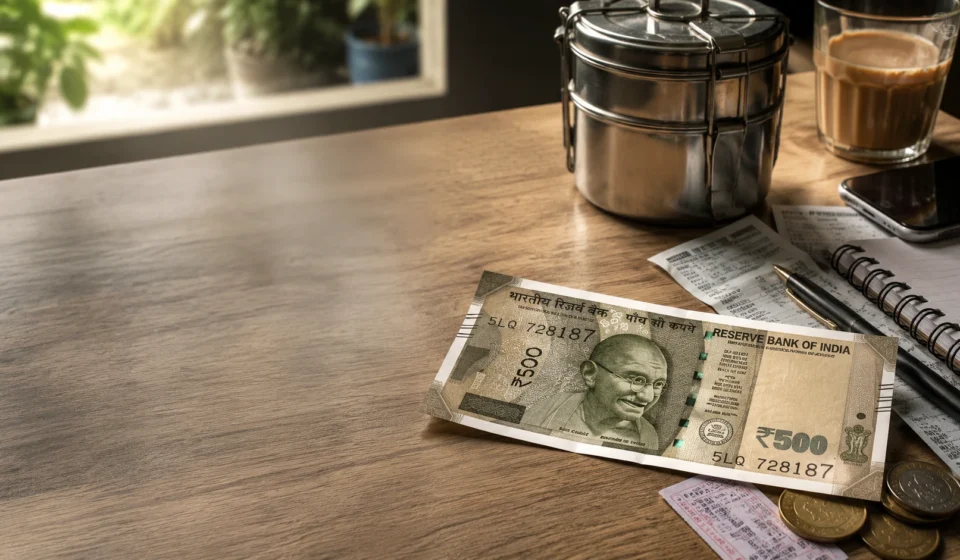
I Tried a ₹500 a Day Budget for 7 Days—The First 5 Expenses I Cut Shocked Me (And I Didn’t Miss Them)

I Tried a ₹500 a Day Budget for 7 Days — Here’s What I Cut First (and What I Wish I’d Stopped Buying Earlier)
Can you actually survive on ₹500 a day?
I thought I knew the answer. I figured food would be the killer — that I’d be counting rice grains by Wednesday.
I was completely wrong. Food wasn’t the problem. My habits were.
So I ran a seven-day money-saving challenge: ₹500 a day, no exceptions. Here’s exactly what living on a budget like that taught me — the boring parts, the surprising parts, and the one expense I swore I’d cut but couldn’t.
Why I Tried the ₹500 a Day Budget Challenge
Honestly? A mix of curiosity and a financial reset I’d been putting off.
Cost of living in India has crept up everywhere, even outside the big metros. Fresh data from March 2026 puts a single person’s monthly essentials — food, utilities, transport, and leisure — at around ₹27,300, not including rent. That works out to roughly ₹900 a day just for the basics, before rent even enters the picture.
So ₹500 a day felt like a real test, not a gimmick. I wanted to see:
- Where my money actually goes, versus where I think it goes
- Which spending is survival and which is just habit
- Whether budgeting really is as painful as it sounds
Spoiler: it wasn’t food. It was the small stuff I never thought to track.
My Rules Before the Challenge Started
I kept this simple, almost strict, on purpose. Loose rules make it too easy to cheat yourself.
- ₹500 maximum, per day — no rollover, no borrowing from tomorrow
- Cash only — no cards, no UPI, no “I’ll just tap”
- No food delivery — cook or step outside
- No impulse purchases — anything not planned that morning was off-limits
- No subscriptions — paused what I could, ignored the rest for the week
Cash-only budgeting sounds old-fashioned, but it works for a reason: watching physical money leave your hand hurts more than a silent notification. That friction was the whole point.
Every Expense Had to Earn Its Place
By day two, I was writing everything down and asking one question before I spent a rupee: keep or cut?
| Purchase | Category | Keep or Cut? | Why |
|---|---|---|---|
| Breakfast | Survival | Keep | Needed to function |
| Coffee (outside) | Comfort | Cut | Pure habit, not hunger |
| Cab to work | Convenience | Cut | Bus worked fine |
| Online shopping browsing | Impulse | Cut | Didn’t need any of it |
| Netflix | Entertainment | Cut | Added zero value that week |
Nobody frames a budget this way, but it should be the first thing you do. Once you sort spending into survival, comfort, convenience, impulse, and entertainment, the cuts basically make themselves.
The First Expenses I Cut (And Didn’t Regret)
Coffee. The craving was gone by day three. It wasn’t the coffee I wanted — it was the 10-minute break from my desk.
Food delivery. This was the biggest one, and the numbers back up why. One budgeting analysis found that a moderate delivery user’s annual spend of around ₹72,000, if invested instead at a typical long-term equity return, would grow to roughly ₹1,28,000 in five years. That’s real money quietly leaking out through convenience.
Snacks. Turns out most of my “hunger” was boredom wearing a disguise.
Online shopping. Even window shopping without buying anything primed me to want things I didn’t need an hour later.
Paid apps and subscriptions. These are the sneakiest — you forget they exist until the bank statement reminds you.
The Expense I Thought I’d Cut… But Couldn’t
I was sure I’d cut transportation. I was wrong.
I don’t live near my workplace, and skipping transport wasn’t optional — it was tied to my income. I could downgrade from cab to bus, but I couldn’t cut it entirely.
Same story with mobile recharge. My phone is how I coordinate everything else in my day — work, family, even the budget tracking itself. Cutting it would have cost me more than it saved.
This is the twist nobody expects going in: some expenses aren’t habits at all. They’re infrastructure.
What Surprised Me Most About Living on ₹500 a Day
It wasn’t the money. It was the emotions around the money.
- I felt a strange social pressure when a friend suggested a coffee run, and I had to say no
- I noticed real stress on the days I was close to my limit by 4 PM
- Convenience felt less like a luxury, and more like a coping mechanism I leaned on without noticing
Budgeting isn’t just arithmetic. It’s a window into how you actually cope with your day.
The Psychology Behind Everyday Spending
This is the part most “budget challenge” posts skip entirely, and it’s the part that actually explains why you overspend.
Decision fatigue is real. Roughly $5.5 billion in sales happen at checkout counters in the US every year, largely because people run out of mental energy for decisions and grab whatever’s in front of them. By evening, I noticed the same thing — I was far more likely to say yes to a snack or a small purchase after a long day of decisions at work.
Impulse buying is emotional, not logical. Research on impulse spending shows more than half of shoppers admit to spending $100 or more on a single impulse purchase, with a fifth having spent $1,000 or more. The trigger usually isn’t the product — it’s stress, boredom, or the urge for instant relief.
Even the placement of items works against you. Studies on retail behavior have found stores see 60 to 70% higher impulse purchase rates on items placed at checkout, precisely where shoppers are already mentally worn down from earlier decisions.
Once I understood this, cutting spending stopped feeling like willpower and started feeling like just… removing the triggers.
What I’d Never Cut Again
Balance matters. A few things I protected no matter what:
- Healthy food — cutting this to save money backfires fast
- Internet — not a luxury anymore, it’s how most of us work and stay connected
- Medicine — non-negotiable, always
- A small emergency buffer — even ₹50 saved daily adds up to a safety net
The goal was never to strip life down to nothing. It was to tell the difference between what supports you and what just feels good in the moment.
Can You Really Live on ₹500 a Day in India?
Honestly — it depends heavily on where you live and what you’re responsible for.
Rent alone typically eats up 30 to 50% of a household’s monthly income in Indian cities, and it varies enormously by location — a one-bedroom in Mumbai’s city centre can run several times what the same size flat costs in a smaller city. If you’re paying rent, supporting family, or commuting long distances, ₹500 a day is closer to a discipline exercise than a permanent lifestyle.
It’s far more realistic for someone with:
- Low or no rent burden (living with family, for instance)
- Short, cheap commutes
- No dependents to support
For most people, it’s not a forever plan — it’s a reset button.
My Biggest Money Lessons After One Week
- ✔ Small purchases matter more than you think
- ✔ Convenience is expensive — you’re paying for time, every time
- ✔ Budgeting removes stress; it doesn’t add it
- ✔ Tracking spending changes behavior almost immediately
- ✔ Most “needs” are actually habits wearing a disguise
10 Expenses You Should Audit Today
If you want the shortcut version of this whole experiment, start here:
- Coffee runs
- Food delivery
- Subscriptions you forgot you had
- Snacks bought out of boredom
- Impulse online shopping
- Ride-hailing for short distances
- Streaming services you barely watch
- Unused gym or app memberships
- “Deal” purchases you didn’t plan for
- Late-night online purchases
Pick even three of these and audit them for a week. You’ll be surprised what shows up.
Frequently Asked Questions
Q. Can you really survive on ₹500 a day?
- For a short period, yes — especially if rent, transport, and dependents aren’t part of the equation. As an ongoing lifestyle, it’s tough for most working people in Indian cities.
Q. What is the biggest expense people overlook?
- Small, recurring “convenience” spending — coffee, delivery fees, subscriptions — adds up faster than big, one-time purchases.
Q. How do I reduce daily spending?
- Start by tracking everything for a week, then sort each expense into keep-or-cut. Awareness alone changes behavior.
Q. Is cash budgeting better than UPI?
- For many people, yes — physically handing over cash creates friction that a tap-to-pay simply doesn’t, which naturally slows down impulse spending.
Q. What should you cut first when saving money?
- Anything driven by comfort or convenience rather than actual need — that’s usually where the easiest, most painless cuts live.
Conclusion
The challenge didn’t prove that everyone should live on ₹500 a day. It proved that most of us spend on autopilot.
Once you separate needs from habits, budgeting stops feeling like a sacrifice and starts feeling like control.
Abhishek Kandir is the founder and lead writer at Paisewaise, a personal
finance publication covering Indian markets, budgeting, and investing since 2023.
Abhishek’s work focuses on making complex financial topics — from RBI
Interventions to SIP strategies — understandable for everyday Indian readers
without a financial background.