
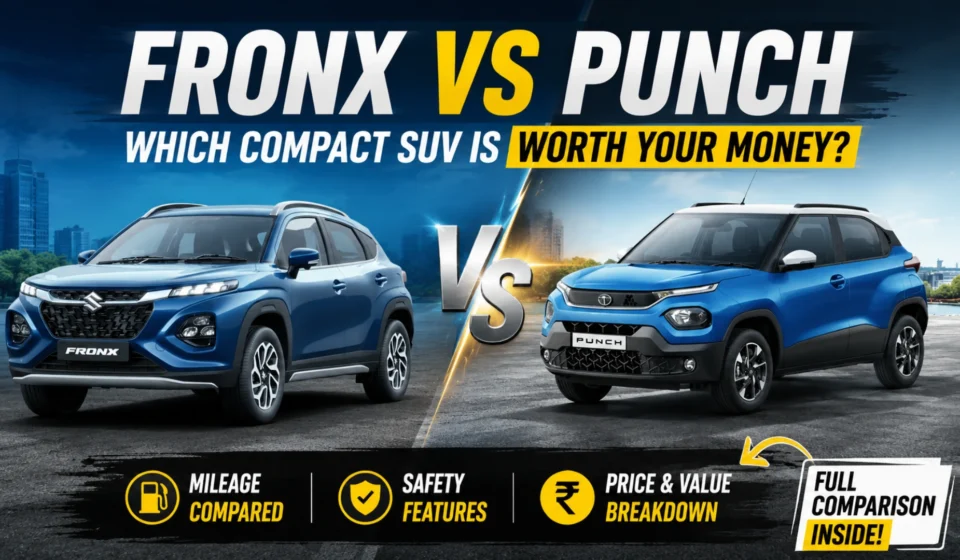
India’s compact SUV segment has never been more exciting — or more confusing. Walk into any tea stall or office pantry, and chances are someone’s debating the Tata Punch EV against the Maruti Fronx. One camp swears by Tata’s electric revolution. The other won’t budge from Maruti’s tried-and-tested dependability. Both are right. Both are wrong. Let’s settle this properly.
Quick Glance: What Are These Cars?
The Tata Punch EV is India’s most affordable electric micro-SUV — a fully electric version of the hugely popular Punch, offering zero tailpipe emissions, a punchy electric motor, and Tata’s reputation for safety. It starts at ₹9.69 lakh (ex-showroom) and goes up to ₹12.59 lakh for the top Empowered Plus S 40kWh variant.
The Maruti Suzuki Fronx is a stylish crossover from Maruti’s premium NEXA channel, available exclusively at NEXA dealerships. It blends sporty design with the reliability that Maruti owners have trusted for decades. Prices start at ₹6.85 lakh and go up to ₹11.98 lakh (ex-showroom).
Price Comparison: Who Gives More for Your Money?
| Variant | Tata Punch EV | Maruti Fronx |
|---|---|---|
| Starting Price | ₹9.69 lakh | ₹6.85 lakh |
| Top Variant | ₹12.59 lakh | ₹11.98 lakh |
| Sweet Spot | ~₹10–11 lakh | ~₹9–11 lakh |
On paper, the Maruti Fronx is more affordable to get into. The Fronx’s entry price is nearly ₹3 lakh less than the Punch EV’s base model. However, this comparison isn’t entirely fair — one runs on electricity, and your fuel savings over 3–5 years with the Punch EV can more than cover that price gap.
Verdict: Fronx wins on upfront cost; Punch EV wins on long-term savings.
Engine & Performance: ICE Thrills vs Electric Surges
Tata Punch EV
The Punch EV comes with two battery options:
- 30 kWh battery — producing around 82 bhp, certified range of ~312 km
- 40 kWh battery — producing around 122 bhp, certified range of ~375 km
The electric motor delivers instantaneous torque, which means zero lag off the line. In city traffic, the Punch EV feels genuinely quick. The 40 kWh version even supports fast charging — reaching 20–80% in just 26 minutes with a 65kW DC charger.
Maruti Fronx
The Fronx offers India’s beloved choice of powertrains:
- 1.2-litre naturally aspirated petrol — 88.5 bhp, available with manual/AMT/CNG
- 1.0-litre turbocharged petrol — available with manual and torque converter automatic
The turbo unit is the real star here. It has a punchy mid-range delivery and a throaty exhaust note, transforming the Fronx from a city runabout into something genuinely fun. Claimed mileage stands at an impressive 21.5–21.79 kmpl.
Verdict: Punch EV wins on city performance and running costs. Fronx turbo wins for highway-driving excitement and freedom from charging anxiety.
Range & Running Costs: The Big EV Question
This is where the Tata Punch EV debate gets real. India’s EV infrastructure has improved dramatically, but range anxiety is still a genuine concern for many buyers.
- Punch EV 40 kWh: 375 km certified range. Ideal for city dwellers who charge at home overnight.
- Fronx petrol: Fill up anywhere in India — from metros to mountain highways. No compromise on convenience.
On running costs, though, the Punch EV is a clear winner. Electricity costs roughly ₹1–2 per km, compared to ₹5–7 per km for petrol at today’s prices. Over 1 lakh km, that’s a saving of ₹3–6 lakh — nearly recovering the price premium over the Fronx.
Verdict: Fronx wins on convenience and flexibility; Punch EV wins decisively on per-kilometre cost.
Design & Styling: Street Presence
Tata Punch EV
The Punch EV keeps the bold, boxy micro-SUV stance of the regular Punch but adds EV-specific touches — a closed grille, distinctive LED DRLs, and a refreshed interior with a new two-spoke steering wheel. The 193mm ground clearance and 90-degree door opening make it practical for Indian roads and tight parking spots. New TrailCrest R16 diamond-cut alloy wheels add a premium touch.
Maruti Fronx
The Fronx looks genuinely striking. With bumper-integrated headlights, a large front grille, bulging wheel arches, and extensive black cladding, it has a crossover-like stance that’s hard to ignore. The sloping roofline gives it a sporty silhouette, and the rear connected light bar and chunky silver skid plate make it look expensive from every angle. Its 190mm ground clearance is on par with segment rivals.
Verdict: Both look great, but the Fronx has slightly stronger visual appeal and a more premium NEXA presence. The Punch EV scores on practicality.
Interior & Features: Who Spoils You More?
Tata Punch EV
- 10.25-inch infotainment screen
- 10.25-inch digital instrument cluster
- Wireless Android Auto & Apple CarPlay
- 360-degree camera
- Auto climate control with rear AC vents
- Sunroof with voice command opening
- Tyre Pressure Monitoring System (standard)
- Extended thigh support & height-adjustable driver seat
- 366 litres of boot space (among the best in class)
Maruti Fronx
- 9-inch HD touchscreen with wireless connectivity
- 360-degree camera (top variants)
- Dual-tone premium interiors with leather-wrapped flat-bottom steering
- Wireless charging pad
- Twin analogue instrument dials with a central info screen
- Paddle shifters (automatic variants)
- 308 litres of boot space
Verdict: Punch EV edges ahead on screen size, digital instrumentation, and boot space. Fronx counters with a more premium interior feel.
Safety: One Wins by a Mile
This is not even close.
The Tata Punch EV carries a 5-Star BNCAP (Bharat NCAP) safety rating — the highest possible. Tata even simulated a head-on crash scenario publicly to demonstrate real-world protection. Safety features include:
- 6 airbags
- ABS + EBD + ESP
- Tyre Pressure Monitoring
- Hill Assist
- ISOFIX child-seat mounts
The Maruti Fronx also offers decent safety (ABS, ESP, Hill Assist, ISOFIX), but it does not have a 5-star BNCAP rating as of this writing.
Verdict: Tata Punch EV wins safety comprehensively. This alone could be a deal-breaker for family buyers.
After-Sales & Reliability: The Maruti Advantage
Let’s be honest — this is where Maruti has an almost unfair advantage. With over 4,000+ service centres across India, a Maruti owner in tier-2 or tier-3 cities rarely worries about servicing. Spare parts are cheaper and more available. Resale value is among the best in the industry.
Tata’s service network, while improving rapidly, still trails Maruti in smaller towns. Additionally, EV servicing requires trained technicians — something that isn’t uniformly available outside metros yet.
Verdict: Maruti Fronx wins on after-sales, serviceability, and resale value — especially outside major cities.
Who Should Buy What?
Choose the Tata Punch EV if you:
- Drive primarily in the city or within a 150 km daily radius
- Can charge at home or at your office
- Prioritise safety ratings above everything else
- Want lower running costs over the long term
- Are excited about being part of India’s EV transition
Choose the Maruti Fronx if you:
- Drive long distances or travel frequently to smaller towns
- Want a fun turbo petrol experience
- Value a wide service network access
- Are you buying your first car and want minimal ownership headaches
- Prefer a lower upfront cost and stronger resale value
Final Verdict: Who Actually Wins?
There is no single winner — and that’s the honest answer.
The Tata Punch EV is the smarter choice for the environment-conscious, city-based buyer who values safety, modern technology, and long-term savings. It’s India’s best electric micro-SUV, full stop.
The Maruti Fronx is the smarter choice for the pragmatic, freedom-seeking buyer who wants performance, convenience, and the assurance of Maruti’s unmatched service network.
India is fighting over these two cars because they represent two genuinely different visions of what a car should be. Both are excellent. Your lifestyle decides the winner.
Prices mentioned are ex-showroom and subject to change. Always check with your local dealer for the latest offers and on-road pricing in your city.

Abhishek Kandir is the founder and lead writer at Paisewaise, a personal
finance publication covering Indian markets, budgeting, and investing since 2023.
Abhishek’s work focuses on making complex financial topics — from RBI
Interventions to SIP strategies — understandable for everyday Indian readers
without a financial background.


[…] Also Read – Tata Punch EV vs Maruti Fronx: Indians Are Fighting Over This — Who Actually Wins? […]