
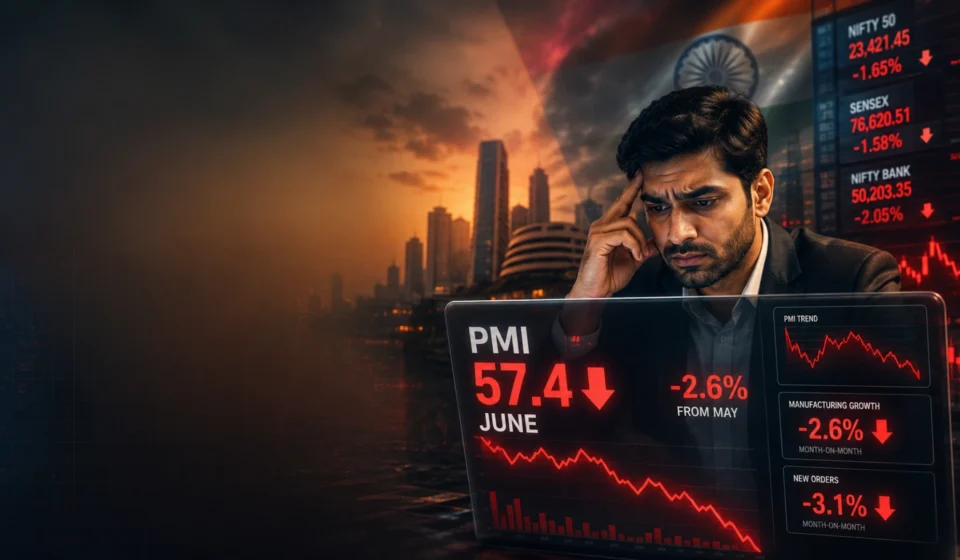
India’s PMI Fell to 57.4 in June — Is the Economic Slowdown a Warning Sign?
India’s economic pulse ticked a little slower in June. India’s Manufacturing PMI fell to 57.4 — down from 59.3 in May — according to preliminary estimates. While the number still signals growth, the drop is hard to ignore.
What is PMI and why does it matter?
PMI stands for Purchasing Managers’ Index. It’s a monthly survey that measures business activity in manufacturing and services. A reading above 50 means the sector is growing; below 50 means contraction.
Think of PMI as a live health check for the economy — businesses report whether orders, output, and employment are rising or falling. It’s one of the first major indicators released each month, which makes it closely watched by investors, policymakers, and analysts.
June 2026 PMI breakdown
| Sector | May reading | June reading | Change |
|---|---|---|---|
| Manufacturing | 59.3 | 57.4 | ▼ −1.9 |
| Services | 55.0 | 54.5 | ▼ −0.5 |
| Composite | 59.8 | 57.3 | ▼ −2.5 |
The manufacturing sector saw the steepest decline. PMI fell to 57.4 from 59.3 — a drop of nearly 2 points in a single month. Still, a reading of 57.4 is comfortably above 50, which means factories are still expanding, just at a slower pace.
Possible factors behind the dip include:
- Seasonal slowdowns at the start of India’s monsoon season
- Mild softening in new orders or export demand
- Rising input costs are eating into production momentum
- Post-election uncertainty leading to cautious business decisions
Services PMI dipped too, but held firm
The services sector also cooled off, with PMI slipping from 55.0 to 54.5. The decline was modest but consistent with the broader trend of slower activity across the economy.
India’s service sector — which includes IT, banking, hospitality, and retail — remains resilient. A PMI above 54 is still a healthy reading, suggesting demand is holding up even if the pace of growth has moderated.
Composite PMI: the big picture
The Composite PMI, which blends both manufacturing and services data, fell from 59.8 in May to 57.3 in June — a drop of 2.5 points. This is the combined economic report card, and it still shows strong overall growth, just not as strong as last month.
To put it plainly: India’s economy grew in June, but not as fast as it did in May.
Should you be worried?
Not necessarily. A single-month dip doesn’t make a trend. India’s PMI readings have been consistently strong — often among the highest in the world. Even at 57.4, India’s manufacturing PMI beats most major economies.
However, it’s worth watching the next 2–3 months to see whether this is a temporary blip or the start of a longer slowdown. Investors and analysts will be looking at:
- Monsoon progress and its effect on rural demand
- Global trade conditions and export orders
- RBI’s monetary policy stance
- Government capital expenditure pace in Q2
Also Read: I Invested ₹500 a Month for 5 Years — Here’s Exactly How Much I Have Now
Bottom line
The fact that India’s PMI fell to 57.4 in June is a gentle reminder that no economy grows in a straight line. India’s growth engine is still very much running — it just shifted slightly down a gear. Whether it picks up speed again in July will be the real story to watch.
FAQs
- India’s PMI fell to 57.4 due to a moderation in manufacturing activity, softer new orders, and possible seasonal factors tied to the monsoon. It still signals growth, just at a slower pace than May’s 59.3.
- A PMI of 57.4 is still strong — any reading above 50 indicates expansion. While it’s lower than May, it remains well above the global average and reflects a healthy, growing economy.
- The Composite PMI falling to 57.3 from 59.8 means that overall economic activity — across both manufacturing and services — grew at a slower rate in June compared to May.
- Even with the June dip, India’s PMI readings are among the highest in the world. Most major economies would consider a reading above 55 exceptional. India has consistently outperformed its peers in recent months.
- Investors should monitor July PMI data, RBI policy signals, monsoon progress, and government spending trends. A single-month dip is not alarming, but a sustained decline would warrant closer attention.

Abhishek Kandir is the founder and lead writer at Paisewaise, a personal
finance publication covering Indian markets, budgeting, and investing since 2023.
Abhishek’s work focuses on making complex financial topics — from RBI
Interventions to SIP strategies — understandable for everyday Indian readers
without a financial background.