
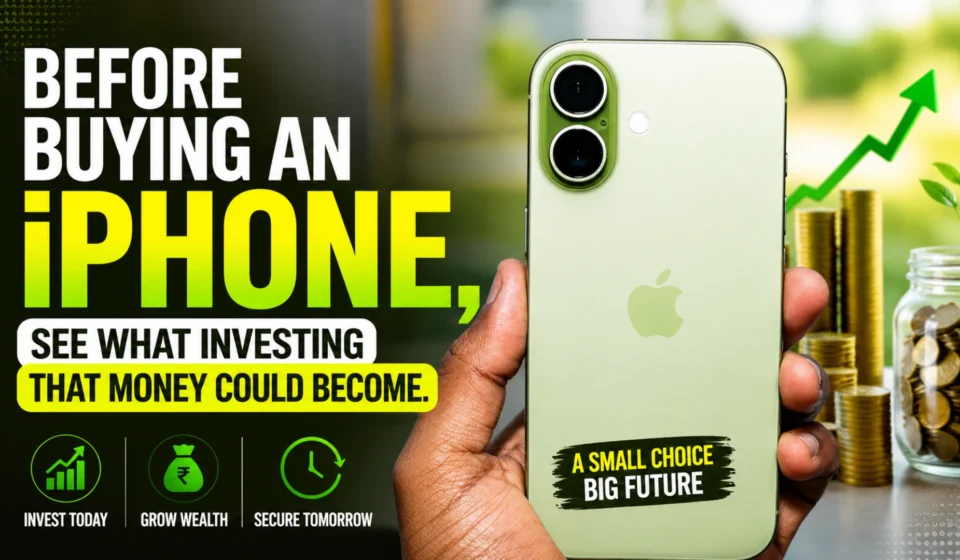
Before buying an iPhone, take five minutes to see what the same money could become if you invested it instead. The comparison isn’t about avoiding technology — it’s about understanding the financial trade-offs before making a major purchase.
The Apple iPhone 17 starts at ₹82,900 in India. It’s stunning. It’s fast. And it’s a serious chunk of money. So let’s run the numbers — honestly.
Why Buying an iPhone Is More Than Just a Purchase
An iPhone isn’t just a phone. For most people, it’s all of these at once:
- Lifestyle upgrade — better camera, smoother experience, that feeling of holding something premium
- Status signal — like it or not, people notice what you carry
- Productivity tool — especially if your work relies on apps, calls, video, or content
- Financial decision — one of the single largest discretionary purchases most Indians make in a year
That last one is the one we rarely talk about. We compare specs. We read reviews. But we rarely ask: what does this money cost me in the future?
The Hidden Cost Most Buyers Never Calculate
There’s a concept in personal finance called opportunity cost — what you give up when you choose one thing over another.
When you spend ₹82,900 on an iPhone 17, you’re not just spending that money. You’re also not investing it.
Here’s the difference that makes:
Buying a ₹82,900 iPhone = you get a phone that starts losing value the moment you open the box.
Investing ₹82,900 = that money starts compounding, quietly growing — while you go about your life.
The iPhone depreciates. The investment appreciates. And over 15 years, the gap between the two becomes enormous.
Let’s Compare Both Choices
Here’s what ₹82,900 looks like across two paths — spending vs. investing.
| Choice | Value Today | Value After 15 Years |
|---|---|---|
| Buy iPhone 17 | ₹82,900 | ~₹5,000–₹8,000 (estimated resale) |
| Invest ₹82,900 in Index Fund | ₹82,900 | ~₹5.5–₹7.5 lakh (projected at 12–14% CAGR)* |
*These are illustrative projections based on historical index fund returns in India. Past performance does not guarantee future results. Actual returns may vary.
The iPhone becomes e-waste. The investment becomes a down payment, an emergency fund, or early retirement capital.
How Compound Growth Changes Everything
Compound interest is often called the eighth wonder of the world — and for good reason.
Here’s a simple example:
- You invest ₹82,900 once.
- At 12% annual return, it doubles roughly every 6 years.
- After 6 years → ~₹1.64 lakh
- After 12 years → ~₹3.27 lakh
- After 18 years → ~₹6.5 lakh
The key is time. The longer you stay invested, the less effort it takes to build serious wealth. The iPhone 17 will be outdated in 3 years. A well-placed investment at 25 could still be compounding at 45.
Investment Scenarios: What ₹82,900 Could Become
Assuming a one-time lump sum investment of ₹82,900 (or equivalent monthly SIP):
| Investment Type | Assumed Annual Return | After 10 Years | After 15 Years | After 20 Years |
|---|---|---|---|---|
| SIP (Equity Mutual Fund) | 12% p.a. | ~₹2.57 lakh | ~₹4.52 lakh | ~₹7.97 lakh |
| Nifty 50 Index Fund | 13% p.a. | ~₹2.80 lakh | ~₹5.17 lakh | ~₹9.55 lakh |
| Bank Fixed Deposit | 7% p.a. | ~₹1.63 lakh | ~₹2.28 lakh | ~₹3.20 lakh |
⚠️ Disclaimer: These figures are illustrative projections, not guaranteed returns. Mutual fund investments are subject to market risk. Consult a SEBI-registered financial advisor before investing.
Even the most conservative option (FD at 7%) more than triples your money in 20 years — and the iPhone is worth ₹0 by then.
Buying on EMI? Here’s the Real Cost
Many people buy iPhones on EMI, which feels affordable. But EMI hides the true price.
Here’s what it actually costs you:
| Phone Price | Down Payment | EMI (12 months) | Interest (15.99% p.a.) | Total Paid |
|---|---|---|---|---|
| ₹82,900 | ₹0 | ~₹7,490/month | ~₹6,980 | ~₹89,880 |
| ₹82,900 | ₹20,000 | ~₹5,700/month | ~₹5,400 | ~₹88,400 |
No Cost EMI offers from banks often have hidden processing fees or lock you into specific cards. Always read the fine print.
The real cost of a ₹82,900 phone on EMI can easily cross ₹90,000 when you factor in interest. That’s money leaving your pocket every month — money that could be going into a SIP instead.
What Happens to an iPhone’s Value Over Time?
iPhones hold their value better than most Android phones — but they still depreciate significantly.
| Year | Estimated Resale Value |
|---|---|
| Purchase (new) | ₹82,900 |
| After 1 Year | ~₹55,000–₹62,000 |
| After 2 Years | ~₹38,000–₹45,000 |
| After 3 Years | ~₹25,000–₹32,000 |
| After 4 Years | ~₹14,000–₹20,000 |
⚠️ Resale values vary based on model, condition, storage variant, and market demand. The figures above are estimates based on typical depreciation trends for flagship iPhones in India.
By the time you’ve used a phone for 3–4 years, it’s worth roughly 25–35% of what you paid. That’s not a terrible depreciation curve — but it’s still a liability, not an asset.
Who Should Buy the iPhone 17?
This article isn’t anti-iPhone. The iPhone 17 is genuinely impressive — A19 chip, 48MP dual cameras, ProMotion 120Hz display, all-day battery. For the right person, it’s worth every rupee.
You should seriously consider buying it if you are:
- Content creators who rely on a camera that just works — the 48MP Dual Fusion system and 4K 60fps Dolby Vision video are genuinely pro-level tools
- Video editors and photographers who need consistent colour science, ProRes output, and a reliable mobile editing workflow
- App developers building for iOS who need the latest hardware to test on
- Business owners who use their phone as a primary work device for calls, documents, emails, and presentations
- People upgrading from iPhone 13 or older — the jump in performance, display, and camera is significant and tangible
If your phone is a tool that earns you money, investing in a great one makes financial sense.
Who Should Invest Instead?
The honest answer: most people. Especially if you fall into any of these groups:
- College students or fresh graduates — your early twenties are the most powerful time to start a SIP. ₹82,900 invested at 22 could be ₹8+ lakh by 37.
- First salary earners — resist the lifestyle inflation trap. Start small, invest first.
- Anyone without an emergency fund — before buying a luxury phone, build 3–6 months of expenses as a safety net. No emergency fund = one bad month away from financial stress.
- People with high-interest debt — if you have a credit card balance at 36–42% annual interest, paying that off first returns more than any investment can.
- People who already have a working phone — if your current phone does the job, the upgrade is a want, not a need. Know the difference.
What I Would Do
Honestly? It depends on your situation.
If you need a phone upgrade, buying an iPhone 17 isn’t a bad decision — it’s a premium product with a long software support life (6+ years of iOS updates), great resale value compared to most phones, and real productivity benefits.
But if you’re buying it because:
- Everyone else has one
- You want the new camera despite already having a good phone
- It’s going on a credit card you’ll struggle to pay off
…then pause. That ₹82,900 invested in an index fund today could become ₹5–7 lakh in 15 years. That’s a used car. A down payment. A safety net.
The balanced recommendation: If you need a new phone, set a budget and buy smartly — trade in your old device, use the Apple Trade In offer to reduce the outlay, and pay in full if possible. But if your current phone is still working, consider investing the upgrade money instead. Even a 12-month delay on the upgrade, invested wisely, compounds in your favour.
You can always buy an iPhone later. You can never get back the compounding years you missed.
Also Read: I Almost Bought iPhone 17 for ₹82,900 — Then I Did This SIP Math Instead
Frequently Asked Questions
Q. Can I invest and still buy an iPhone later?
- Absolutely — and this is often the smartest move. Invest your ₹82,900 today. In 12–18 months, your investment has grown, and the iPhone 17 has dropped in price (or the iPhone 18 is out). You buy the phone at a lower cost, and your investment has still had time to compound. Best of both worlds.
Q. Should I buy an iPhone on EMI?
- Only if it’s genuinely No Cost EMI with zero processing fees, and you’re fully confident you can pay every instalment without missing a payment. Regular EMI at 15–18% annual interest makes an already-expensive phone significantly more expensive. If you’re stretching to afford the EMI, that’s a sign the purchase might be premature.
Q. How much can ₹82,900 become in 15 years?
- At a 12% annual return (typical for diversified equity mutual funds historically), ₹82,900 invested as a lump sum can grow to approximately ₹4.5–5.5 lakh in 15 years. At 13–14% (historical Nifty 50 average), it could reach ₹5.5–7.5 lakh. These are projections, not guarantees — but the direction is clear.
Q. Is buying a flagship phone a bad financial decision?
- Not necessarily. A flagship phone bought intentionally — when you need it, can afford it without debt, and will use its features — is a reasonable purchase. The problem is buying it impulsively, on debt, or as a status symbol when your financial foundation isn’t in place. Financial decisions aren’t about deprivation — they’re about sequencing. Build your emergency fund, start your SIP, then enjoy the things you love.
All investment return figures in this article are illustrative projections based on historical data. Mutual fund investments are subject to market risk. This article does not constitute financial advice. Please consult a SEBI-registered investment advisor before making investment decisions.

Abhishek Kandir is the founder and lead writer at Paisewaise, a personal
finance publication covering Indian markets, budgeting, and investing since 2023.
Abhishek’s work focuses on making complex financial topics — from RBI
Interventions to SIP strategies — understandable for everyday Indian readers
without a financial background.