
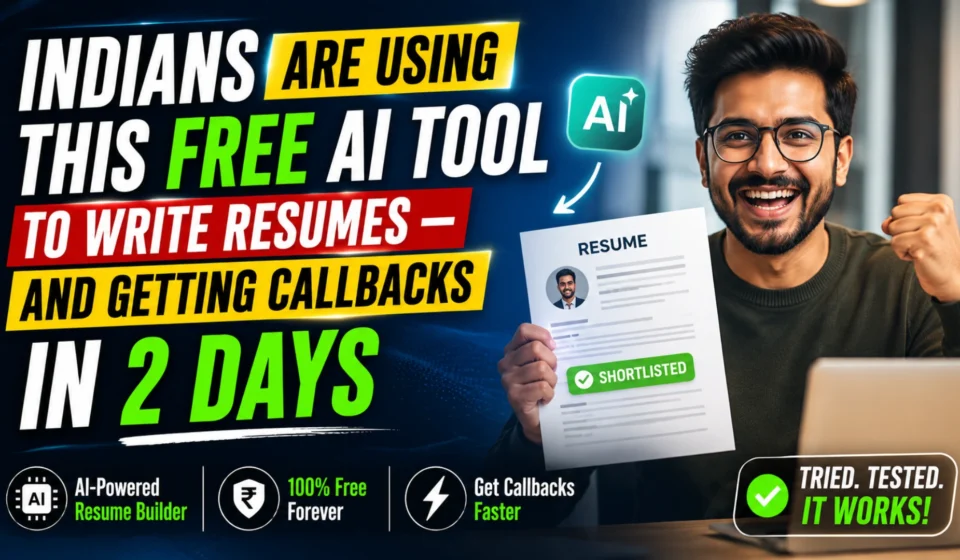
Priya Sharma had been sending out resumes for three months. A marketing graduate from Pune with two internships and decent grades, she was doing everything right — or so she thought. Then a friend told her about a free AI tool that rewrites your resume in minutes. She uploaded her old CV, answered a few prompts, and sent out five applications that same evening.
Two days later, her phone buzzed with an interview invite from a Bengaluru startup.
“I honestly couldn’t believe it,” she says. “I’d been using the same resume format since college. The AI completely changed how I was presenting myself.”
Priya isn’t alone. Across India — from tier-1 metros to smaller cities like Nagpur, Coimbatore, and Bhubaneswar — a quiet resume revolution is underway. Young job seekers are turning to free AI writing tools to transform generic, template-stuck CVs into sharp, keyword-rich documents that actually make it past automated screening systems. And the results, many say, are arriving faster than they ever expected.
The Problem With Most Indian Resumes
Walk into any career counselling centre in India, and you’ll likely see the same resume template — name at the top, an “Objective” statement, a list of duties copied from job descriptions, and a row of skills that ends with “MS Office” and “Good Communication.”
This format might have worked in 2005. In 2026, it’s nearly invisible.
The reality is that most large Indian employers — from IT giants like TCS and Infosys to new-age startups — now use Applicant Tracking Systems (ATS) to filter resumes before a human ever sees them. These systems scan for specific keywords, formatting patterns, and relevance signals. A resume that reads beautifully to a human can be rejected by an ATS in seconds if the right terms aren’t present.
“Most freshers and even mid-level professionals don’t know what ATS is,” says Ramesh Iyer, a Hyderabad-based HR consultant with over 15 years of experience. “They wonder why they never hear back. The resume isn’t bad — it’s just invisible to the system.”
Enter the AI Resume Builder
The tool that’s quietly becoming a go-to resource for Indian job seekers is Claude, Anthropic’s free AI assistant — though tools like ChatGPT, Gemini, and Resume.io’s AI features are also gaining traction. What sets these tools apart is their ability to understand context, not just format.
Here’s how most users are using it:
- Paste your existing resume into the chat window.
- Share the job description you’re applying for.
- Ask the AI to rewrite your resume to match the role, optimise for ATS keywords, and sharpen your impact statements.
- Iterate — ask it to make the summary punchier, reframe internship bullet points with measurable outcomes, or tailor it for a specific industry.
The entire process takes 20 to 45 minutes. For free.
Rahul Verma, a mechanical engineering graduate from Chennai, used this method when applying for a product operations role at a logistics startup — a pivot from his core field. “I had no idea how to position my background for a non-engineering role. The AI helped me frame my problem-solving skills in business language. I got shortlisted within 48 hours.”
Why It Actually Works
The secret isn’t magic — it’s specificity.
Most people write resumes in vague, passive language: “Responsible for managing social media accounts.” AI tools push you toward active, measurable language: “Grew Instagram engagement by 40% in 3 months by launching a weekly video series.”
The difference is enormous. Recruiters spend an average of 6–8 seconds on an initial resume scan. A strong opening line and quantified achievements can mean the difference between a call and a rejection folder.
AI tools also help with keyword mirroring — the practice of reflecting the exact language used in a job description back into your resume. If a job posting says “cross-functional collaboration,” your resume should say exactly that, not “worked with different teams.”
“It’s not about lying or inflating your experience,” explains Meera Nair, a career coach based in Kochi. “It’s about presenting your real experience in the language that hiring managers and systems are trained to recognise. Most people just don’t know that language. AI does.”
The Tier-2 and Tier-3 Advantage
Perhaps the most meaningful impact of this trend is being felt outside India’s major metros.
In cities like Indore, Vadodara, Visakhapatnam, and Patna, access to professional resume writing services has historically been limited or expensive. A good resume consultant in Mumbai might charge ₹2,000–₹5,000 per session. For a recent graduate earning nothing, that’s a significant barrier.
Free AI tools have effectively democratised this advantage.
Ananya Dubey, a commerce graduate from Raipur, had never spoken to a career counsellor. She used an AI chatbot to write her first “professional” resume for a banking sector role. “The AI even told me what not to include — like my Class 10 marks and a photo. Nobody had ever told me that before.”
She got an interview call from a private bank within three days.
What AI Can’t Do (Yet)
To be clear, AI is not a guaranteed shortcut to employment. It’s a tool — and like any tool, the outcome depends on how you use it.
Several users report that AI-generated resumes can sound generic if you don’t personalise them. “I got a template-ish output the first time,” says Siddharth Joshi, a data analyst from Ahmedabad. “I had to go back and forth with the AI several times, give it specific examples from my work, before it sounded like me.”
Career experts also caution that the resume is only the first step. Interview skills, networking, and company research still matter enormously.
“AI can open the door,” says Ramesh Iyer. “But you still have to walk through it.”
How to Try It Yourself
If you want to test this for yourself, here’s a simple starting prompt you can use with any free AI tool:
“I’m applying for [Job Title] at [Company Type]. Here is my current resume: [paste resume]. Here is the job description: [paste JD]. Please rewrite my resume to be ATS-optimised, use strong action verbs, quantify achievements where possible, and match the language of the job description. Keep it to one page.”
Run it. Read the output critically. Push back, ask for revisions, add your own voice. Repeat until it feels like an honest but sharper version of yourself on paper.
In a job market where thousands of applicants compete for every opening, a smarter resume isn’t a luxury.
It might just be the edge you’ve been missing.
Have you used AI to write or improve your resume? Share your experience in the comments below.

Abhishek Kandir is the founder and lead writer at Paisewaise, a personal
finance publication covering Indian markets, budgeting, and investing since 2023.
Abhishek’s work focuses on making complex financial topics — from RBI
Interventions to SIP strategies — understandable for everyday Indian readers
without a financial background.