
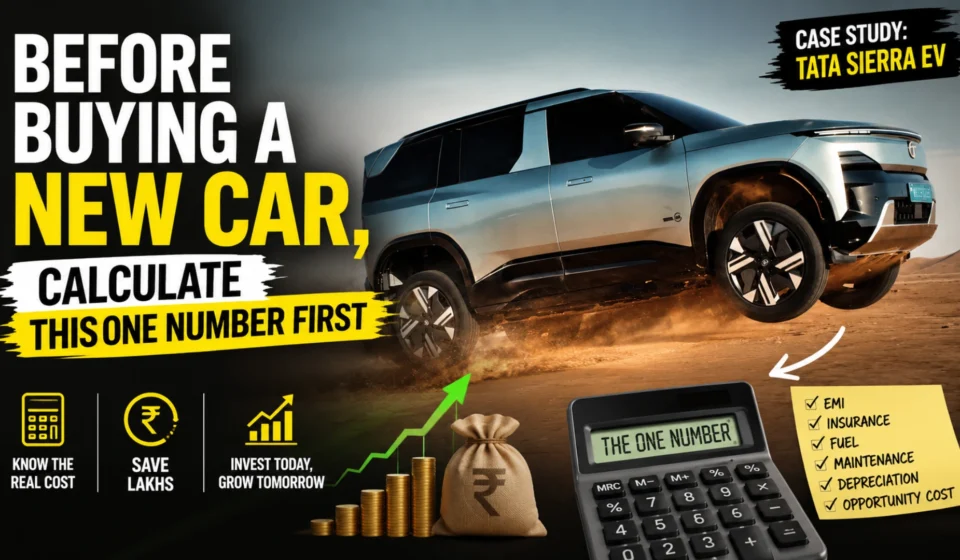
Before Buying a New Car, Calculate This One Number First (Case Study: Tata Sierra EV) Is it worth 20 Lakhs?

Imagine booking the upcoming Tata Sierra EV for around ₹22 lakh, feeling proud of your down payment and a “manageable” EMI.
Five years later, you realise the car actually cost you closer to ₹32-35 lakh. The showroom price was never the real price. It was just the entry ticket.
That gap between what you think a car costs and what it actually costs has a name: Total Cost of Ownership. And before buying a new car, this is the one number you need to calculate — not the EMI.
This isn’t an anti-car article. It’s an anti-illusion article. Whether you’re eyeing a compact hatchback or something like the electric SUV Tata is preparing to launch, the math below applies to every new car purchase in India.
Why Most People Only Calculate the EMI Before Buying a New Car
Salespeople talk in EMIs because EMIs sound small. “Just ₹35,000 a month” feels lighter than “₹15 lakh commitment plus running costs for five years.”
This is a well-known behavioural finance trap. Breaking a high cost into small monthly pieces makes it psychologically easier to say yes — even when the full cost hasn’t changed at all.
Most buyers walk into a showroom asking one question: “What’s the EMI?”
Almost nobody asks: “What will this car cost me, total, over the years I plan to keep it?”
That second question is uncomfortable. It’s also the only one that actually protects your financial goals.
Here’s what typically gets left out of the mental math:
- Loan interest paid over the tenure
- Comprehensive insurance, renewed every year
- Fuel or charging costs
- Scheduled maintenance and service
- Registration, road tax, and cess
- Depreciation — the silent cost nobody sends you a bill for
- Opportunity cost — what that money could have earned elsewhere
Skip these, and your “affordable” car quietly becomes the biggest liability on your balance sheet.
The One Number That Actually Matters
That number is Total Cost of Ownership (TCO) — everything you pay to buy, run, and eventually let go of a car, spread across your ownership period.
A simple way to think about it:
TCO = Purchase Price + Loan Interest + Insurance + Fuel/Charging + Maintenance + Registration − Resale Value
Notice that resale value is subtracted, not added. Whatever you get back when you sell reduces your effective cost — but it never fully cancels out depreciation, which is usually the single largest hidden expense of car ownership.
Did You Know? According to industry ownership-cost estimates referenced by insurers and automotive researchers, a private car in India can lose 15-20% of its value in the first year alone, even before you touch the highway.
This is why financial planners increasingly tell clients: don’t ask “can I pay the EMI?” Ask “what does this car cost me per year, all-in, and does that number fit my financial goals?”
Let’s Calculate the Real Cost: A Tata Sierra EV Example
Let’s make this concrete using a real, currently talked-about model — the upcoming Tata Sierra EV, expected to be priced roughly between ₹20 lakh and ₹25 lakh (ex-showroom) depending on variant and battery pack, based on Tata’s publicly shared expectations.
We’ll model a mid-variant priced at ₹22,00,000 (ex-showroom), financed with a 5-year car loan, 20% down payment, at a typical car loan interest rate of around 9% per annum. These are illustrative assumptions for demonstration — your actual quote will vary by lender, city, and negotiation.
| Expense (Year 1–5, approx.) | Amount |
|---|---|
| Purchase Price (ex-showroom) | ₹22,00,000 |
| Registration, Road Tax & Insurance Cess (one-time, EV benefits may apply) | ₹1,10,000 |
| Down Payment (20%) | ₹4,40,000 |
| Loan Amount (80%) | ₹17,60,000 |
| Loan Interest (5 years @ ~9%) | ₹4,30,000 |
| Comprehensive Insurance (5 years, incl. battery cover) | ₹1,75,000 |
| Charging Cost (5 years, ~12,000 km/year) | ₹1,20,000 |
| Maintenance & Service (5 years, EV — lower than ICE) | ₹1,00,000 |
| Total Cost of Ownership (5 years) | ₹32,75,000 |
A ₹22 lakh car has quietly become a ₹32.75 lakh commitment — roughly 49% more than the sticker price. And this doesn’t even subtract depreciation yet; we’ll get to that separately below.
Common Mistake: Buyers compare EV running costs to petrol cars and assume “EVs are basically free to run.” Charging isn’t free, home charger installation isn’t free, and battery-related insurance is usually priced higher than for a comparable ICE car.
What If You Invested the Same Money Instead?
Here’s the question almost nobody asks at the showroom: what if the down payment, or an equivalent monthly amount, had gone into an investment instead?
Let’s say instead of paying ₹4,40,000 upfront and an EMI of roughly ₹36,500/month, you invested a comparable amount — say ₹15,000/month — into a SIP, assuming average long-term equity returns. These are illustrative projections based on stated assumptions, not guaranteed outcomes.
| Investment Route (₹15,000/month SIP) | 5 Years | 10 Years | 15 Years |
|---|---|---|---|
| Equity Mutual Fund SIP (~12% assumed CAGR) | ₹12.4 lakh | ₹34.9 lakh | ₹75.6 lakh |
| Index Fund (~11% assumed CAGR) | ₹12.1 lakh | ₹32.8 lakh | ₹68.3 lakh |
| Fixed Deposit (~7% assumed rate) | ₹10.7 lakh | ₹26.0 lakh | ₹47.3 lakh |
These numbers are projections for illustration, based on historical average return ranges cited by SEBI-registered mutual fund literature and general market data — actual returns depend on market performance and are never guaranteed.
The point isn’t “invest instead of buying a car.” It’s this: every rupee that goes into a car is a rupee that stops compounding somewhere else. That’s the real trade-off, and it deserves to be seen clearly before you sign the loan papers.
How Much Does a Car Lose in Value?
Depreciation is the cost you never get a bill for — it just shows up the day you try to sell.
Using the same ₹22 lakh Sierra EV example, and typical depreciation curves seen across SUVs and EVs in India (actual figures vary by demand, battery health, and market conditions):
| Year | Estimated Resale Value |
|---|---|
| Purchase | ₹22,00,000 |
| Year 1 | ₹17,60,000 (approx. 20% drop) |
| Year 3 | ₹13,20,000 (approx. 40% cumulative drop) |
| Year 5 | ₹9,90,000 (approx. 55% cumulative drop) |
EVs carry an extra variable here: battery degradation. Buyers should specifically check battery warranty terms and expected capacity retention, since a battery nearing end-of-warranty can affect resale value more sharply than mechanical wear does on a petrol car.
Resale values always vary by model popularity, condition, odometer reading, and local demand — treat the table above as a planning estimate, not a promise.
The Hidden Opportunity Cost
Opportunity cost is simply this: what else could this money have done for you?
Take the ₹32.75 lakh total cost of ownership from our example. If, instead, that same capital had been split — say a smaller, well-chosen car plus the difference invested — the investor version of you could be sitting on a meaningfully larger net worth in 10-15 years, purely from compounding.
Consider a young professional in a metro city who buys a ₹22 lakh electric SUV right after their first promotion. It feels earned. But if their emergency fund is thin and their SIP contributions pause to support the EMI, the car isn’t just a car — it’s a delay on every other financial goal: a house down payment, a child’s education fund, or early retirement planning.
This isn’t about guilt. It’s about visibility. Once you see the opportunity cost, you can decide with open eyes instead of drifting into it.
When Buying a Car Actually Makes Sense
Buying a new car is not automatically a bad financial decision. Context matters more than the price tag.
- Large families needing reliable, safe space for daily school runs and long trips
- Business owners where the car is a genuine income-generating or client-facing asset
- Long daily commutes where public transport isn’t practical or safe
- Safety upgrades — moving from an ageing, unsafe vehicle to one with modern crash protection
- Professional necessity — sales roles, fieldwork, or jobs requiring constant travel
In these cases, a car isn’t a luxury — it’s infrastructure for your life or livelihood. The TCO exercise still matters, but the decision to buy isn’t really in question.
When Waiting Could Be the Better Financial Choice
On the other hand, some situations are a signal to pause, regardless of how attractive the car looks.
- No emergency fund — ideally 3-6 months of expenses set aside first
- Existing high-interest debt — credit cards or personal loans should usually be cleared before adding a car loan
- Unstable income — freelancers, early-stage entrepreneurs, or anyone mid-transition
- Short-term financial goals — a wedding, a home down payment, or education expenses due within 2-3 years
Expert Insight: Financial planners often use a simple filter — if buying the car means your EMI plus other debt obligations cross 40% of monthly take-home income, it’s time to either downsize the car or delay the purchase.
Decision Checklist
Before signing anything, work through this checklist honestly:
- Emergency fund available (3–6 months of expenses)?
- EMI below 15–20% of monthly income?
- Existing high-interest debt cleared?
- Annual insurance premium comfortably affordable?
- Comfortable with the depreciation curve shown above?
- Will buying delay important financial goals (home, retirement, education)?
- Have you calculated 5-year TCO, not just EMI?
- Does the car serve a real need, not just a want triggered by a launch or ad?
If you tick most of these boxes confidently, you’re likely buying from a position of strength, not impulse.
Expert Tips
- Always calculate 5-year TCO before comparing EMIs across models.
- Negotiate the on-road price, not just the ex-showroom figure — registration and insurance are often padded.
- For EVs, check battery warranty length and degradation guarantees, not just range figures.
- Keep your EMI-to-income ratio under 20%, including any other existing loans.
- Get insurance quotes from at least three insurers before renewal — don’t auto-renew blindly.
- Factor in home charger installation costs upfront if you’re buying an EV.
- Avoid maxing out your loan tenure just to shrink the EMI — it increases total interest paid.
- Build or top up your emergency fund before, not after, taking a car loan.
- Don’t let a “launch offer” or waitlist hype override your own affordability math.
- Revisit your TCO calculation whenever a new variant or competing model changes the numbers.
Final Verdict
There’s no universal right answer here. A car — even a premium electric SUV like the Tata Sierra EV — can be a smart, well-earned purchase for one household and a financially strained decision for another.
What separates the two isn’t the car. It’s whether the buyer calculated Total Cost of Ownership honestly, checked it against their income and goals, and chose with clarity instead of excitement.
This article isn’t telling you to invest instead of buying a car forever. It’s telling you to know the real number before you decide — because that number, not the EMI, is what will actually sit on your monthly budget for the next five to seven years.
Also Read: Is the Tata Sierra EV Worth Your Money? I Dug Deep So You Don’t Have To
Frequently Asked Questions (FAQs)
Q. What is Total Cost of Ownership (TCO) for a car?
- TCO is the complete cost of owning a car over a set period — including purchase price, loan interest, insurance, fuel or charging, maintenance, registration, and depreciation, minus resale value.
Q. How do I know if I can afford a new car?
- Check that your EMI stays under 15–20% of your monthly take-home income, you have an emergency fund in place, and you’ve calculated the 5-year TCO — not just the EMI.
Q. Is the Tata Sierra EV a good example for calculating car affordability?
- Yes — as an upcoming electric SUV expected in the ₹20-25 lakh range, it’s a useful reference point for buyers evaluating premium EV purchases in India, though final pricing and specifications will be confirmed closer to launch.
Q. How much does a new car depreciate in the first year?
- Many new cars, including SUVs and EVs, can lose approximately 15-20% of their value in the first year, though this varies by brand, model demand, and condition.
Q. Should I pay a higher down payment or invest that money instead?
- It depends on your loan interest rate versus expected investment returns, and your comfort with EMI size. A larger down payment reduces interest cost; investing instead offers growth potential but carries market risk.
Q. Are EVs cheaper to maintain than petrol or diesel cars?
- Generally yes, since EVs have fewer moving parts and no engine oil changes, but battery-related insurance and eventual battery replacement costs should be factored into long-term ownership costs.
Q. What is a safe EMI-to-income ratio for a car loan?
- Most financial planners suggest keeping total EMI obligations, including a car loan, under 40% of monthly income, with the car loan itself ideally under 15-20%.
Q. Does opportunity cost really matter when buying a car?
- Yes — money spent on a car (down payment plus EMIs) is money that isn’t compounding in investments. Over 10-15 years, this difference can be substantial due to compounding.
Abhishek Kandir is the founder and lead writer at Paisewaise, a personal
finance publication covering Indian markets, budgeting, and investing since 2023.
Abhishek’s work focuses on making complex financial topics — from RBI
Interventions to SIP strategies — understandable for everyday Indian readers
without a financial background.