
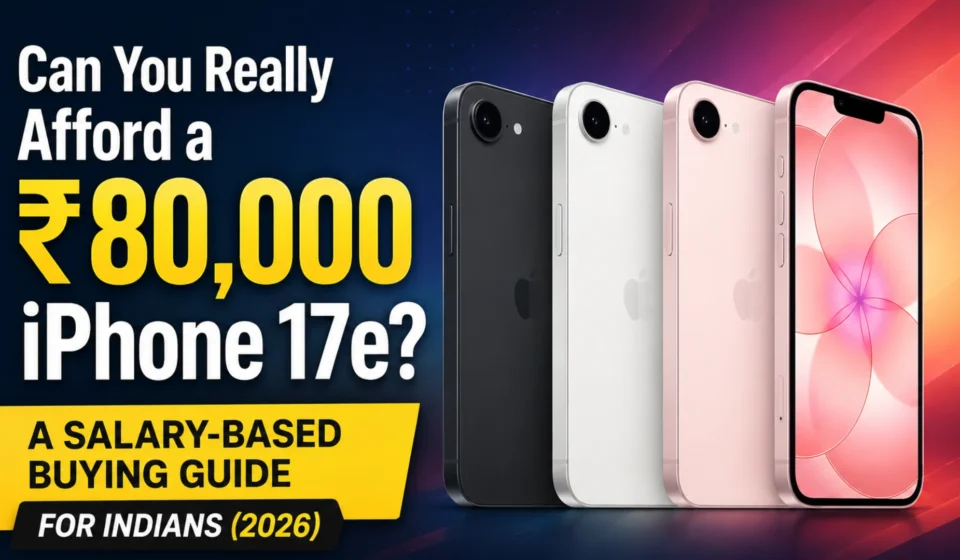
Can You Really Afford a ₹80,000 iPhone 17e? A Salary-Based Buying Guide for Indians (2026)

So you’ve got your eye on the new iPhone 17e. The notch is back, the camera looks solid, and Apple’s calling it “feature stacked, value packed.” But here’s the real question: should you actually buy one?
Not “can you buy it” — anyone with a credit card can do that. The real question is whether the iPhone 17e fits your income without quietly wrecking your finances. Let’s break it down with actual numbers, not vibes.
What Does the iPhone 17e Actually Cost in India?
First, the facts. The iPhone 17e starts at ₹64,900 for the 256GB base model and goes up to ₹84,900 for the 512GB version, available in Black, White, and Soft Pink. That’s a starting price firmly in the “think twice” category for most Indian salaries.
| Variant | Price (MRP, incl. taxes) | EMI starts at |
|---|---|---|
| 256GB | ₹64,900 | ₹11,327/month |
| 512GB | ₹84,900 | ₹14,817/month |
Now let’s apply some real math to this.
The 5–10% Rule: How Much Phone Can Your Salary Handle?
Financial planners often use a simple rule for big-ticket discretionary buys like phones: spend no more than 5–10% of your annual income on a device that depreciates the moment you unbox it.
Here’s how that plays out for the iPhone 17e:
| Monthly Salary | Annual Income | 5% Budget | 10% Budget | Can You Afford iPhone 17e (₹64,900)? |
|---|---|---|---|---|
| ₹25,000 | ₹3,00,000 | ₹15,000 | ₹30,000 | No — even 10% falls short |
| ₹40,000 | ₹4,80,000 | ₹24,000 | ₹48,000 | Close, but still under budget |
| ₹50,000 | ₹6,00,000 | ₹30,000 | ₹60,000 | Just about at the 10% edge |
| ₹70,000 | ₹8,40,000 | ₹42,000 | ₹84,000 | Yes, comfortably |
| ₹1,00,000 | ₹12,00,000 | ₹60,000 | ₹1,20,000 | Yes, easily |
The takeaway is blunt: if your monthly salary is ₹25,000–40,000, the iPhone 17e is a stretch purchase, not a casual one. You’d be putting 15–25% of your annual income into a phone — that’s the kind of money that should go toward an emergency fund or investments first.
EMI vs Full Payment: Which One Actually Makes Sense?
This is where most buyers trip up. EMI feels “free” because it’s a small monthly payment, but it changes the iPhone 17e’s real cost.
Full payment pros:
- No interest, no EMI charges
- You own it outright, zero pending liability
- Psychologically forces you to confirm you can actually afford it
EMI pros:
- Spreads cash flow, so it doesn’t dent your monthly budget in one shot
- No-cost EMI options exist on qualifying cards for 3–6 month tenures
- Useful if you have a stable income and just want to manage liquidity
The catch: Apple’s listed EMI option for the iPhone 17e runs at 15.99% p.a. over 6 months (unless you specifically qualify for a No Cost EMI offer). That interest adds real rupees to your final cost — it’s not actually “free” money, even if the monthly number looks small.
Opportunity Cost: What Else Could ₹65,000 Do for You?
Here’s the part nobody talks about. If you invest ₹65,000 instead of spending it on a phone, here’s a rough picture of what it could become:
| Investment Option | Approx. Annual Return | Value After 3 Years |
|---|---|---|
| Fixed Deposit | ~7% | ~₹79,600 |
| Index Mutual Fund (SIP/lumpsum) | ~12% | ~₹91,300 |
| Equity (historical avg.) | ~14–15% | ~₹97,000+ |
That’s the opportunity cost of buying an iPhone 17e instead of investing the same amount. The phone, meanwhile, will be worth a fraction of ₹65,000 by year three.
This doesn’t mean never buy a phone — it means know the trade-off you’re making.
So, Should You Buy the iPhone 17e?
Here’s a simple gut-check before swiping that card:
- If your monthly salary is under ₹40,000, consider looking at the iPhone under 30000 or iPhone under 20000 segment instead — there are solid Android alternatives that won’t eat into your savings.
- If you’re earning ₹50,000–70,000/month and have no high-interest debt, the iPhone 17e fits comfortably within the 10% rule, especially if it’s your first iPhone and you’re buying into the ecosystem (Face ID, AirDrop, Find My iPhone, and the rest of the Apple experience).
- If you’re above ₹1,00,000/month, this is a non-issue — buy whichever colour you like.
If you do decide to buy, walking into an Apple Store near me, searching or shopping online lets you compare full payment vs EMI side by side, and check the current trade-in value if you’re upgrading from an older iPhone.
A Quick Word on the Apple Ecosystem
If this is your first iPhone, know that the value isn’t just the hardware — it’s the system around it. Setting up your Apple ID unlocks Face ID, Screen Time controls for managing usage, AirDrop for fast file sharing, and Find My iPhone (officially “Apple Find My iPhone”) for device security. These features matter more once you’re inside the ecosystem, especially if you’re switching from an iPhone USA model or another region’s device — note that specs and warranty terms can differ slightly by region.
Final Verdict
The iPhone 17e isn’t a bad phone by any stretch — it’s a genuinely well-specced device at a slightly more accessible price than Apple’s flagship lineup. But “more accessible” doesn’t mean “cheap,” and your salary should be the real filter, not your wishlist.
Run the 5–10% rule on your own income, weigh EMI against full payment honestly, and ask what else that money could do for you. If it still makes sense after that, go ahead and treat yourself.
Also Read: Which iPhone 17 series model should you buy, and why? Based on your monthly income, which one would be the most suitable for you?
Frequently Asked Questions (FAQs)
Q. Is the iPhone 17e a good buy for someone earning ₹30,000 a month?
- Not really. At ₹64,900, the iPhone 17e would eat over 25% of your annual income, well above the recommended 5–10% rule for discretionary tech purchases.
Q. Should I buy the iPhone 17e on EMI or pay in full?
- If you can pay in full without dipping into savings, that’s the smarter route since EMI on the iPhone 17e carries 15.99% p.a. interest unless you qualify for a No Cost EMI offer.
Q. What salary is ideal to comfortably afford the iPhone 17e?
- A monthly salary of ₹50,000–70,000 or higher generally keeps the iPhone 17e within the safe 5–10% annual income guideline.
Q. Is the iPhone 17e a good first iPhone?
- Yes, it’s a solid entry point — you get Face ID, AirDrop, Find My iPhone, and Apple’s ecosystem at a lower price than the iPhone 17 or iPhone Air.
Q. What’s the price difference between iPhone 17e storage variants?
- The 256GB iPhone 17e starts at ₹64,900, while the 512GB version costs ₹84,900 — a ₹20,000 jump for double the storage.
Abhishek Kandir is the founder and lead writer at Paisewaise, a personal
finance publication covering Indian markets, budgeting, and investing since 2023.
Abhishek’s work focuses on making complex financial topics — from RBI
Interventions to SIP strategies — understandable for everyday Indian readers
without a financial background.


[…] is where the Pixel 10 Pro genuinely stands out from both iPhone and Samsung. Google has committed to 7 full years of OS updates, security patches, and Pixel Drop […]