
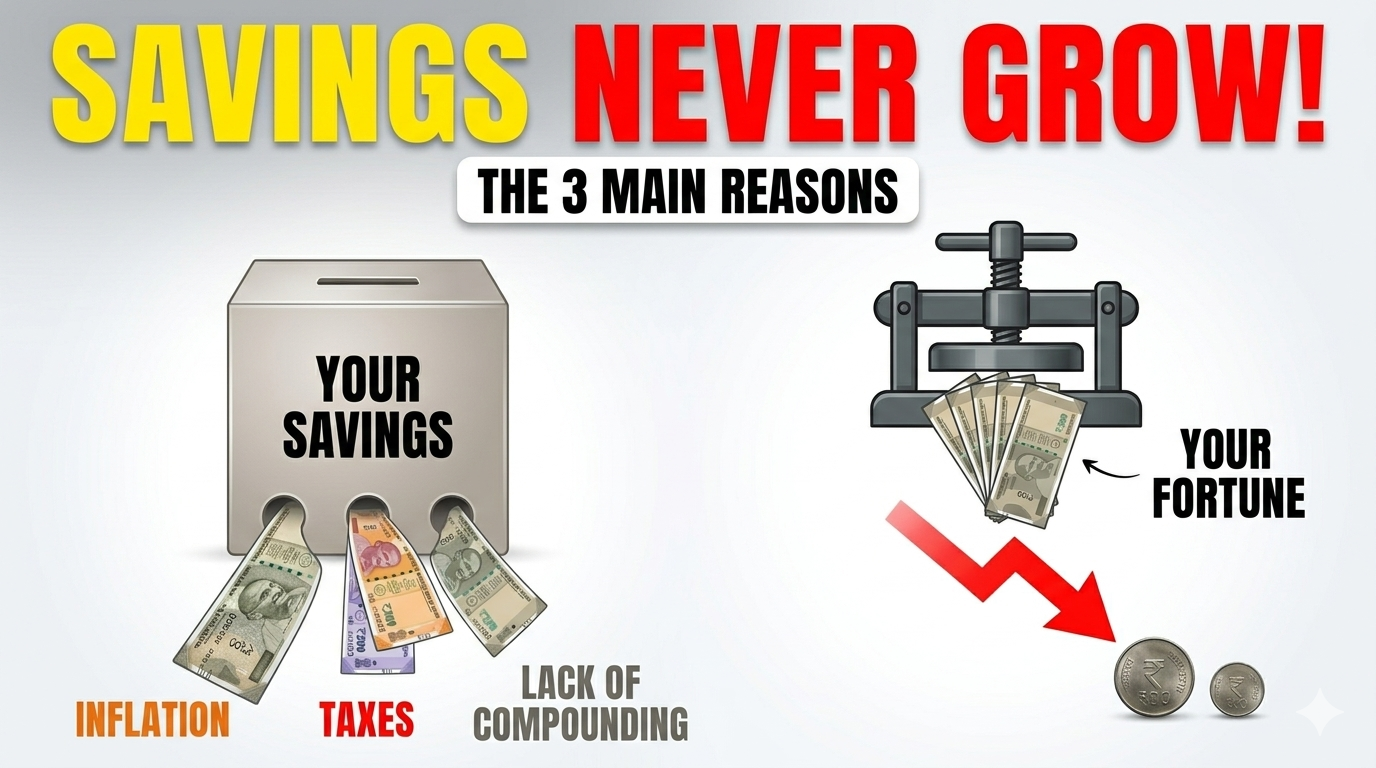
Why Your Savings Never Grow (Even When You’re Trying Hard) — The Hidden Mistakes Keeping You Stuck Financially

Why Your Savings Never Grow (Even When You’re Trying Hard) — The Truth Most People Miss
You make an effort to save.
Some months are good—you manage to put aside a decent amount. Other months, not so much.
But when you step back and look at your total savings after a year or two… it feels disappointing.
It’s not zero—but it’s nowhere near what you expected.
So what’s going wrong?
The answer isn’t just “you need to save more.”
It’s deeper than that.
The Core Problem: Saving Without a System Never Works
Most people treat saving like a leftover activity:
“I’ll save whatever is left at the end of the month.”
But here’s the reality:
👉 There is rarely anything left.
Planned vs Actual Saving Behavior
| Approach | Result |
|---|---|
| Save after spending | Inconsistent, low savings |
| Save before spending | Stable, growing savings |
👉 Savings isn’t about intention—it’s about priority and structure
Hidden Reason #1: Inconsistent Saving Kills Growth
Saving randomly doesn’t create momentum.
What Inconsistency Looks Like
| Month | Amount Saved (₹) |
|---|---|
| Jan | 5,000 |
| Feb | 0 |
| Mar | 3,000 |
| Apr | 0 |
Total saved: ₹8,000
But potential: ₹20,000+
👉 The gap comes from inconsistency—not income.
Why This Happens:
- No fixed saving rule
- Dependence on “leftover money.”
- Lack of automation
Hidden Reason #2: Inflation Is Quietly Destroying Your Money
Even if your money is “safe” in a bank account, it’s losing value.
Inflation vs Savings Reality
| Factor | Percentage |
|---|---|
| Average Inflation | 5–7% |
| Savings Account Rate | 2.5–4% |
👉 Your money is effectively shrinking in real terms
Simple Example:
- You save ₹1,00,000 today
- After a year, its purchasing power may drop to ₹93,000–₹95,000
You don’t see the loss—but it’s happening.
Hidden Reason #3: Fragmented Savings Don’t Create Real Growth
Many people save—but without a plan.
Money gets scattered:
- Some in bank accounts
- Some in cash
- Some in random apps
- Some in short-term deposits
Fragmentation Problem
| Location | Amount (₹) |
|---|---|
| Bank Account | 20,000 |
| Wallet/Cash | 5,000 |
| Digital Apps | 10,000 |
| FD | 15,000 |
Total: ₹50,000
But it feels like “nothing substantial.”
👉 Because it’s unstructured and disconnected
Hidden Reason #4: Frequent Withdrawals Break Compounding
This is one of the biggest silent killers.
You save money… and then:
- Use it for small emergencies
- Spend it on short-term needs
- Dip into it casually
The Compounding Break Effect
| Scenario | Outcome |
|---|---|
| No withdrawals | Strong growth |
| Frequent withdrawals | No growth |
👉 Compounding needs time + stability
If you keep interrupting it, growth never happens.
Hidden Reason #5: No System = No Growth
At its core, the issue is simple:
Your savings don’t have a system.
Without a system:
- Saving depends on mood
- Expenses take priority
- Discipline fades over time
System vs No System
| Approach | Result |
|---|---|
| No structure | Random, weak savings |
| Fixed system | Predictable growth |
👉 Wealth is built on systems—not motivation.
Why Your Savings Feel “Too Small” After Years
Even if you’ve been saving, it feels underwhelming because:
- Contributions are inconsistent
- Inflation reduces real value
- No compounding effect
- Money is frequently withdrawn
Example Reality
| Years | Total Saved (₹) | Expected Feeling | Actual Feeling |
|---|---|---|---|
| 1 | 50,000 | Good start | Okay |
| 3 | 1,50,000 | Strong base | Still small |
| 5 | 3,00,000 | Solid savings | Not enough |
👉 Because growth wasn’t optimized.
How to Fix It: Turn Saving Into a Growth System
1. Automate Your Savings First
- Set auto-transfer on salary day
- Treat savings like a bill
👉 No decision-making = no inconsistency
2. Follow a Fixed Saving Percentage
| Salary | Ideal Saving |
|---|---|
| ₹30K | ₹3K–₹6K |
| ₹50K | ₹5K–₹10K |
| ₹1L | ₹10K–₹20K |
👉 Start small—but stay consistent
3. Protect Your Savings From Yourself
Create separation:
- Emergency fund (liquid)
- Long-term savings (don’t touch)
👉 This prevents unnecessary withdrawals
4. Beat Inflation With Better Allocation
Don’t keep all money in savings accounts.
Explore:
- Fixed deposits
- Mutual funds (for long-term)
- Recurring deposits
👉 Growth > Safety alone
5. Focus on Consistency Over Amount
Saving ₹3,000 every month is better than saving ₹10,000 occasionally.
👉 Consistency builds momentum—and momentum builds wealth
Final Takeaway: Savings Don’t Grow on Effort — They Grow on Structure
If your savings aren’t growing, it’s not because you’re not trying.
It’s because:
- Your system is weak
- Your habits are inconsistent
- Your money isn’t working for you
Fix the structure—and growth becomes automatic.
FAQs
Q. Why do my savings not increase even though I save money?
- Because of inconsistent saving, inflation, and frequent withdrawals, which prevent compounding.
Q. Is keeping money in a savings account enough?
- No. Savings accounts often don’t beat inflation, reducing real value over time.
Q. What is the best way to grow savings in India?
- Automate savings, stay consistent, and invest in options that beat inflation.
Q. How can I stop using my savings?
- Separate emergency funds and long-term savings to avoid unnecessary withdrawals.
Abhishek Kandir is the founder and lead writer at Paisewaise, a personal
finance publication covering Indian markets, budgeting, and investing since 2023.
Abhishek’s work focuses on making complex financial topics — from RBI
Interventions to SIP strategies — understandable for everyday Indian readers
without a financial background.