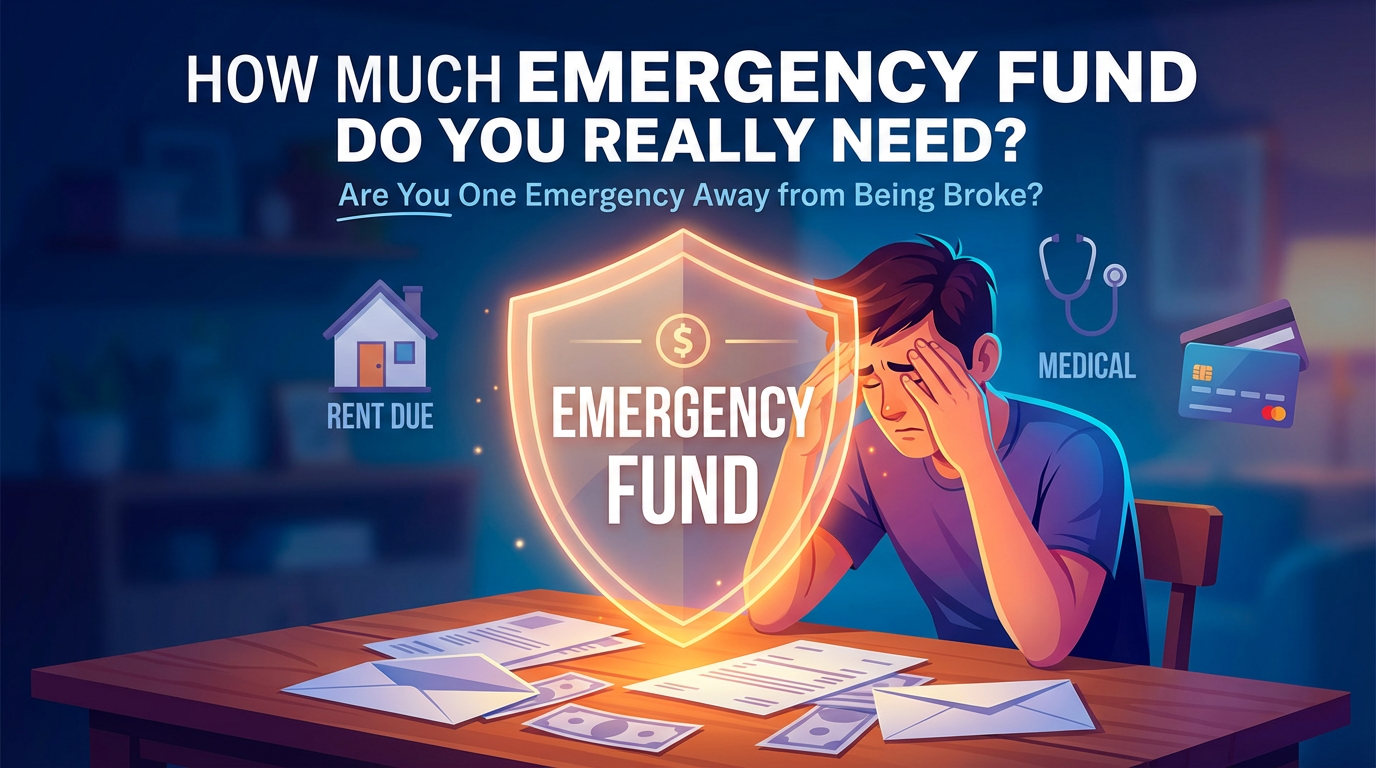
How Much Emergency Fund Do You Really Need in America? (Complete US Guide)
Reading Time: 7 minutes
If you lost your job tomorrow, how long could you survive financially? That single question is why knowing how much emergency fund you need is one of the most important things you can figure out in your financial life.
An emergency fund is your personal financial safety net — money set aside specifically for unexpected expenses like medical bills, car repairs, job loss, or sudden home repairs. Yet according to a 2024 Federal Reserve report, nearly 37% of Americans would struggle to cover a $400 unexpected expense without borrowing.
Understanding how much emergency fund you need in the US isn’t a one-size-fits-all answer. It depends on your income, family size, job stability, and monthly expenses. This guide breaks it all down with real numbers, practical examples, and clear guidance so you can build the right financial cushion for your specific life.
The Basic Rule — What Does “3 to 6 Months” Actually Mean?
The most widely recommended emergency fund rule is saving 3 to 6 months of living expenses. But this rule is often misunderstood.
It does not mean 3 to 6 months of your income. It means 3 to 6 months of your essential monthly expenses — the money you need to survive, not your full lifestyle spending.
What counts as essential monthly expenses?
| Category | Annual Average | Monthly Average |
|---|---|---|
| Housing (incl. rent/mortgage/utilities) | $26,266 | ~$2,189 |
| Rented dwellings | $5,660 | ~$472 |
| Owned dwellings | $9,310 | ~$776 |
| Food (total) | $10,169 | ~$847 |
| Food at home (groceries) | $6,224 | ~$519 |
| Transportation | $13,318 | ~$1,110 |
| Health insurance | $4,055 | ~$338 |
| Utilities/fuels (subset of housing) | Not separately broken out; electricity/gas/water ~$1,800–2,500 annually per secondary sources, Bankrate | ~$150–$208 |
Source: Bureau of Labor Statistics Consumer Expenditure Survey
How to Calculate Your Personal Emergency Fund Target
Knowing how much emergency fund you need starts with calculating your actual monthly expenses — not what you think you spend, but what the numbers say.
Step-by-Step Calculation
Step 1: Pull your last 3 months of bank and credit card statements.
Step 2: Add up only essential expenses (housing, food, utilities, transport, insurance, minimum debt payments).
Step 3: Calculate your monthly essential spending average.
Step 4: Multiply by your target months (3, 6, or 9, depending on your situation).
Step 5: That number is your emergency fund goal.
Quick Formula:
Emergency Fund = Monthly Essential Expenses × Target Months
3 Months vs. 6 Months vs. 9 Months — Which Is Right for You?
Not everyone needs the same cushion. Here’s how to decide how much emergency fund you need based on your personal situation.
| Your Situation | Recommended Target |
|---|---|
| Stable government or corporate job, no dependents | 3 months |
| Dual-income household, stable jobs | 3–4 months |
| Single-income household with dependents | 6 months |
| Self-employed or freelancer | 6–9 months |
| Commission-based income (sales, real estate) | 6–9 months |
| Industry with high layoff risk (tech, media) | 6–9 months |
| Health conditions with high medical costs | 6–9 months |
The more variable or unpredictable your income, the more you need. Freelancers especially need to think carefully about how much emergency fund they need since they don’t have employer-sponsored unemployment benefits.
Real-Life Case Studies
Case Study 1 — The Single Professional (Chicago)
Sarah, 29, marketing manager, no dependents. Monthly essential expenses: $3,200 Job stability: High (large corporate employer) Recommended fund: 3 months → $9,600
Sarah keeps her emergency fund in a high-yield savings account earning 4.5% APY. She reached her target in 18 months by automating $535/month into savings.
Case Study 2 — The Freelance Designer (Austin, TX)
Marcus, 35, freelance graphic designer, one child. Monthly essential expenses: $4,100 Income stability: Variable (3–4 clients at a time) Recommended fund: 9 months → $36,900
Marcus needed a larger fund because losing even one major client could cut his income by 30%. He built his fund over 3 years by setting aside 20% of every client payment.
Case Study 3 — The Dual-Income Family (Ohio)
The Petersons, two incomes, two kids, mortgage. Monthly essential expenses: $5,800. Both employed in stable industries. Recommended fund: 4 months → $23,200
Since both spouses work, the household could survive on one income temporarily if needed. That’s why a slightly lower target makes sense here.
Where Should You Keep Your Emergency Fund?
Knowing how much emergency fund you need is only half the equation. Where you keep it matters almost as much.
Your emergency fund needs to be:
- Liquid (accessible within 1–2 business days)
- Safe (not subject to market risk)
- Earning something (ideally beating inflation)
Best Options in 2026
| Account Type | Average APY (2026) | Liquidity | Risk |
|---|---|---|---|
| High-Yield Savings Account (HYSA) | 4.0%–5.2% | 1–2 business days | None (FDIC insured) |
| Money Market Account | 3.8%–4.8% | Same day – 2 days | None (FDIC insured) |
| Treasury Bills (short-term) | 4.2%–5.0% | 1–3 business days | Minimal |
| Regular Savings Account | 0.4%–0.6% | Immediate | None |
| Checking Account | Near 0% | Immediate | None |
| Stock Market / Index Funds | Variable | 2–5 days (+ risk) | High |
Top recommendation: A high-yield savings account at an online bank (like Marcus by Goldman Sachs, Ally, or SoFi) is the gold standard for emergency fund storage in the US. You earn meaningful interest without putting your money at risk.
What to avoid: Never invest your emergency fund in stocks or crypto. The whole point of the fund is that it’s available when you need it — market crashes often coincide with job losses, which is the worst time to liquidate investments at a loss.
Common Mistakes Americans Make With Emergency Funds
Even people who understand how much of an emergency fund they need often make these critical errors:
- Using it for non-emergencies. A vacation sale or Black Friday deal is not an emergency. Create a clear written definition of what qualifies.
- Keeping it in a regular savings account. You’re leaving meaningful interest on the table every month.
- Setting the target too low. Many Americans aim for $1,000 and stop. That covers a minor car repair but not a job loss.
- Not adjusting as life changes. Had a baby? Bought a home? Your emergency fund requirement should be recalculated.
- Counting it as an investment. An emergency fund has one job — protection. Don’t expect it to grow your wealth.
- Building it while ignoring high-interest debt. If you carry 24% APR credit card debt, consider splitting extra money between debt payoff and emergency savings simultaneously.
How to Build Your Emergency Fund Faster
Once you know how much emergency fund you need, here’s how to build it efficiently:
- Automate transfers on payday — even $100/week adds up to $5,200 in a year
- Direct tax refunds straight into your emergency fund (the average US refund in 2024 was $3,011)
- Sell unused items (eBay, Facebook Marketplace, Craigslist)
- Apply work bonuses directly to the fund before lifestyle inflation kicks in
- Use cash-back rewards from credit cards as deposits
- Start a side income — even $200–$300/month accelerates your timeline significantly
FAQs
Q. Is $10,000 enough for an emergency fund in the US?
- It depends entirely on your monthly expenses. For someone spending $2,500/month on essentials, $10,000 covers 4 months — which is solid. For someone spending $5,000/month, $10,000 only covers 2 months. Always calculate based on your expenses, not a fixed dollar amount.
Q. Should I build an emergency fund before paying off debt?
- Most financial experts recommend a starter emergency fund of $1,000 first, then aggressive debt paydown, then building your full fund. However, if your debt is low-interest (under 6%), you can build your emergency fund and pay down debt simultaneously.
Q. Does my emergency fund need to cover my full salary?
- No. It needs to cover your essential monthly expenses, which are typically 50–70% of your take-home pay. You don’t need to fund discretionary spending like entertainment or dining out during an emergency.
Q. What if I’m self-employed — how much emergency fund do I need?
- Self-employed Americans should target a minimum of 6 months, ideally 9 months. Since you’re not eligible for traditional unemployment benefits, you carry more financial risk during slow periods or client loss.
Q. Can I use a Roth IRA as an emergency fund?
- Technically, Roth IRA contributions (not earnings) can be withdrawn tax-free and penalty-free at any time. Some people use this as a backup layer. However, it’s not recommended as your primary emergency fund — you lose the tax-advantaged growth space permanently once withdrawn.
Final Thoughts
Knowing how much emergency fund you need is genuinely one of the most impactful financial decisions you can make. The 3-to-6-month rule is a solid starting point, but the right number is always personal — shaped by your income stability, dependents, expenses, and risk tolerance.
Start where you are. If $21,000 feels overwhelming, begin with $1,000. Then $3,000. Build the habit first, then the balance follows. Keep your fund in a high-yield savings account, automate your contributions, and revisit the target whenever life changes significantly.
An emergency fund doesn’t build wealth — but it protects the wealth you’re building. That’s its entire purpose, and it’s worth every dollar.
Disclaimer
This content is for informational purposes only and does not constitute financial advice. Emergency fund needs vary by individual circumstance. Readers should conduct independent research or consult a qualified financial professional before making financial decisions.

Abhishek Kandir is the founder and lead writer at Paisewaise, a personal
finance publication covering Indian markets, budgeting, and investing since 2023.
Abhishek’s work focuses on making complex financial topics — from RBI
Interventions to SIP strategies — understandable for everyday Indian readers
without a financial background.