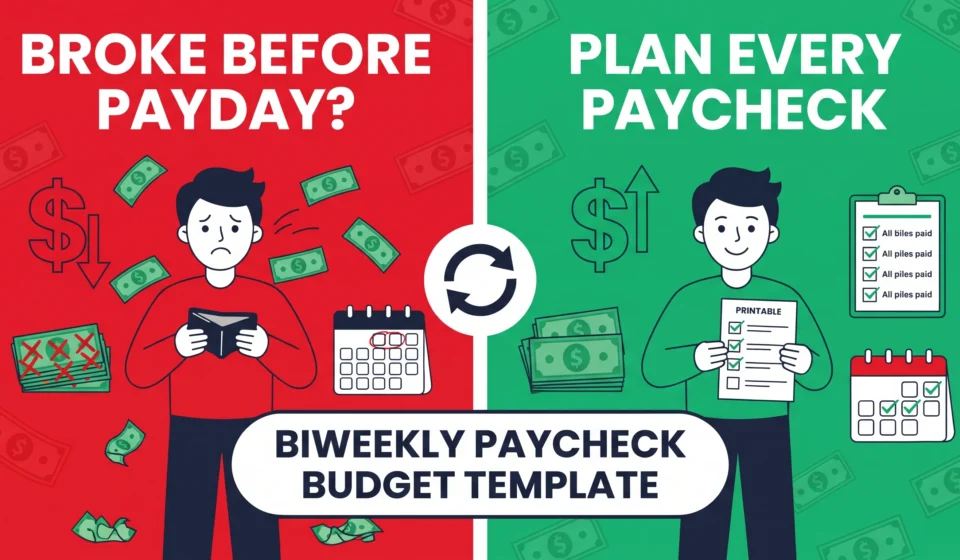
- Budget by paycheck, not by month.
- Match each bill to the paycheck that arrives before its due date.
- Move a fixed amount to savings from every check.
- Set a weekly spending limit.
- Save the 2 extra paychecks each year for debt or savings.
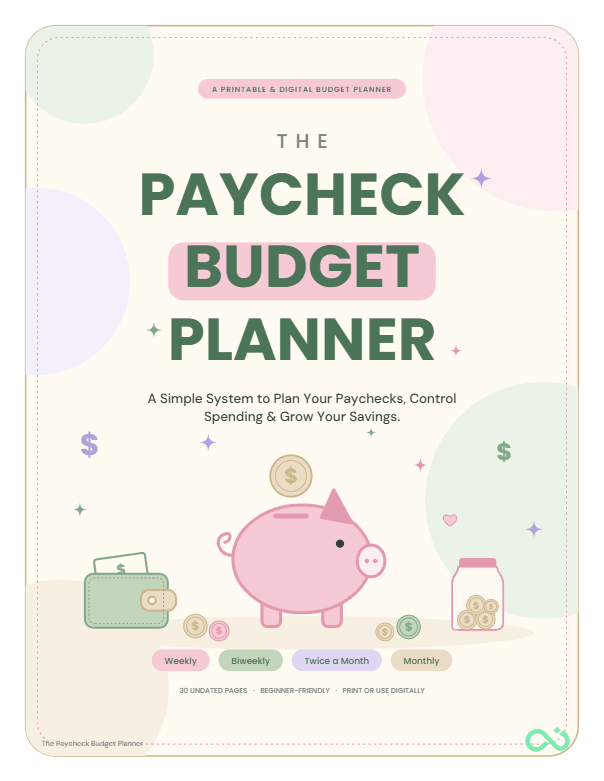
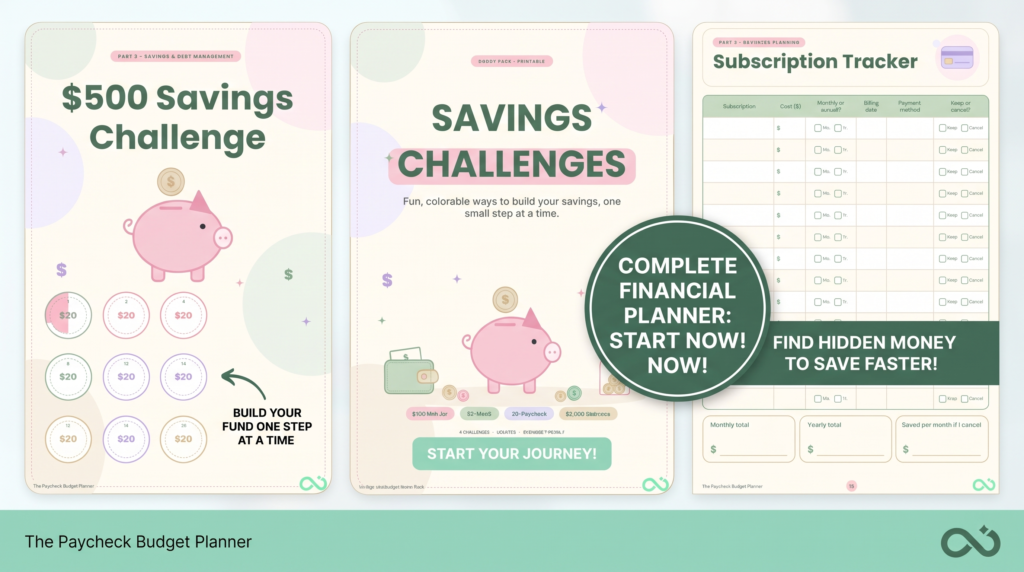
A printable biweekly paycheck budget planner puts all of this on one page per paycheck, so nothing slips through.
Why Biweekly Pay Makes Budgeting So Hard
Your bills come monthly, but your pay comes every two weeks.
That mismatch causes most of the stress.
A regular monthly budget assumes one paycheck. You actually get 26 a year, not 24. And your rent, car payment, and phone bill never land on the same day your money does.
So one paycheck ends up carrying all the heavy bills, and the next one feels like free money. Then it’s gone by Wednesday.
You’re probably not bad with money. You just need a system that matches how you get paid. If you want the full background first, read our guide on how to budget with biweekly paychecks.
Biweekly is not the same as twice a month
People mix these up all the time.
| Pay schedule | Paychecks per year | Typical payday | Budget tip |
|---|---|---|---|
| Weekly | 52 | Every Friday | Plan 4 to 5 checks per month |
| Biweekly | 26 | Every other Friday | Plan per paycheck, expect 2 three-check months |
| Semi-monthly | 24 | 15th and 30th | Same two checks every month |
| Monthly | 12 | Last day of month | One budget per month |
If you’re curious whether weekly or monthly planning suits you better, we compared both in weekly vs. monthly budgeting.
What a Biweekly Paycheck Budget Planner Does Differently
Instead of one big monthly budget, you plan each paycheck on its own.
Each page answers three questions:
- How much money is coming in?
- Which bills need to be paid before the next check?
- What’s left for savings and spending?
No complicated formulas. No app to open.
What Should Be in a Good Template
Not every template is worth printing. Look for these:
- Income section for your take-home pay (not gross)
- Bill list with due dates so you can see what’s coming
- Savings and debt payments on every paycheck
- Weekly spending limit for groceries, gas, and fun
- Extra paycheck tracker for the months with three checks
- Notes section for one-off expenses
How to Use It: 4 Simple Steps
Step 1: Write down your take-home pay
Use the amount that actually hits your bank account. Not your salary, not your gross pay.
If your pay changes from check to check, use your lowest recent amount to stay safe.
Step 2: List every bill with its due date
Rent, utilities, phone, insurance, subscriptions, car payment. Everything.
Don’t forget yearly bills like car registration. Divide the yearly cost by 26 and set that amount aside each check.
New to listing expenses? Our step-by-step guide to creating a budget walks through it.
Step 3: Match bills to paychecks
Look at each due date and ask: which paycheck arrives right before this?
That’s the check that pays it. Here’s an example with paydays on the 3rd and 17th:
| Bill | Amount | Due date | Paid from |
|---|---|---|---|
| Rent | $1,400 | 1st | $700 from each check |
| Phone | $60 | 5th | Paycheck 1 (3rd) |
| Electric | $90 | 12th | Paycheck 1 (3rd) |
| Car payment | $250 | 10th | Paycheck 1 (3rd) |
| Internet | $55 | 20th | Paycheck 2 (17th) |
| Water | $45 | 25th | Paycheck 2 (17th) |
| Car insurance | $150 | 28th | Paycheck 2 (17th) |
Rent too big for one check? Split it, so neither paycheck feels crushed.
Step 4: Set savings and spending
Whatever’s left after bills gets divided up:
- A set amount to savings
- Any extra debt payment
- The rest for spending, split by week
Pay yourself first. Move the savings the day you get paid, before you can talk yourself out of it.
Example: A $2,000 Biweekly Paycheck
Here’s how it could look with real numbers.
| Category | Paycheck 1 | Paycheck 2 |
|---|---|---|
| Take-home pay | $2,000 | $2,000 |
| Rent | $700 | $700 |
| Utilities and phone | $150 | $100 |
| Car and insurance | $250 | $150 |
| Savings | $200 | $200 |
| Debt payment | $100 | $100 |
| Groceries and spending | $600 | $750 |
| Left over | $0 | $0 |
Every dollar has a job.
Chart data: where each paycheck goes
Use this for a pie or stacked bar chart:
| Category | Paycheck 1 | % of check | Paycheck 2 | % of check |
|---|---|---|---|---|
| Rent | $700 | 35% | $700 | 35% |
| Utilities and phone | $150 | 7.5% | $100 | 5% |
| Car and insurance | $250 | 12.5% | $150 | 7.5% |
| Savings | $200 | 10% | $200 | 10% |
| Debt payment | $100 | 5% | $100 | 5% |
| Groceries and spending | $600 | 30% | $750 | 37.5% |
| Total | $2,000 | 100% | $2,000 | 100% |
Prefer a rule of thumb? On a $2,000 check, the 50/30/20 rule would look like this:
| Bucket | Share | Amount per paycheck |
|---|---|---|
| Needs | 50% | $1,000 |
| Wants | 30% | $600 |
| Savings and debt | 20% | $400 |
Your real numbers will differ, especially if rent is high. That’s normal. Use the rule as a starting point, not a test you can fail.
What to Do With the 2 Extra Paychecks
26 paychecks minus 24 equals 2 extra checks a year. They land in two months, and which months depends on your first payday.
Here’s an example year if your first payday is January 2:
| Month | Paychecks | Month | Paychecks |
|---|---|---|---|
| Jan | 3 | Jul | 3 |
| Feb | 2 | Aug | 2 |
| Mar | 2 | Sep | 2 |
| Apr | 2 | Oct | 2 |
| May | 2 | Nov | 2 |
| Jun | 2 | Dec | 2 |
Most people treat the third check like a bonus and spend it. Try this instead:
- Put it toward your emergency fund
- Pay down a credit card
- Build a small fund for holidays or car repairs
Budget your normal 24 checks as if the extra two don’t exist. Then the extras become pure progress.
How Small Savings Add Up Across 26 Paychecks
You don’t need big numbers to start.
| Saved per paycheck | Per month (approx.) | Per year (26 checks) |
|---|---|---|
| $25 | $54 | $650 |
| $50 | $108 | $1,300 |
| $100 | $217 | $2,600 |
| $200 | $433 | $5,200 |
Add the 2 extra paychecks on top, and the numbers grow even faster. Not sure how big your safety net should be? See how much emergency fund you need.
Mistakes That Break Biweekly Budgets
- Budgeting with gross pay. You’ll overspend every time.
- Forgetting small bills. Subscriptions add up fast.
- No buffer. Keep $50 to $100 unplanned for surprises.
- Skipping the review. Take 5 minutes before each payday to plan the next check.
These are common everywhere. For more, see common budgeting mistakes Americans make. If you keep abandoning your budget after a week, how to stick to a budget is worth a read.
Printable Template vs. App vs. Spreadsheet
| Printable template | Budgeting app | Spreadsheet | |
|---|---|---|---|
| Setup time | About 10 minutes | 20 to 30 minutes | 1 hour or more |
| Cost | One-time purchase | Often monthly fee | Free but time-heavy |
| See whole paycheck at a glance | Yes | Sometimes | Depends on layout |
| Works without internet | Yes | No | Sometimes |
| Auto-tracks spending | No | Yes | No |
| Best for | Planning and staying in control | Automatic tracking | Custom setups |
Apps are fine, and you can compare them in our best budgeting apps for 2026. But a printed page lets you see the whole paycheck at once, write on it, and stick it on the fridge. Many people also spend less when they write things down by hand.
Who Benefits Most From This Template
- Couples with different pay dates. See budgeting tips for couples.
- Families juggling kids’ costs. See budgeting for families with kids.
- Freelancers who want a steady rhythm. See budgeting tips for freelancers.
- Anyone who just got a raise. Here’s how to budget after a salary increase.
FAQs
How do I budget biweekly pay with monthly bills?
Match each bill to the paycheck that arrives before it’s due. Split large bills across two checks if you need to.
Is it better to budget by paycheck or by month?
If you’re paid biweekly, budget by paycheck. It lines up with when money actually arrives.
How much should I save from each paycheck?
Start with 5% to 10% of your take-home pay. Even $25 a check adds up to $650 a year.
What do I do in a month with three paychecks?
Treat the third check as extra. Use it for savings, debt, or irregular bills.
Ready to Plan Your Next Paycheck?
Budgeting by paycheck is simple once you see it on paper.
If you’d rather skip the setup, the Paycheck Planner has every page ready to go. Download it, print it, and plan your next paycheck in about 10 minutes.
Want more ideas to grow your savings? Try these 9 simple ways people save money.

Abhishek Kandir is the founder and lead writer at Paisewaise, a personal
finance publication covering Indian markets, budgeting, and investing since 2023.
Abhishek’s work focuses on making complex financial topics — from RBI
Interventions to SIP strategies — understandable for everyday Indian readers
without a financial background.