
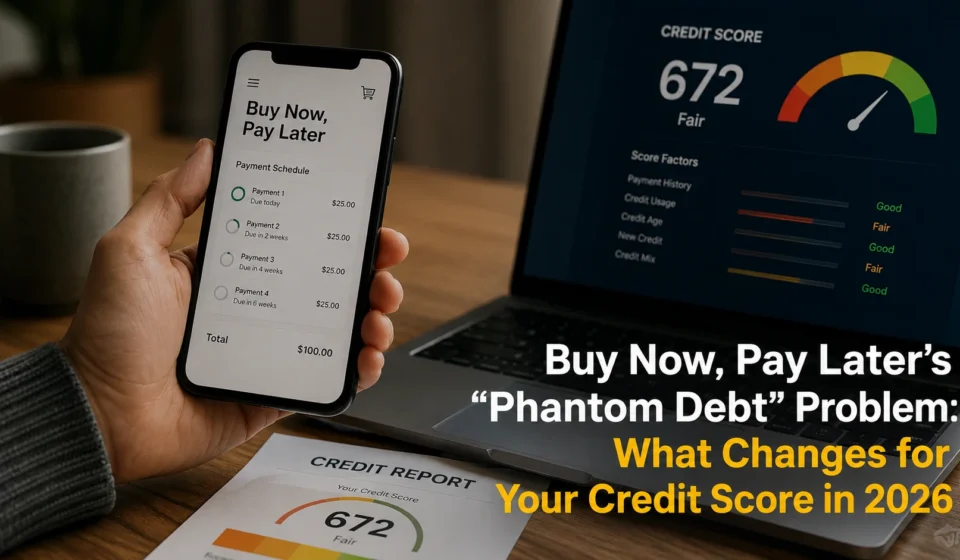
Buy Now, Pay Later’s “Phantom Debt” Problem: What Changes for Your Credit Score in 2026

Phantom Debt Is the Hidden Buy Now, Pay Later Problem That Could Hurt Your Credit Score in 2026
Something changed quietly over the past year, and most Buy Now, Pay Later users have no idea. For as long as BNPL has existed, splitting a purchase into four payments felt almost consequence-free. It didn’t show up on your credit report, so missing a payment — or juggling four different apps at once — never seemed to carry the same weight as a missed credit card bill.
Federal Reserve researchers have a name for the debt this created: phantom debt. It’s money you genuinely owe, sitting almost entirely outside the system that’s supposed to track it.
In 2026, that invisibility is disappearing. Here’s what’s actually changing, what the numbers say about how exposed the average user is, and how to get ahead of it before your credit score does.
What “Phantom Debt” Actually Means
Every time you use a credit card, the balance, the payment history, and the credit limit all get reported to Equifax, Experian, and TransUnion. Lenders use that picture to decide whether you can handle a mortgage, an auto loan, or another card.
Buy Now, Pay Later never worked that way. Most BNPL providers simply didn’t furnish loan data to the credit bureaus, so a $135 pay-in-four purchase (the average BNPL transaction size, according to the Consumer Financial Protection Bureau) could exist entirely off the books. On-time payments didn’t build credit. Late payments, in most cases, didn’t hurt it either.
The Federal Reserve Bank of Richmond has flagged this as the real story behind BNPL — not its growth rate, but its invisibility. When a meaningful layer of borrowing sits outside the credit reporting system, every downstream risk model, from mortgage underwriting to auto loans, is working from an incomplete picture. A lender looking at your credit report simply cannot see debt that was never reported in the first place.
That gap is now closing.
Why 2026 Is Different
Three things shifted the ground under BNPL almost simultaneously:
FICO built BNPL into its scoring model. Starting in fall 2025, FICO rolled out a new scoring model, often referred to as Score 10 BNPL, that can factor in Buy Now, Pay Later payment data where it’s reported. That’s a first. Before this, BNPL activity was essentially outside FICO’s view.
Affirm started reporting to the bureaus. Affirm began furnishing loan data to credit reporting companies in 2025, making it one of the first major providers to do so consistently. Klarna and Afterpay have been more cautious about following suit, so coverage across the industry is still uneven — which matters, because it means your own exposure depends heavily on which apps you actually use.
Consumer protections went the other direction. The CFPB withdrew its BNPL interpretive rule in May 2025, which means Buy Now, Pay Later purchases currently carry fewer formal, federally guaranteed dispute and billing-error protections than a credit card does under the Fair Credit Billing Act.
Put together, the risk side of BNPL is getting bigger (your history can now follow you) while the protection side is getting smaller. That combination is exactly why this is worth paying attention to now, not later.
The Numbers: How Big Has BNPL Actually Gotten?
| Metric | Figure | Source |
|---|---|---|
| BNPL users in the past 90 days | 37% of U.S. consumers in 2025 | J.D. Power bankingjournal.aba |
| Users who say BNPL is necessary to make ends meet | 54% of BNPL users | eMarketer emarketer |
| BNPL used for groceries | 29% of BNPL-using households | eMarketer emarketer |
| BNPL used for rent | 13% of U.S. BNPL customers | eMarketer emarketer |
| Users who paid late in the past year | 47% of users | eMarketer emarketer |
| Users with three or more active BNPL loans | 25% of users | eMarketer emarketer |
| Overall market positioning | BNPL is growing but still a relatively small part of consumer credit | Richmond Fed richmondfed |
6 Warning Signs You’re Carrying More Phantom Debt Than You Think
- You have active loans with more than two BNPL providers at once. Each app only shows you its own balance — none of them show you the full picture.
- You couldn’t say, right now, what your combined BNPL balance is across every app. If you’d have to open four apps to add it up, that’s the phantom debt problem in miniature.
- You’ve used BNPL for groceries or everyday essentials, not just discretionary purchases. LendingTree’s 2026 data found this is a growing pattern, and it’s often a sign a budget is already stretched.
- You’ve opened a new BNPL loan partly to free up cash for an existing one. This is the installment-loan version of using one credit card to pay another.
- You’ve paid late at least once and didn’t think much of it, because “it’s not like a credit card.” That assumption is exactly what’s changing in 2026.
- You chose BNPL specifically because it wouldn’t show up on your credit report. Surveys from financial-wellness platform Empower found that roughly 40% of BNPL users cite this as a top benefit — and that’s the exact assumption providers are now moving away from.
If two or more of these sound familiar, it’s worth doing the audit in the next section before, not after, a missed payment shows up somewhere you didn’t expect.
Buy Now, Pay Later vs. Credit Cards: A Side-by-Side Comparison
| Buy Now, Pay Later | Credit Cards | |
|---|---|---|
| Interest | Typically 0% on standard pay-in-4 plans | Revolving interest, often 21%+ APR |
| Credit bureau reporting | Inconsistent — expanding, but not universal (Affirm yes; others partial or cautious) | Always reported |
| Approval process | Instant, usually a soft credit check | Hard inquiry, fuller underwriting |
| Repayment window | Short and fixed — often 6 weeks for pay-in-4 | Revolving, no fixed end date |
| Late payment consequences | Increasingly can affect your score; late fees vary by provider | Reported every cycle; can significantly affect your score |
| Dispute/fraud protections | Fewer formal protections since the CFPB’s 2025 rule withdrawal | Strong federal protections under the Fair Credit Billing Act |
| Visibility of multiple loans | Fragmented across separate apps and providers | Consolidated on one credit report |
| Best used for | A single, planned purchase you can pay off in weeks | Larger purchases, building credit history, purchases needing strong protections |
The takeaway isn’t that one product is simply “better.” It’s that BNPL’s biggest historical advantage — staying off your credit profile — is the exact feature that’s now eroding.
5 Mistakes to Avoid With BNPL in 2026
- Stacking loans across multiple providers without a running total. If Affirm reports and Klarna doesn’t (or vice versa), you can look fine on paper while still being overextended in reality.
- Assuming “0% interest” means “no risk.” No interest doesn’t mean no consequences — late and missed payments are the real cost center now.
- Skipping the budget check because “it’s not a credit card.” Treat every BNPL commitment as a real, fixed near-term bill, because that’s exactly what it is.
- Not checking your specific provider’s current reporting policy. This is changing fast and unevenly across the industry, so what was true last year may not be true today.
- Ignoring a late BNPL payment because it never used to matter. That assumption is precisely what 2026’s changes are undoing.
How to Protect Your Credit Score, Starting Today
- Audit every BNPL app you currently use. List each provider, the remaining balance, and the next due date in one place — a notes app or simple spreadsheet works fine.
- Check whether your providers report to the bureaus. Affirm has reported since 2025; Klarna and Afterpay have been more conservative, but policies are shifting, so check each provider’s current terms directly.
- Treat every BNPL installment like a bill with a due date, not a purchase you’ve already mentally closed the book on. Auto-pay, where available, removes the risk of forgetting.
- Set a personal cap on how many active BNPL plans you’ll carry at once. Two is a reasonable ceiling for most budgets; the data shows risk climbs sharply once you’re past that.
- Pull your credit report periodically (free at AnnualCreditReport.com) to see whether BNPL activity is starting to appear as a new tradeline, and confirm it’s accurate if it does.
Frequently Asked Questions
Q. Does Klarna affect your credit score?
- Klarna has historically been more cautious than Affirm about reporting payment data to credit bureaus. Policies in this space are moving quickly, so check Klarna’s current terms for the specific plan you’re using rather than assuming last year’s rules still apply.
Q. Does Afterpay report to credit bureaus?
- Like Klarna, Afterpay has taken a more conservative approach to bureau reporting than Affirm. That could change as FICO’s new scoring model puts industry-wide pressure on providers to report.
Q. Will paying my BNPL loans on time help my credit score?
- Where a provider reports payment data and FICO’s newer scoring models are used, consistent on-time payments can now work in your favor, similar to any other installment credit. That benefit only applies if your specific provider actually reports, though — so it’s not guaranteed across every app.
Q. Is Buy Now, Pay Later worse than a credit card for my credit?
- Not inherently. BNPL loans are smaller, shorter-term, and have historically had lower default rates than credit cards. The real risk isn’t the product itself — it’s stacking multiple loans across providers that don’t talk to each other, which makes it easy to lose track of your total exposure.
Q. How many BNPL loans is too many?
- There’s no official limit, but the data offers a useful benchmark: 63% of users have carried multiple loans at once, and the risk of late payment climbs noticeably among the 25% carrying three or more. If you can’t quickly state your combined balance across every app, that’s a sign to consolidate or pay down before taking on another.
The Bottom Line
Buy Now, Pay Later isn’t disappearing, and it isn’t inherently dangerous — for a single, planned purchase you can pay off on schedule, it still works exactly as intended. What’s changed is the safety net of invisibility that made it feel lower-stakes than a credit card. With FICO now able to factor in BNPL data and providers like Affirm already reporting, 2026 is the year that safety net starts to have real gaps in it.
The fix isn’t complicated: know your total balance across every app, treat each installment like the real bill it is, and keep a cap on how many plans you’re juggling at once. Phantom debt only stays invisible if you’re not the one looking for it.
This article is for general informational purposes and isn’t financial or credit advice. BNPL reporting policies vary by provider and are changing quickly — confirm current terms directly with each provider before making decisions based on this information.
Abhishek Kandir is the founder and lead writer at Paisewaise, a personal
finance publication covering Indian markets, budgeting, and investing since 2023.
Abhishek’s work focuses on making complex financial topics — from RBI
Interventions to SIP strategies — understandable for everyday Indian readers
without a financial background.