
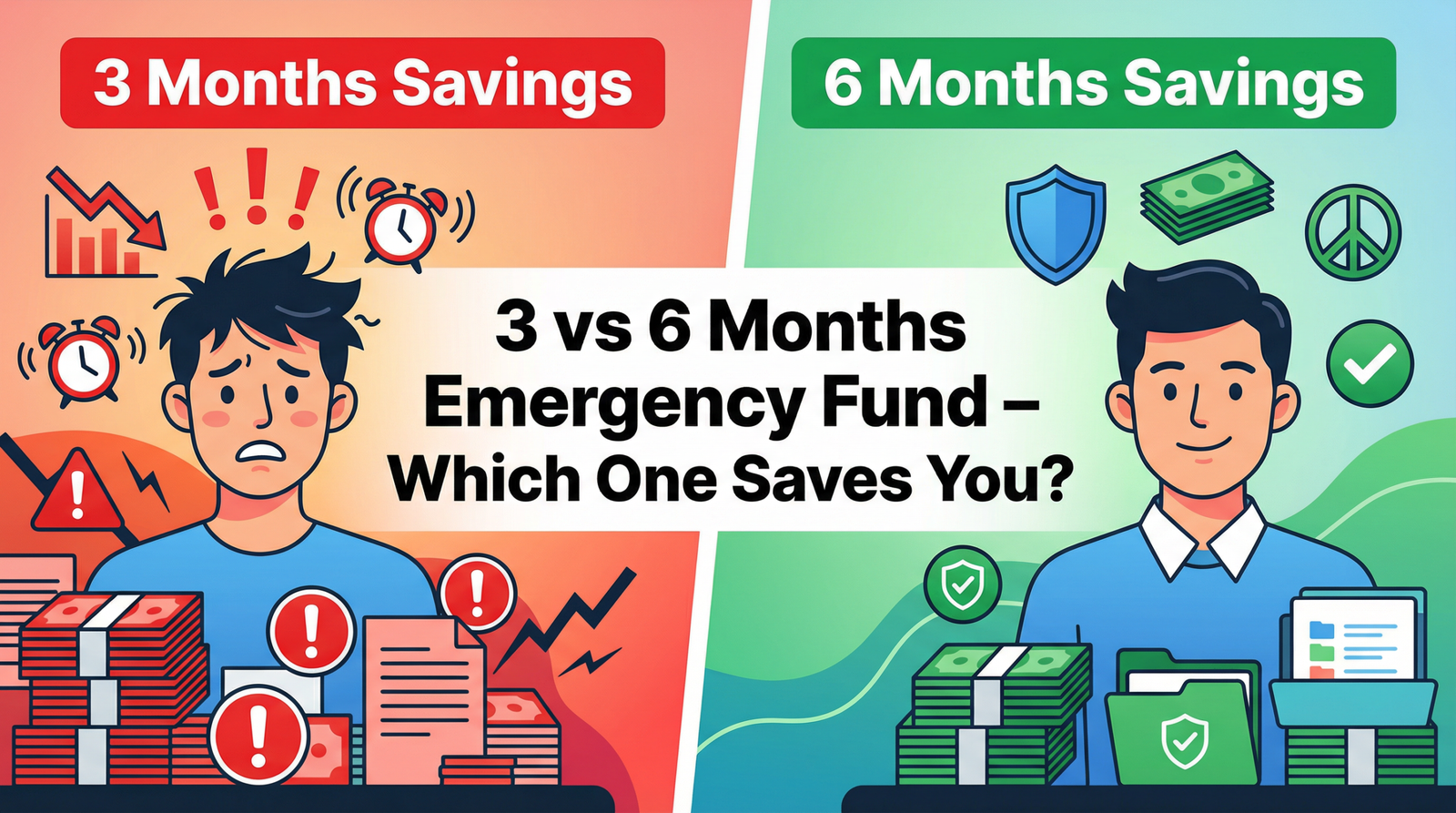
3-Month vs 6-Month Emergency Fund: What’s Better?
If you’ve spent any time reading about personal finance, you’ve probably heard the advice: build an emergency fund. But when it comes to the 3-month vs 6-month emergency fund debate, most people hit a wall. Which one is actually right for you?
The answer matters more than most people realize. According to a 2024 Bankrate survey, nearly 57% of Americans couldn’t cover a $1,000 emergency expense from savings alone. That means the majority of households are one unexpected car repair, one medical bill, or one layoff away from financial chaos.
The goal of this guide is simple — cut through the noise on the 3-month vs 6-month emergency fund question, give you real numbers based on U.S. living costs, and help you decide exactly how many months of expenses to save based on your actual life situation.
What Is an Emergency Fund?
An emergency fund is a dedicated pool of liquid cash reserved exclusively for genuine financial emergencies — unexpected job loss, medical expenses, urgent home repairs, or a major car breakdown. It is not a vacation fund. It is not a down payment fund. It is your personal financial safety net.
In the U.S., the standard personal finance emergency fund strategy recommends keeping this money in a high-yield savings account (HYSA) — somewhere accessible, FDIC-insured, and completely separate from your checking account.
The size of this fund is measured in months of essential living expenses, which is exactly where the 3-month vs 6-month emergency fund debate begins.
How to Calculate Your Emergency Fund Target
Before you can even pick a side in the 3-month vs 6-month emergency fund debate, you need to know your monthly essential expense number. Essential expenses typically include:
- Rent or mortgage payment
- Groceries and household supplies
- Utilities (electric, gas, water, internet)
- Health insurance premiums and out-of-pocket costs
- Car payment and auto insurance
- Minimum debt payments (student loans, credit cards)
- Childcare or dependent care costs
Do NOT include dining out, streaming services, gym memberships, or any discretionary spending in this number.
U.S. Benchmark Calculations
According to the Bureau of Labor Statistics, the average U.S. household spends $6,545 per month on total expenses (2024 data). Trimming to essentials only (e.g., housing, food, transportation, utilities), a conservative estimate is $3,000–$4,000/month for a single person or couple in lower-cost areas.
| Monthly Essentials | 3-Month Target | 6-Month Target |
|---|---|---|
| $2,500 (frugal single/low-cost area) | $7,500 | $15,000 |
| $3,500 (single moderate area) | $10,500 | $21,000 |
| $4,500 (household average essentials) | $13,500 | $27,000 |
| $6,000 (family/high-cost area total) | $18,000 | $36,000 |
These numbers look large — and that’s intentional. Understanding the real target is the first step toward taking the 3-month vs 6-month emergency fund decision seriously.
The Case for a 3-Month Emergency Fund
A 3-month emergency fund gives you 90 days of financial runway. For many Americans, this is the recommended starting point — and for some, it’s the right long-term target.
Key Benefits
- Faster to build — especially important for younger workers or those paying off debt
- Lower opportunity cost — less cash sitting in a savings account instead of working in an investment account
- Sufficient for short-term disruptions — covers most single emergencies like a job transition, ER visit, or major appliance replacement
- Reduces credit card dependency — even 3 months eliminates the need to reach for high-interest debt in most scenarios
- Beginner-friendly milestone — achievable within 12–18 months on a modest savings rate
Who a 3-Month Fund Works Best For
- Dual-income households where one partner’s income can carry essentials if the other loses their job
- Salaried W-2 employees in stable industries like healthcare, government, or education
- People with strong employer-provided benefits, including paid sick leave, disability insurance, and severance packages
- Anyone under 30 with minimal fixed financial obligations
The Case for a 6-Month Emergency Fund
A 6-month emergency fund doubles your financial runway to 180 days. This is the benchmark widely recommended by financial advisors for anyone with income variability, dependents, or employment in an unstable sector.
Key Benefits
- Stronger job loss protection — the average U.S. job search currently takes 5 to 6 months according to the Bureau of Labor Statistics, meaning a 3-month fund may literally run out before you land your next role
- Covers compounding emergencies — job loss and a medical bill hitting simultaneously won’t wipe you out
- Critical for variable income earners — freelancers, contractors, commission-based workers, and gig workers need more runway between income gaps
- Reduces forced financial decisions — without adequate savings, people accept the wrong job offer, sell investments at a loss, or take on high-interest debt out of necessity
- Psychological stability — research from the Urban Institute links emergency savings above $2,500 to measurably lower financial anxiety and better long-term financial decision-making
3-Month vs 6-Month Emergency Fund — Direct Comparison
| Factor | 3-Month Fund | 6-Month Fund |
|---|---|---|
| Coverage Period | 90 days | 180 days |
| Average U.S. Target | $7,500–$13,500 | $15,000–$27,000 |
| Time to Build (saving $500/mo) | 15–27 months | 30–54 months |
| Job Loss Coverage | Partial | Full (for most searches) |
| Opportunity Cost | Lower | Higher |
| Best For | Dual income, stable employment | Single income, variable income, dependents |
| Inflation Risk | Lower | Moderate |
| Beginner Accessibility | ✅ High | ⚠️ Moderate |
| Psychological Security | Moderate | High |
Real-World Case Studies
Case Study 1 — Jake and Sarah, Dual-Income Couple, Dallas, TX
Jake earns $72,000/year as a project manager. Sarah earns $58,000 as a registered nurse. Their combined essential monthly expenses are $4,800. In the 3-month vs 6-month emergency fund analysis, they comfortably sit in the 3-month camp — targeting $14,400. With two stable incomes in high-demand fields, even a job loss by one partner still leaves the household covered. Their remaining savings capacity goes toward maxing out their 401(k)s and a Roth IRA.
Case Study 2 — Marcus, Freelance Web Developer, Austin, TX
Marcus averages $85,000/year, but his monthly income swings between $3,000 and $12,000 depending on client contracts. His essential expenses run $3,200/month. For Marcus, the 3-month vs 6-month emergency fund decision is clear — 6 months minimum, targeting $19,200. A dry stretch of two or three months with no new contracts is a realistic scenario in freelancing, and without a buffer, he would be forced to take below-market work or tap into credit.
Case Study 3 — Diana, Single Mom, Two Kids, Chicago, IL
Diana earns $62,000/year as a school administrator. She is the sole income earner supporting herself and two children. Monthly essential expenses, including childcare, run $4,400. In Diana’s case, the ideal emergency fund size is firmly 6 months — $26,400 —, and her financial advisor actually recommends pushing toward 9 months given her single-income, high-dependent situation. Any job loss would be immediately catastrophic without a large buffer.
Risks on Both Sides
Even the right answer in the 3-month vs 6-month emergency fund debate comes with trade-offs worth understanding.
Risks of Stopping at 3 Months
- Job searches take longer than expected — especially in fields like tech, finance, and media, where layoffs have been widespread since 2022
- Medical emergencies don’t follow a 90-day schedule — a serious illness, surgery recovery, or mental health crisis can run well beyond 3 months
- Simultaneous emergencies — losing your job the same month your car transmission fails and your child needs an ER visit is not rare — it’s a documented financial stress pattern
Risks of Over-Saving Beyond 6 Months
- Inflation erosion — cash in a savings account loses real purchasing power every year. Even at 4.5% HYSA rates, inflation at 3%+ means real returns are slim
- Massive opportunity cost — $25,000 sitting in a savings account instead of a total market index fund over 10 years at a 7% average return is roughly $24,000 in foregone gains
- Paralysis trap — many people use “building the emergency fund” as an excuse to delay investing indefinitely, which significantly damages long-term wealth
Where to Keep Your Emergency Fund in the U.S.
The 3-month vs 6-month emergency fund question isn’t just about size — location matters too.
| Account Type | Pros | Cons |
|---|---|---|
| High-Yield Savings Account (HYSA) | FDIC insured, easy access, 4–5% APY currently | Rates variable, not investment growth |
| Money Market Account | Slightly higher rates, check-writing access | Minimum balance requirements |
| Treasury Bills (T-Bills) | Government-backed, competitive yields | Less liquid, requires a brokerage account |
| Cash Management Account | Flexible, often higher APY | Not always FDIC insured directly |
For most Americans, a high-yield savings account at an online bank — Marcus by Goldman Sachs, Ally, SoFi, or American Express — is the simplest and most effective home for an emergency fund in 2026.
Common Mistakes Americans Make
- Treating a HELOC or credit card as an emergency fund — debt is not a safety net; it’s a trap with interest
- Keeping the fund in a regular checking account — too easy to spend, and you earn almost nothing
- Never updating the target — if your rent goes up, you get married, or you have a child, your 3-month vs 6-month emergency fund calculation must be recalculated
- Raiding the fund for non-emergencies — a vacation deal or Black Friday sale is not an emergency
- Waiting until debt is fully paid off — you need at least a $1,000 starter fund even while paying off debt; emergencies don’t wait for your payoff timeline
FAQs
Q. Is a 3-month emergency fund enough in the U.S.?
- For dual-income, stable-employment households, a 3-month emergency fund is a reasonable baseline. However, given that the average U.S. job search takes 5 to 6 months and medical costs continue to rise, most financial advisors now recommend treating 3 months as the floor, not the goal. The 3-month vs 6-month emergency fund question really comes down to your income stability and household dependency structure.
Q. How many months of expenses should I save?
- The universally accepted range is 3 to 6 months of essential expenses. Three months is the minimum; six months is the standard recommendation for anyone self-employed, single-income, or with dependents. Some planners recommend up to 12 months for retirees, those with chronic health conditions, or workers in highly volatile industries.
Q. Does my 401(k) count toward my emergency fund?
- No. Withdrawing from a 401(k) before age 59½ triggers a 10% early withdrawal penalty plus ordinary income tax on the amount withdrawn. It is slow to access, costly to use, and damages your long-term retirement trajectory. Your 401(k) is a retirement asset — not a financial safety net.
Q. Should I pay off debt or build an emergency fund first?
- Most financial advisors, including Dave Ramsey’s Baby Steps framework, recommend building a small $1,000 starter fund first, aggressively paying off high-interest debt, then returning to build your full 3-month vs 6-month emergency fund. This prevents a single emergency from pushing you back into debt while you’re in payoff mode.
Q. What is the best account for an emergency fund in 2026?
- A high-yield savings account (HYSA) remains the most practical option for most Americans — currently offering 4.00–5.00% APY at major online banks, FDIC insured up to $250,000, and accessible within 1 to 2 business days. Money market accounts are a close second for those who want check-writing flexibility.
Final Thoughts
The 3-month vs 6-month emergency fund debate ultimately comes down to one question: how much financial disruption could your household absorb before you’re forced into a bad decision?
If you have two stable incomes, strong employer benefits, and low fixed obligations — 3 months is a solid, achievable target that lets you redirect more money toward wealth-building investments. If you’re self-employed, a sole earner, or working in a volatile industry, 6 months isn’t being overly cautious — it’s being realistic about how long genuine emergencies actually last in America today.
Start where you are. Build for 3 months first. Then, honestly evaluate whether your situation calls for more. The best emergency fund isn’t the one you read about — it’s the one sitting in your savings account when you actually need it.
Sources
- U.S. Bureau of Labor Statistics — Job Openings and Labor Turnover Summary (JOLTS)
- Bankrate Annual Emergency Savings Report 2026
This content is for informational purposes only and does not constitute financial advice. Readers should conduct independent research or consult a qualified financial professional before making financial decisions.

Abhishek Kandir is the founder and lead writer at Paisewaise, a personal
finance publication covering Indian markets, budgeting, and investing since 2023.
Abhishek’s work focuses on making complex financial topics — from RBI
Interventions to SIP strategies — understandable for everyday Indian readers
without a financial background.