
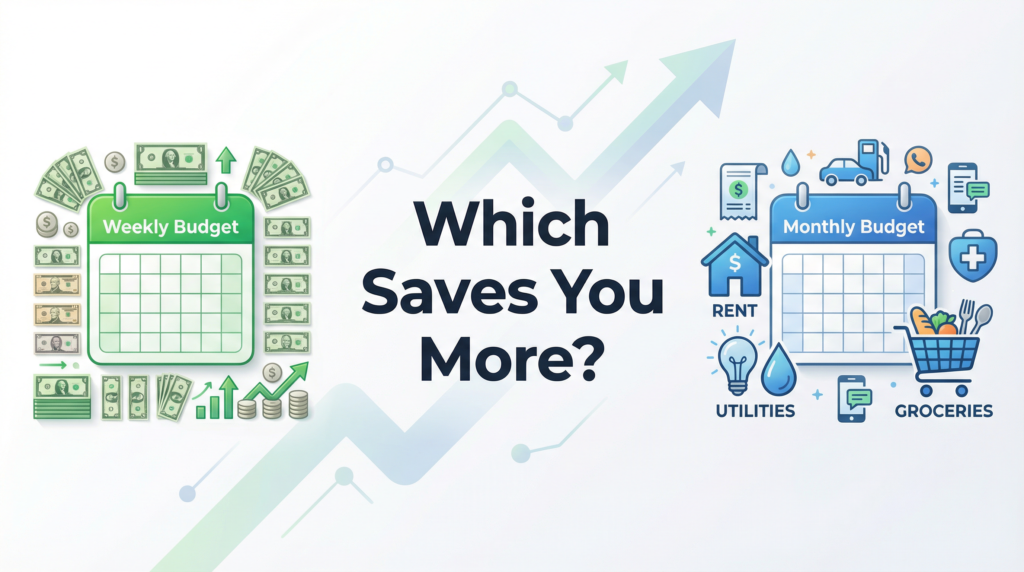
Weekly vs Monthly Budgeting: Which Works Better for Beginners?
When you first start managing your money, one of the earliest decisions you’ll face is surprisingly simple — but genuinely important: how often should you budget? Weekly vs monthly budgeting is one of the most common comparisons in personal finance management tips, and the answer isn’t the same for everyone.
Your paycheck schedule, spending habits, and financial goals all play a role in choosing the right system. Budget too infrequently, and small expenses slip through the cracks. Budget too often, and it becomes an exhausting chore you abandon after two weeks.
This guide breaks down both budgeting methods, compares them side by side, and helps you figure out which one actually fits your life — especially if you’re just getting started.
What Are These Two Budgeting Methods?
Monthly Budgeting
Monthly budgeting means you plan your income and expenses once per month. You set category limits — rent, groceries, transport, and entertainment — and track whether you stay within them over 30 days. Most bills (rent, utilities, subscriptions) are monthly, which makes this a natural fit for many people.
Weekly Budgeting
Weekly budget planning means you divide your money into 7-day windows. Each week gets an allocated amount, and you track spending within that shorter timeframe. This method creates more frequent check-ins and tighter control over daily spending.
Both are legitimate approaches to personal finance management. The key difference is in how much structure and oversight you want on a day-to-day basis.
How Each System Works
How Monthly Budgeting Works
- Add up your total monthly income (salary, freelance, side income)
- List all fixed expenses — rent, loan payments, subscriptions
- Estimate variable expenses — food, transport, entertainment
- Subtract total expenses from income — what remains is savings or discretionary spending
- Review at month-end to see where you over- or underspent
How Weekly Budgeting Works
- Calculate your weekly income (monthly income ÷ 4.33)
- Set a weekly spending limit for variable categories
- Track daily purchases within the week
- Review every Sunday (or your chosen reset day)
- Roll over or reset — some people roll unused money forward, others reset entirely
Side-by-Side Comparison
| Feature | Weekly Budgeting | Monthly Budgeting |
|---|---|---|
| Review Frequency | Every 7 days | Once a month |
| Best For | Daily spenders, beginners | Salaried earners, bill-heavy budgets |
| Overspending Risk | Lower (caught faster) | Higher (problems hide longer) |
| Time Required | 15–20 min/week | 30–60 min/month |
| Complexity | Low-Medium | Low |
| Works With Irregular Income? | Yes | Less ideal |
| Handles Fixed Bills Well? | Requires adjustments | Very naturally |
| Behavioral Benefit | High (frequent accountability) | Moderate |
Key Benefits of Each Method
Benefits of Weekly Budgeting
- Catches overspending early — You notice a problem in Week 1, not Week 4
- Creates strong habits — Frequent check-ins build financial awareness faster
- Better for variable or gig income — Freelancers and part-time workers often get paid weekly or irregularly
- Reduces “end of month” panic — No more realizing on the 28th that money is nearly gone
- Psychologically manageable — Smaller numbers feel less overwhelming for beginners
Benefits of Monthly Budgeting
- Aligned with how bills work — Rent, insurance, and most subscriptions are monthly
- Less time-intensive — One planning session per month is simpler to maintain
- Better for stable, salaried income — One paycheck, one plan
- Easier to track big-picture goals — Savings targets and debt payoff timelines are naturally monthly
- Lower mental load — Fewer decisions and check-ins
Real-World Example
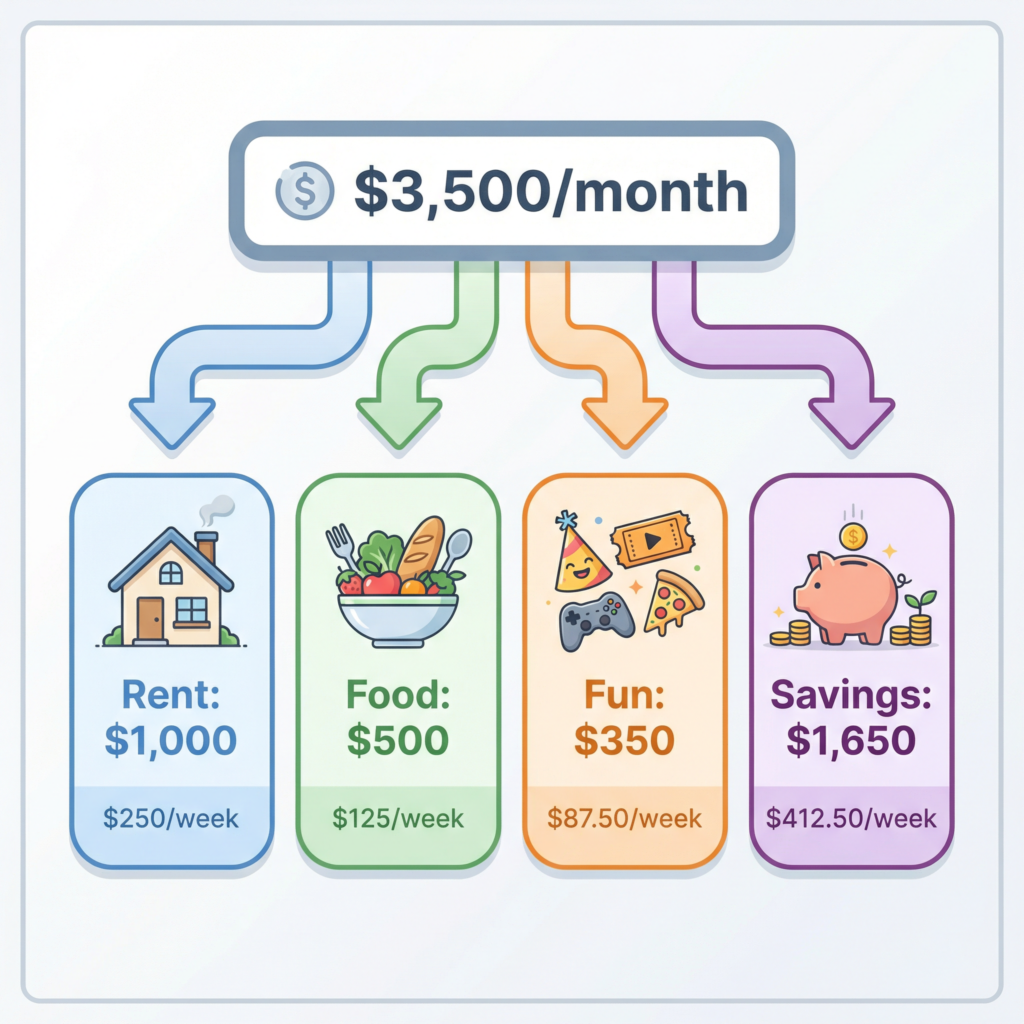
Case Study: Meet Priya, 24, First Job
Priya earns $3,500/month after tax. She tried monthly budgeting first.
- Month 1: Spent $400 on dining out (budget was $150). Didn’t notice until the 29th.
- Month 2: Switched to weekly budgeting. Gave herself $35/week for dining out.
- By Week 2 of Month 2: She’d spent $30 and knew she had $5 left — so she cooked at home.
- Result after 3 months: Saved $280 more than she had under monthly budgeting.
The shorter window gave Priya real-time feedback, which monthly budgeting couldn’t.
Case Study: James, 31, Salaried with Fixed Expenses
James earns $5,200/month. His rent, car payment, and loan EMIs total $3,100 fixed.
He tried weekly budgeting but found it confusing — his big bills didn’t align neatly with 7-day windows.
- Switched to monthly budgeting with one setup session on the 1st of each month
- Used a simple spreadsheet with 8 categories
- Result: Consistent $600–$700 savings monthly with minimal effort
For James, monthly expense tracking was cleaner and more sustainable.
Risks and Limitations
Weekly Budgeting — Risks
- Irregular months cause confusion — Months have 4.33 weeks, not exactly 4, which creates math headaches
- Large annual or monthly bills don’t fit neatly — Rent paid weekly feels artificial
- Fatigue risk — Tracking every week can burn people out if their lifestyle doesn’t support it
- Can create false security — A great Week 1 doesn’t guarantee a good month overall
Monthly Budgeting — Risks
- Problems hide too long — 30 days of overspending on food is a much bigger hole than 7 days
- Poor fit for variable income — If income fluctuates, a fixed monthly plan breaks quickly
- Behavioral gap — One review per month means fewer opportunities to course-correct
- “I’ll fix it next month” syndrome — Easy to keep postponing adjustments
Who Should Choose Which?
Choose Weekly Budgeting If You:
- Are a complete beginner who needs structure and accountability
- Have a spending problem in categories like food, shopping, or entertainment
- Earn income weekly, biweekly, or irregularly (freelancers, gig workers)
- Want to build financial habits faster
- Tend to “forget” how much you’ve spent mid-month
Choose Monthly Budgeting If You:
- Receive a single monthly salary
- Have mostly fixed, predictable expenses
- Are comfortable with moderate self-discipline
- Prefer simplicity over frequent check-ins
- Are you managing long-term goals like debt payoff or retirement saving
Common Mistakes Beginners Make
- Using the wrong method for their income type — A gig worker forcing a monthly plan will constantly miscalculate
- Skipping the review session — The method only works if you actually check in
- Tracking spending but not comparing to the budget — Recording expenses without acting on the data is pointless
- Making the budget too strict — Zero room for spontaneity leads to abandonment
- Switching systems too frequently — Give any method at least 60–90 days before judging it
FAQs
Q. Is weekly or monthly budgeting better for beginners?
- Weekly budgeting tends to work better for most beginners because it creates faster feedback loops. When you overspend on lunch five days in a row, a weekly budget shows you that problem by Day 7 — not Day 30. That said, beginners with stable monthly salaries and mostly fixed expenses may find monthly budgeting simpler to stick with. The best budgeting method is the one you’ll actually use consistently.
Q. Can I combine weekly and monthly budgeting?
- Yes — and many personal finance experts recommend it. Use a monthly budget for your fixed expenses (rent, utilities, loan payments) and a weekly budget for variable spending (food, entertainment, shopping). This hybrid approach to personal finance management gives you the structure of monthly planning with the real-time control of weekly tracking.
Q. How do I handle bills in a weekly budget?
- Set aside a fixed amount each week for monthly bills. For example, if your rent is $1,200/month, mentally “reserve” $300/week. Some people move this into a separate account immediately on payday so it’s never accidentally spent.
Q. What’s the best app for weekly budget planning?
- Apps like YNAB (You Need A Budget) are purpose-built for weekly budget planning and zero-based budgeting. Mint and EveryDollar work well for monthly expense tracking. If you prefer simplicity, a Google Sheets template customized for your schedule works just as well for beginners.
Q. How long should I try a budgeting method before switching?
- Give it a minimum of 60–90 days. The first month of any budgeting method comparison is always rough — you’re still learning your actual spending patterns. By month 2 or 3, you’ll have real data to evaluate whether the system is working.
Final Thoughts
There’s no universally “better” system when it comes to weekly vs monthly budgeting — there’s only the system that fits your income, habits, and lifestyle.
If you’re a beginner who struggles with impulse spending or has a variable income, start weekly. The frequent check-ins will build discipline faster than anything else. If you’re salaried with predictable bills and a low-stress relationship with money, monthly budgeting offers simplicity without sacrificing effectiveness.
The most important takeaway: pick one, commit to it for 90 days, and review honestly. No budgeting system works if you don’t show up for it.
Sources
- U.S. Bureau of Labor Statistics — Consumer Expenditure Survey
- Consumer Financial Protection Bureau (CFPB) — Budgeting Resources
- National Financial Educators Council — Financial Literacy Research
This content is for informational purposes only and does not constitute financial advice. Readers should conduct independent research or consult a qualified financial professional before making financial decisions.

Owner of Paisewaise
I’m a friendly finance expert who helps people manage money wisely. I explain budgeting, earning, and investing in a clear, easy-to-understand way.