
Budgeting After a Salary Increase: How to Budget After a Salary Increase Without Lifestyle Inflation
Last Updated: March 2026 | Read Time: 7 min |
You just got a raise — congratulations. But here’s the uncomfortable truth: most people discover a few months later that they’re still living paycheck to paycheck, just with bigger paychecks.
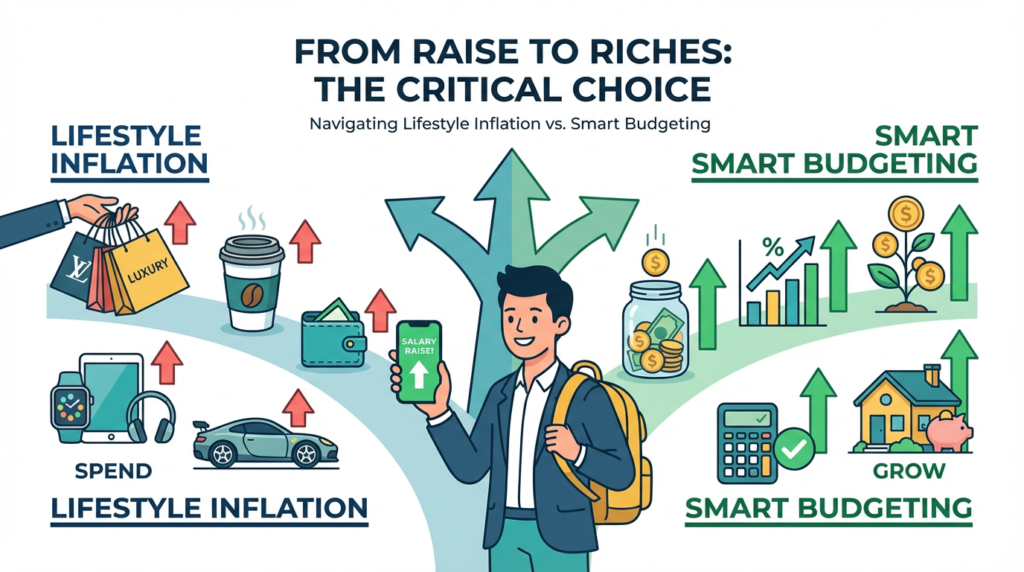
That’s lifestyle inflation in action. Knowing how to budget after a salary increase is one of the most financially important skills you can develop, yet almost nobody teaches it. The moment your income rises, so does the temptation to upgrade your car, eat out more often, or move into a larger apartment.
This article breaks down exactly how to budget after a salary increase — with real numbers, practical frameworks, and strategies to make sure your raise actually builds wealth instead of just funding a more expensive lifestyle.
What Is Lifestyle Inflation and Why Does It Happen?
Lifestyle inflation: It’s the gradual increase in spending that follows an increase in income. You earn more, so you spend more — and your financial position stays roughly the same.
It happens because of three psychological triggers:
- Social comparison — peers at your new salary level spend differently.
- Reward mentality — “I worked hard for this raise, I deserve to enjoy it.”
- Invisible creep — small upgrades across many categories add up silently.
Understanding lifestyle inflation is the first step in learning how to budget after a salary increase without falling into this trap.
How to Budget After a Salary Increase — The Core Framework
The most reliable system for budgeting after a salary increase is the 50/30/20 rule, adjusted for your new income. Here’s how to apply it:
| Budget Category | Old Salary ($60,000/yr) | New Salary ($75,000/yr) | Recommended Increase |
|---|---|---|---|
| Needs (50%) | $2,500/mo | $3,125/mo | Only if truly necessary |
| Wants (30%) | $1,500/mo | $1,875/mo | Moderate, intentional |
| Savings/Debt (20%) | $1,000/mo | $1,500/mo | Priority allocation |
The key insight here: direct the majority of your raise toward savings and debt repayment first, before adjusting lifestyle spending. This is the foundation for correctly budgeting after a salary increase.
The Step-by-Step Process for How to Budget After a Salary Increase
Step 1 — Calculate Your Real Take-Home Increase
A $15,000 raise doesn’t mean $15,000 more to spend. After federal taxes, state taxes, and benefits adjustments, your actual take-home increase is significantly smaller.
Example:
- Gross raise: $15,000/year ($1,250/month)
- After ~28% effective tax rate: approximately $900/month additional take-home
Knowing your real number is critical when figuring out how to budget after a salary increase realistically.
Step 2 — Audit Your Current Spending Before Touching Anything
Before you adjust a single budget line, track your current spending for 30 days. Use a spreadsheet or a budgeting app. Most people who learn how to budget after a salary increase are surprised to find they already have spending leaks they weren’t aware of.
Step 3 — Apply the 50% Savings Rule on New Income
A powerful rule: save at least 50% of every raise before adjusting lifestyle spending. If your take-home increases by $900/month, commit $450 to savings or investments immediately — before you get used to the extra money.
Step 4 — Set Intentional Lifestyle Upgrades (Not Reactive Ones)
There’s nothing wrong with enjoying a salary increase. The difference between people who build wealth and those who don’t is intentionality. Decide in advance: “I will increase my dining budget by $100/month and nothing else.” This is how to budget after a salary increase without feeling deprived.
Step 5 — Automate Everything
Set up automatic transfers to savings and investment accounts on payday. What you don’t see, you don’t spend. Automation removes willpower from the equation entirely.
Where to Allocate the Extra Money — Priority Order
This is the most practical part of understanding how to budget after a salary increase. Here’s the recommended allocation priority:
- Emergency fund — build to 3–6 months of expenses if not already there
- High-interest debt — credit cards, personal loans above 7% interest
- Retirement contributions — increase 401(k) or IRA contributions
- Investment accounts — taxable brokerage, index funds
- Lifestyle upgrades — intentional, capped increases to the wants category
Real Case Study — How to Budget After a Salary Increase
Profile: Sarah, 29, marketing manager. Old salary: $58,000/year | New salary: $74,000/year. Take-home increase: ~$820/month after taxes
What Sarah did wrong (first 3 months): She upgraded her apartment (+$300/mo), started meal delivery subscriptions (+$120/mo), and bought a new car (+$280/mo in payments). Total lifestyle increase: $700/month — nearly her entire raise.
What Sarah did after recalibrating: She learned how to budget after a salary increase using the 50% rule. She:
- Kept her apartment and cancelled two subscriptions
- Directed $400/month to her Roth IRA
- Directed $200/month to her emergency fund
- Allowed herself $220/month in intentional lifestyle spending
Result after 12 months: $7,200 saved/invested, $2,640 in upgraded lifestyle spending, emergency fund fully funded.
The numbers show why knowing how to budget after a salary increase early makes a dramatic difference.
How to Manage Salary Increase — Risks to Watch
Even people who understand how to budget after a salary increase intellectually can fall into these traps:
| Risk | Description | How to Avoid |
|---|---|---|
| Subscription creep | Small monthly charges accumulate unnoticed | Audit subscriptions quarterly |
| Housing upgrade temptation | Bigger home = locked-in higher fixed costs | Keep housing under 30% of gross income |
| Social spending pressure | Higher-earning peers spend more socially | Set a social/entertainment budget cap |
| Delayed savings start | “I’ll start next month,” thinking | Automate savings on day one of the new salary |
| Tax bracket surprise | Unexpected tax bill in April | Increase withholding or set aside 25–30% of the raise |
How to Save Money After a Salary Raise — Specific Tactics
Here are actionable ways to save money after a salary raise beyond the basic budgeting framework:
- Increase 401(k) contribution by 1–2% immediately after a raise
- Open a high-yield savings account for the emergency fund portion
- Use a zero-based budget — assign every dollar a job before the month begins
- Set a 72-hour rule on non-essential purchases over $100
- Review your budget monthly for the first 6 months after a raise
Financial Planning After a Pay Raise — The Long-Term View
Financial planning after a pay raise isn’t just about the next few months. Consider what consistent behavior looks like compounded over time:
| Scenario | Monthly Investment | Annual Return | 20-Year Value |
|---|---|---|---|
| No raise invested | $0 extra | 7% | $0 additional |
| 50% of the raise saved | $450/mo | 7% | ~$235,000 |
| 100% of raise saved | $900/mo | 7% | ~$470,000 |
Assumes consistent contributions. Actual returns vary. Not a guarantee.
This table is the most compelling argument for understanding how to budget after a salary increase as early as possible in your career.
FAQs
Q. What should I do with my first paycheck after a raise?
- Before spending anything differently, recalculate your take-home pay, update your budget, and automate an increased savings transfer. That first paycheck sets the tone. Most people who know how to budget after a salary increase treat the raise as invisible income initially.
Q. How much of a raise should I save vs. spend?
- A commonly recommended split is 50% saved, 50% available for lifestyle. However, if you have high-interest debt or no emergency fund, consider directing 70–80% toward financial priorities first.
Q. What is lifestyle inflation, and how do I avoid it?
- Lifestyle inflation, meaning, in simple terms, spending rises with income, leaving net worth unchanged. You avoid it by deciding in advance how you’ll allocate a raise before you receive it, and automating savings so the money never hits your checking account.
Q. Is it okay to spend some of my raise on lifestyle?
- Absolutely. The goal of knowing how to budget after a salary increase isn’t deprivation — it’s intentionality. A planned lifestyle upgrade is completely reasonable. The problem is unplanned, reactive lifestyle creep.
Q. How do I handle a raise if I already have debt?
- Prioritize high-interest debt (above 6–7%) before investing. The guaranteed “return” of eliminating a 20% APR credit card always outperforms market investments in the short term.
Final Thoughts
A salary increase is one of the most powerful financial moments in your life — but only if you capture it intentionally. Knowing how to budget after a salary increase means understanding that income growth alone doesn’t create wealth. What you do with the difference does.
The core principles are simple: calculate your real take-home increase, save at least half of it before adjusting lifestyle spending, automate your allocations, and make any lifestyle upgrades deliberately rather than reactively.
The people who consistently build wealth across their careers aren’t necessarily the highest earners. They’re the ones who learned how to budget after a salary increase every single time they got one — and let compound growth do the rest.
Sources
- U.S. Bureau of Labor Statistics — Wage and salary data
- IRS.gov — Federal tax bracket and withholding guidance
- Consumer Financial Protection Bureau (CFPB) — Budgeting frameworks
This content is for informational purposes only and does not constitute financial advice. Readers should conduct independent research or consult a qualified financial professional before making financial decisions.

Owner of Paisewaise
I’m a friendly finance expert who helps people manage money wisely. I explain budgeting, earning, and investing in a clear, easy-to-understand way.
Pingback: Psychology of Spending and Saving Money Habits Explained