
Most Americans Are Budgeting Wrong in 2026 — Are You Making These Costly Mistakes?
64% of Americans say they follow a budget — yet nearly half end each month with less money than expected.
If that sounds familiar, the problem probably isn’t your income. It’s your method.
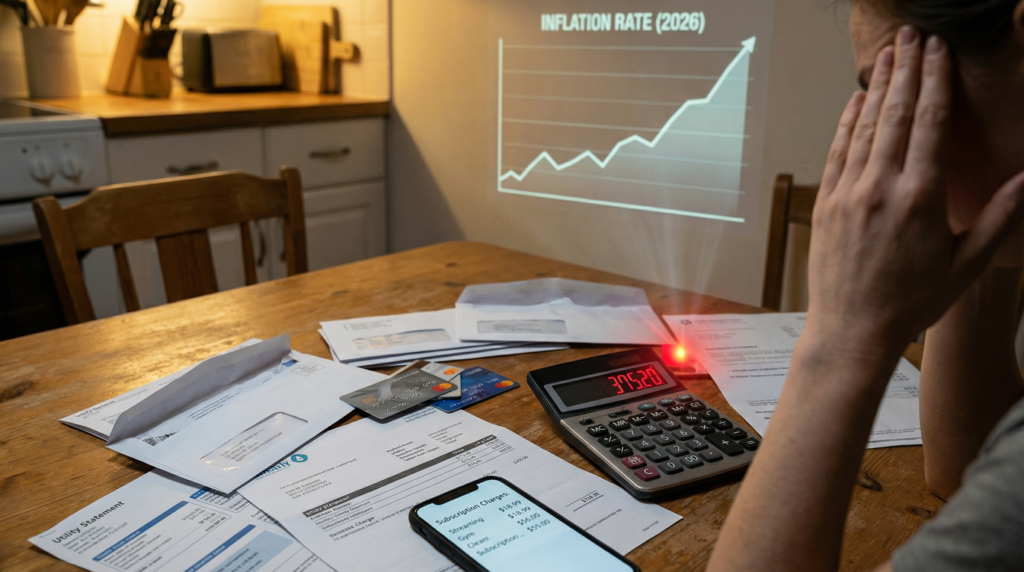
Budgeting in 2026 looks nothing like it did four years ago. Groceries are up over 20% since 2021. Rent in most metros has climbed by a third. And somewhere between your streaming services, AI subscriptions, fitness apps, and cloud storage, you’re likely losing $150–$300 a month you can’t account for.
Pay raises haven’t kept pace with any of it. The cost of living crisis isn’t just a news headline — it’s showing up in your bank statement every single month. What worked in 2022 doesn’t work anymore, and people who are still using old budgeting rules are paying the price.
What makes budgeting in 2026 uniquely difficult is the combination of persistent inflation, an explosion of micro-subscriptions, and lifestyle pressure that never existed at this scale before.
By the end of this article, you’ll know exactly whether your personal finance habits are silently working against you — and what to do about it today.
Why Budgeting in 2026 Is Completely Different
The financial landscape has shifted so dramatically that strategies your parents used — or even strategies that worked for you just three years ago — may now be actively hurting you. Budgeting in 2026 isn’t about tightening your belt. It’s about rebuilding the entire system from scratch.
Inflation Has Changed the Rules
The classic fixed-percentage budget assumed relatively stable prices. That assumption is dead.
Groceries, car insurance, utilities, and rent now carry unpredictable surges. A budget you set in January may already be broken by March. Worse, hidden cost creep — tiny recurring price hikes that arrive without a notification — chips away at budgets that aren’t reviewed regularly.
Your car insurance has been renewed 14% higher. Your grocery staples cost $30 more per week. Your gym quietly raised its monthly rate by $5. None of it felt dramatic in isolation. All of it added up to hundreds of dollars leaving your account every month without a conscious decision.
The old 50/30/20 rule assumed housing would consume roughly 25–30% of income. In high-cost cities today, rent alone eats 45–55%. The math simply doesn’t work anymore — which is exactly why budgeting in 2026 demands a different framework entirely.
The Subscription Economy Is Quietly Draining Budgets
Most people guess they spend around $80/month on subscriptions. Research consistently shows the real number is closer to $219/month — and it grows every year.
| Subscription Category | Avg. Monthly Cost | Commonly Forgotten? |
|---|---|---|
| Streaming (3–4 services) | $52 | ✅ Yes |
| AI tools (ChatGPT Plus, Copilot, etc.) | $40 | ✅ Yes |
| Fitness & wellness apps | $28 | ✅ Yes |
| Cloud storage (Google, iCloud, etc.) | $14 | ✅ Yes |
| News & magazine subscriptions | $22 | ✅ Yes |
| Software & productivity tools | $35 | ✅ Yes |
| Food delivery memberships | $28 | Sometimes |
| Total | ~$219 |
These are “invisible expenses” — auto-renewing charges that never trigger a conscious spending decision. One of the core principles of smart budgeting in 2026 is treating subscriptions as a category that needs a monthly audit, not a set-and-forget line item.
Quick subscription audit: Pull your last two bank statements and highlight every recurring charge. Cancel anything you haven’t actively used in the past 30 days. Most people recover $40–$90/month on the first pass alone.
Lifestyle Inflation Is Happening Faster Than Income Growth
Social media makes it appear that everyone is renovating their kitchen, flying business class, and upgrading their phone annually. This is lifestyle inflation — the gradual, unconscious expansion of your spending to match a curated standard of “normal.”
A 5% salary bump rarely outpaces a 10–12% lifestyle creep driven by social comparison, emotional spending, and frictionless one-click purchasing. Effective budgeting in 2026 means identifying these emotional spending triggers before they become habits.
The 7 Biggest Budgeting Mistakes Americans Are Making
These are the most common personal finance mistakes driving the gap between what people earn and what they actually keep. Each follows a clear structure: the problem, why it’s dangerous, and the fastest fix.
Mistake 1 — Not Tracking Every Dollar
Most people track big purchases but ignore the $6 app, the $11 lunch, the $14 in-app upgrade. Small untracked expenses routinely account for 15–25% of monthly overspending — one of the most persistent budgeting mistakes in 2026.
Quick fix: Use a budgeting app that auto-syncs to your bank and categorizes every transaction. Spend 10 minutes every Friday reviewing the week. Awareness alone closes the gap.
Mistake 2 — Ignoring Irregular Expenses
Annual subscriptions, car registration, dental bills, and back-to-school costs feel like surprises — but they’re entirely predictable. When a $900 car repair hits a budget that never planned for it, the result is credit card debt and a blown month.
Quick fix: List every irregular expense expected in the next 12 months. Divide the total by 12 and auto-transfer that amount monthly into a dedicated sinking fund.
Mistake 3 — Relying Only on the 50/30/20 Rule
If rent alone is eating 40–50% of your take-home pay, the 50/30/20 framework is mathematically impossible to follow. Forcing your life into a formula that doesn’t fit your reality leads to guilt, then total abandonment of the budget entirely.
Quick fix: Switch to zero-based budgeting — every dollar gets assigned based on your actual costs, not a generic percentage that made sense a decade ago.
Mistake 4 — Budgeting Without an Emergency Fund
A budget without a safety net is one medical bill away from collapse. Proper budgeting in 2026 requires a financial cushion of 4–6 months of expenses held in a high-yield savings account (HYSA) earning 4–5% APY.
Quick fix: Open a HYSA today and set up an automatic transfer of even $25–$50 per paycheck. The habit matters more than the starting amount.
Mistake 5 — Cutting Expenses Instead of Increasing Income
There’s a floor to how much you can cut. There’s no ceiling on income. Hyper-frugality triggers deprivation burnout, and budgets built entirely on restriction don’t last longer than a few months.
Quick fix: Identify one monetizable skill — freelancing, tutoring, reselling, consulting — and route that income directly toward debt payoff or savings goals. An income-first strategy is one of the most underused money-saving strategies available.
Mistake 6 — Not Adjusting the Budget Monthly
A static budget written in January doesn’t reflect March’s utility spike or August’s travel spending. Outdated budgets create a false sense of control, while overspending quietly compounds in the background.
Quick fix: Block 15 minutes at the end of each month to compare actuals vs. plan, then adjust the next month’s categories. Budgeting in 2026 is a monthly conversation with your money, not an annual document you file away.
Mistake 7 — Avoiding Financial Automation
Willpower-based budgeting fails. Humans are inconsistent; automated systems are not. Money that sits in a checking account gets spent — that’s behavioral economics, not a personal flaw.
Quick fix: Automate savings transfers, bill payments, and investment contributions to trigger on payday. Remove the decision entirely and let the system do the work.
Signs You’re Budgeting the Wrong Way — Quick Self-Assessment
Score yourself 1 point for every honest “yes.”
- Are you still living paycheck to paycheck despite having a budget?
- Do you reach for a credit card in the last week before payday?
- Does money cause significant anxiety every single month?
- Is your savings balance about the same as it was 6 months ago?
- Have your total subscription costs crept up year over year without you noticing?
Your score:
- 4–5: Your approach to budgeting in 2026 needs a full reset — start with the 30-day plan below
- 2–3: Targeted fixes will make a significant difference fast
- 0–1: You’re ahead of most — keep refining the details
The Right Way to Budget in 2026 — A Modern Framework
Budgeting in 2026 must be flexible, automated, and growth-focused. Rigid rules and willpower-dependent systems belong to a different decade. Here are four modern approaches that actually work:
Zero-Based Budgeting (Reimagined)
Every dollar gets a job before the month begins. Income minus all assignments — bills, savings, investing, discretionary spending — equals zero. Not because you spent everything, but because nothing is left unaccounted for. This is the single most effective method for eliminating “money leakage,” the quiet drain that sinks most budgets before the month even ends.
Inflation-Proof Budget Model
Build in flexible category caps on volatile spending areas like groceries, gas, and utilities — categories where prices can swing 5–15% month to month. Run a quarterly review to recalibrate every category against current real-world costs. A budget that doesn’t adjust for inflation is a budget that’s quietly losing ground every single month.
The “Save First” Automation Strategy
Flip the traditional sequence entirely. Instead of spending first and saving whatever’s left (usually nothing), automate savings and investments to transfer on payday. What remains in checking becomes your actual spending budget. Combined with retirement contributions and brokerage auto-investments, this approach builds wealth passively — the defining smart spending habit of people who are winning financially right now.
Values-Based Budgeting
Ruthlessly cut spending on things that don’t meaningfully improve your life. Spend generously and guilt-free on things that genuinely do. When your budget reflects your real priorities — not social pressure or old habits — it stops feeling like a restriction and starts functioning as a tool. This is the mindset shift that makes budgeting in 2026 sustainable long-term.
Case Study: How Marcus Reset His Budget in 30 Days
Marcus, a 34-year-old teacher in Austin earning $58,000/year, felt constantly broke despite claiming to follow a budget. He’s not unusual — this describes millions of Americans trying to apply outdated personal finance rules to 2026 costs.
His month-1 audit revealed: $214/month in forgotten subscriptions, $340 in untracked dining out, and zero emergency fund. He had no sinking fund despite driving an 8-year-old car.
Over 30 days of applying the budgeting in the 2026 framework:
- Cancelled 6 subscriptions → $147/month recovered
- Built a $500 starter emergency fund
- Set up a $100/month sinking fund for car expenses
- Automated a $150/month transfer to a HYSA
Result: He stopped using his credit card as a month-end bridge by month 2. By month 4, he had $1,800 saved — more than at any point in the previous three years.
The plan wasn’t complicated. It was just built for the world he was actually living in.
How to Reset Your Budget in 30 Days — Step-by-Step Plan
| Week | Focus | Key Actions |
|---|---|---|
| Week 1 | Audit the past 90 days | Pull bank statements, identify spending leaks, and complete subscription audit |
| Week 2 | Rebuild categories | Separate needs vs. wants, set emergency fund target, create sinking funds |
| Week 3 | Automate everything | Set auto-savings transfers, auto-invest contributions, and align bills with paydays |
| Week 4 | Stress test the plan | Model a 10% income drop, model a 10% expense increase, and identify weak points |
Week 4 isn’t about pessimism — it’s about resilience. A budget that only survives perfect conditions isn’t a real budget. The most important feature of budgeting in 2026 is the ability to flex without breaking.
Best Budgeting Tools for 2026
| Tool Type | Best For | Top Options |
|---|---|---|
| AI-powered budgeting apps | Automated categorization & real-time insights | YNAB, Monarch, Copilot Money |
| Cash flow forecasting | Predicting shortfalls before they hit | Tiller Money, Simplifi |
| Subscription trackers | Finding and cancelling invisible expenses | Rocket Money, Trim |
| Net worth tracking | Seeing the full financial picture monthly | Empower (formerly Personal Capital) |
| Spreadsheets | Total customization and manual control | Google Sheets budget templates |
The best financial planning tool is always the one you’ll consistently use. If you’ve tried apps and quit, try a spreadsheet. If spreadsheets feel overwhelming, use an app. The format matters far less than the habit.
The Psychology Behind Why Budgets Fail
Most budgets don’t fail because of math. They fail because of behavior, and understanding this is central to successful budgeting in 2026.
Emotional spending triggers are the biggest culprit:
- Stress spending: “I deserve this after the week I’ve had.”
- Reward spending: “I hit my goal, time to celebrate.”
- Fear-based saving: Hoarding cash anxiously without a clear plan, which ironically prevents wealth-building
The “All or Nothing” trap is equally destructive. One overspent week triggers the thought: “I already blew it, so why bother?” — and the budget collapses entirely. Perfection is the enemy of consistency. A budget followed at 80% is infinitely more valuable than one abandoned at 100%.
Building sustainable money habits requires three things:
- Habit stacking — attaching money check-ins to an existing routine (Sunday morning coffee + 10-minute budget review)
- Weekly money check-ins — short enough to stay consistent, regular enough to catch problems early
- Financial accountability — a partner, an online community, or even a public savings goal
What Smart Budgeters Are Doing Differently in 2026
The people winning financially right now aren’t just cutting lattes. They’ve rebuilt their entire relationship with money around what budgeting in 2026 actually requires:
- Growing income, not just cutting costs — side income, freelance projects, skills-based consulting, running alongside a day job
- Investing while budgeting — even $50/month into a low-cost index fund compounds meaningfully over a decade
- Tracking net worth monthly — because the number that actually matters isn’t what you spend, it’s what you keep and grow
- Reviewing spending quarterly — not obsessively, but strategically, to catch drift before it becomes damage
- Optimizing credit card rewards — using cards as cashback or travel point tools, always paid in full, never as a bridge loan
This is the aspirational standard of budgeting in 2026 — not restriction, but deliberate financial architecture that grows with you.
Final Reality Check — Are You Budgeting Wrong?
Here’s the honest truth: most Americans aren’t bad with money. They’re using outdated systems in a world that has fundamentally changed around them.
The cost of living crisis isn’t going away. Subscriptions will keep multiplying. Lifestyle inflation will keep accelerating. And your income — however hard-earned — will keep disappearing unless your approach to budgeting in 2026 accounts for the actual world you’re living in today, not the one from four years ago.
Every mistake in this article is fixable. Most can be corrected within 30 days with a handful of deliberate decisions and the right system in place.
So here’s your challenge:
🔴 Open your bank app right now and check your last 7 days of spending. If even one category surprises you — that’s exactly where to start.
The reset begins with one honest look. And that look takes about 60 seconds.
Personal finance is individual — this article reflects general guidance and should not replace advice from a certified financial planner.
FAQs
Q. Why are so many Americans budgeting wrong in 2026?
- Because inflation, rising fixed costs, and subscription spending have changed cash flow patterns. Many people still use outdated budgeting frameworks that don’t adjust for economic shifts.
Q. Is the 50/30/20 rule outdated in 2026?
- Not entirely — but it doesn’t work for everyone. In high-cost cities or lower-income households, fixed percentages can create unrealistic expectations. A flexible or zero-based approach often works better.
Q. How much should I have in an emergency fund in 2026?
- Most financial planners recommend 3–6 months of essential expenses. However, in uncertain economic conditions, aiming for 6–9 months can provide stronger financial resilience.
Q. What is the biggest budgeting mistake people make?
- Failing to track irregular expenses and subscriptions. Small recurring charges often cause significant long-term financial leaks.
Q. How can I quickly reset my budget?
- Audit your last 90 days of spending, cancel unused subscriptions, automate savings first, and switch to a flexible budgeting model that adjusts monthly.

Owner of Paisewaise
I’m a friendly finance expert who helps people manage money wisely. I explain budgeting, earning, and investing in a clear, easy-to-understand way.