

Introduction: What AI Notices About Your Spending That You Don’t
You bought coffee three times this week. AI thinks it’s a subscription.
That’s not a joke — it’s exactly how modern AI spending analysis works. When you tap your card at the same café on Monday, Wednesday, and Friday, a pattern-recognition engine doesn’t see three independent choices. It sees a behavioral loop. It timestamps the purchases, notes the merchant category code, flags the regularity, and quietly files it under “recurring behavior.”
You saw caffeine. The algorithm saw a habit worth $47 a month.
This is the fundamental gap between how humans process spending and how machines do. We experience money emotionally — in moments, in moods, in “I deserved that.” AI doesn’t judge. It detects. And what it detects is often something we’ve been walking past for months without noticing.
How AI Reads Your Transactions
Before getting into what AI spots, it helps to understand how it actually reads your financial data.
When you connect a bank account to tools like Rocket Money, Copilot, or YNAB, the system pulls raw transaction data through aggregators like Plaid, which uses read-only, bank-level, encrypted access to your account. It doesn’t store your credentials — it tokenizes the connection. Your data is anonymized at the processing layer before pattern modeling begins.
From there, AI spending analysis runs several simultaneous processes:
- Transaction categorization — Merchant codes and spending descriptions are matched against trained classification models. “SQ *LOCAL ROAST” becomes “Coffee & Café.”
- Merchant recognition — The system maps vendor names, even messy ones, to known merchant profiles.
- Recurring payment detection — Amounts that repeat within predictable windows (7-day, 14-day, 30-day) get flagged as subscriptions or bills.
- Timestamp clustering — Purchases grouped by time of day or day of week reveal behavioral rhythms.
- Location tagging — Geo-tagged transactions help identify commute-based spending vs. travel anomalies.
The machine isn’t smarter than you. It’s just tireless. It processes every transaction with equal attention, every single day.
5 Spending Patterns AI Notices That You Probably Don’t
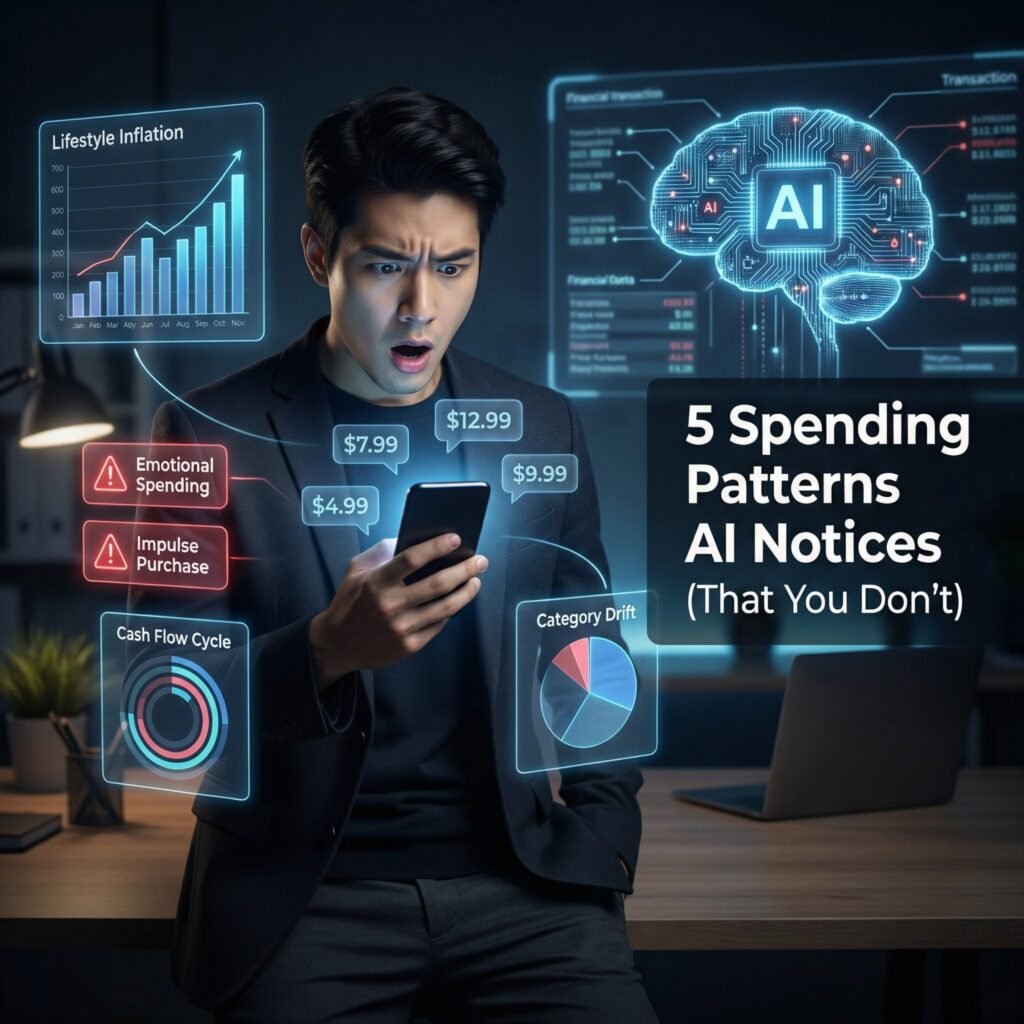
1. Micro-Leaks: The $7.99 Problem
These are the budget killers that never feel like budget killers.
| Subscription | Monthly Cost | Annual Cost |
|---|---|---|
| Forgotten streaming app | $7.99 | $95.88 |
| Unused app premium tier | $4.99 | $59.88 |
| Free trial gone paid | $12.99 | $155.88 |
| Cloud storage upgrade | $2.99 | $35.88 |
| Total | $28.96 | $347.52 |
Individually, each line item feels trivial. Together, they’re a car payment. AI spending analysis catches these because it tracks recurring amounts across rolling 30 and 90-day windows. You glance at your bank statement once a month. The algorithm watches it daily.
2. Lifestyle Inflation Signals
This one is sneaky because it happens gradually.
Six months ago, you spent $280/month at grocery stores. Today, you’re spending $190 on groceries and $140 at restaurants. The total food spend is actually up, but because it shifted categories slowly, you never felt the change.
AI notices the drift. It tracks not just how much you spend in a category, but how the proportions between categories shift over time. A gradual ride-share spend increase from $30 to $85 monthly over four months registers as a lifestyle inflation signal, even if no single month felt unusual.
3. Emotional Spending Triggers
Here’s what the algorithm saw at 11:43 PM on a Tuesday: three purchases — a fast-fashion add-to-cart, a food delivery order, and a streaming rental.
You probably don’t remember that night specifically. The AI does.
Timestamp clustering identifies emotional spending windows — late-night purchases, post-payday splurges in the 48 hours after a deposit clears, and weekend spikes that don’t align with your typical weekly patterns. This isn’t the AI judging your stress shopping. It’s identifying a pattern that correlates with specific time-based triggers, which you can then choose to act on.
4. Inconsistent Cash Flow Cycles
If you’re a freelancer, contractor, or anyone with variable income, AI spending analysis is particularly useful — and revealing.
The system tracks when deposits arrive, then maps spending behavior around those timestamps. A common pattern it catches: spending acceleration before income arrives. You’re buying on credit float in the last week of the month, then paying it down when the check clears. You feel fine. The AI sees a timing mismatch that, if the deposit ever came late, would create a shortfall.
5. Category Drift
Distinct from lifestyle inflation, category drift is when spending migrates between categories without a conscious decision.
Your “Health & Fitness” category last year included a gym membership. Now it includes the gym membership, three wellness apps, a supplement subscription, and a meditation platform. The category didn’t just grow — it sprawled. AI spending analysis maps this sprawl and can show you exactly when each new item entered the category and what the cumulative cost trajectory looks like.
How AI Detects Future Risk Before You Do
This is where AI spending analysis shifts from descriptive to predictive.
- Subscription Overload Forecasting — By tracking the cadence of your subscription additions over time, AI can project what your total recurring monthly spend will look like in 60–90 days if the current rate continues.
- Upcoming Bill Prediction — Tools analyze historical transaction patterns to forecast irregular bills you might forget — annual software renewals, quarterly insurance payments, semi-annual subscriptions. These get surfaced as alerts before the charge lands.
- Seasonal Expense Recognition — The algorithm notices that every November, your spending in “Travel” and “Gifts” spikes by 40%. It remembers that even when you don’t. Some tools will proactively flag the approaching season and the expected budget impact based on prior years.
| Risk Type | How AI Catches It | Typical Window |
|---|---|---|
| Forgotten annual subscription | Recurring amount + 365-day interval match | 2–4 weeks before renewal |
| Holiday spending surge | Year-over-year category spike | 6–8 weeks before the season |
| Income timing gap | Deposit delay vs. spend acceleration | Real-time/rolling 7-day |
| Subscription creep | New recurring amounts added over 90 days | Monthly summary |
AI vs. Human Budgeting: Why We Miss What Machines Catch
Why Humans Miss Patterns
Our brains are not built for financial pattern recognition across hundreds of transactions. Three specific cognitive biases explain most of the gap:
- Present bias — We weigh today’s purchase more heavily than its long-term cumulative cost. The $4.99 app feels like nothing right now.
- Optimism bias — We consistently underestimate future expenses and overestimate future income. Next month will be better.
- Mental accounting — We treat money in separate mental “buckets” that don’t communicate. Dining out feels different from groceries, even when both come from the same account.
Why AI Doesn’t
AI spending analysis operates without any of these filters:
- No emotional framing — a transaction is a data point, not a memory
- Pure pattern recognition across the full transaction history
- Historical trend modeling that compares current behavior to baseline periods without ego or nostalgia
The machine doesn’t tell you that the spending was bad. It tells you the spending happened, this often, in this amount, at this time. What you do with that is yours.
What AI Gets Wrong About Your Spending
Credibility requires honesty: AI spending analysis makes mistakes, and knowing the common ones helps you interpret results better.
- Mis-categorization is the most frequent error. A hardware store purchase for a home repair gets filed under “Home Improvement,” but a hardware store run for a work project should be a business expense. The AI doesn’t know the difference unless you tell it.
- One-off purchases treated as patterns — Buy a $200 item once, and some systems flag it as a spending trend. It was your friend’s birthday. Context matters, and machines lack it.
- Shared household expenses create noise. If two people use one account, the AI is analyzing a composite spending persona that doesn’t represent either person accurately.
- Cash transactions are invisible. If you spend $60 cash at a farmer’s market every week, that’s a real, meaningful budget line that AI spending analysis cannot see. This creates a systematically incomplete picture for cash-heavy spenders.
Privacy: What Happens to Your Financial Data?
This is a fair and important question. Here’s how the reputable systems work:
- Read-only access — Aggregators like Plaid connect to your bank with credentials that allow transaction data to be read but not moved or modified.
- Bank-level encryption — Data in transit is encrypted using the same standards banks use for their own systems (TLS, AES-256).
- Data anonymization — Reputable platforms strip personally identifiable information before running pattern models on transaction data.
- Token-based authentication — Your actual bank login credentials are never stored by the app; a secure token is used instead.
You should always review the privacy policy of any tool you use, specifically looking for whether data is sold to third parties for marketing. Reputable personal finance tools are explicit that they do not sell transaction-level data.
Real-World Examples
Case 1: The Forgotten Subscriptions User A 34-year-old marketing manager connected her accounts to a budgeting app, expecting to find one or two forgotten subscriptions. The AI spending analysis surfaced eleven recurring charges she couldn’t immediately identify — totaling $94.87/month. Six were services she’d stopped using. Canceling them recovered over $1,100 annually.
Case 2: The Weekend Overspender A freelance designer noticed through his app’s weekly summary that 68% of his non-essential spending happened between Friday evening and Sunday afternoon. The AI had flagged a consistent post-work spending spike. He hadn’t consciously noticed the pattern — he’d just felt “broke by Wednesday” without understanding why.
Case 3: The Income Timing Mismatch A contractor with net-30 client payments was consistently spending into negative cash flow territory in weeks 3–4 of the month. The AI flagged a recurring low-balance window that correlated with spending acceleration before deposits cleared. With that pattern visible, she restructured her payment reminders to clients and shifted discretionary spending to the first two weeks of the month.
How to Use AI Insights Without Letting AI Control Your Money
AI spending analysis is a lens, not a decision-maker. The goal is informed autonomy — you stay in control, with better information.
- Use alerts, not automation — Let AI flag unusual charges or pattern shifts; don’t let it auto-cancel subscriptions or move money without your explicit approval.
- Review monthly pattern summaries — A 10-minute monthly review of category trends is more valuable than checking balances daily.
- Compare quarter over quarter — Monthly data has noise. Quarterly comparisons reveal meaningful trend lines.
- Combine AI insights with personal goals — The algorithm doesn’t know you’re saving for a house or that the expensive gym membership is genuinely improving your mental health. You do. AI informs the conversation; your values drive the decisions.
FAQs
Q. How accurate is AI spending analysis?
- For digital transactions, accuracy in categorization typically ranges from 85–95% on major platforms, with user corrections improving performance over time. Cash transactions remain a blind spot.
Q. Is AI budgeting safe?
- Reputable tools use read-only access, bank-level encryption, and token-based authentication. Your credentials are not stored by the app.
Q. Can AI predict my bills?
- Yes — for recurring and semi-recurring expenses, AI can forecast upcoming charges based on historical patterns, often surfacing them 2–4 weeks in advance.
Q. Does AI replace budgeting apps?
- No — AI is increasingly embedded within budgeting apps, enhancing them. It’s the engine inside the tool, not a separate category.
Q. How does AI detect subscriptions?
- By identifying transaction amounts that repeat within consistent time windows (weekly, monthly, annually) from the same merchant or merchant category code.
Q. What spending patterns does AI catch that humans miss?
- Micro-leaks (small recurring charges), category drift, emotional spending windows, lifestyle inflation signals, and income timing mismatches are the most commonly overlooked patterns that AI spending analysis surfaces reliably.
The machine noticed something you missed. That’s not a threat to your financial autonomy — it’s a tool for it. The spending patterns are already there. AI just turns on the lights.

Owner of Paisewaise
I’m a friendly finance expert who helps people manage money wisely. I explain budgeting, earning, and investing in a clear, easy-to-understand way.
Pretty! This has been a really wonderful post. Many thanks for providing these details.