
Tata AIA Life Insurance Plans in India: Types, Benefits and How to Choose (2027)

Imagine you are the only earning member in your family. Your home loan, your children’s school fees, and your parents’ medical needs all depend on your monthly income. What happens to all of this if that income suddenly stops?
This is the question life insurance tries to answer. If you are exploring Tata AIA life insurance, you probably have a few more questions. Which plan is right for me? What is the difference between term, savings, and ULIP plans? How much will it cost, and what are the risks?
This guide explains the main types of Tata AIA plans in simple language. You will also learn what to check before buying and which mistakes to avoid. You do not need any insurance knowledge to follow it.
What Is Tata AIA Life Insurance?
Tata AIA Life Insurance Company Limited is a life insurer in India. Its plans fall into several broad groups: term plans, savings plans, ULIPs (unit-linked insurance plans), retirement or pension plans, and health plans. It also offers optional add-ons called riders.
You do not need every type. Each one solves a different problem, so the first step is understanding what you actually need.
Simple terms you will see in this article:
- Sum assured: the amount your family receives if the insured person passes away during the policy term.
- Premium: the amount you pay (monthly, yearly, or otherwise) to keep the policy active.
- Policy term: the number of years the policy runs.
- Rider: an optional extra benefit, usually for an additional premium.
Why Do Families Buy Life Insurance?
Most people buy life insurance for one of these reasons:
- To protect their family’s income if they are no longer around.
- To make sure loans and EMIs do not become the family’s burden.
- To build a savings fund for goals like a child’s education or marriage.
- To plan a regular income after retirement.
Notice that these are different goals. A plan built for protection is not the same as a plan built for savings. Mixing them up is one of the most common beginner mistakes.
Before you buy any policy, it also helps to know where your money goes every month. Our guide on how to create a budget step by step is a good place to start, and the 50/30/20 rule explained can help you decide how much of your income can safely go towards premiums.
Types of Tata AIA Life Insurance Plans
1. Tata AIA Term Insurance
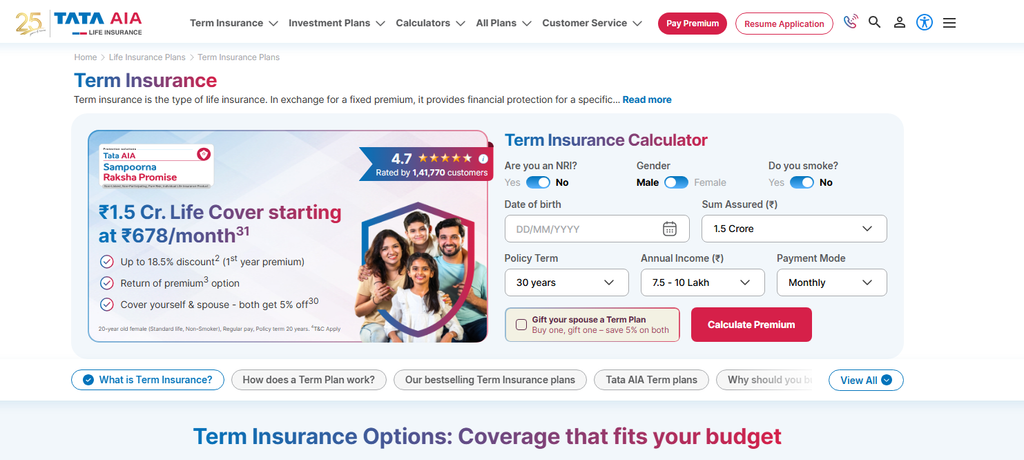
Term insurance is the simplest form of life insurance. You pay a premium for a fixed period. If the insured person passes away during that period, the family receives the sum assured. It is pure protection, so there is no savings or investment element in a standard term plan.
Tata AIA term insurance plans listed on its website include Sampoorna Raksha Promise, Maha Raksha Supreme Select and Shubh Shakti (a plan the company describes as exclusively for women). Tata AIA also lists a term plan with a return of premium option, where premiums paid may be refunded if you survive the policy term, subject to the policy terms. Plans with a return-of-premium option generally cost more than a pure term plan.
Who may consider it: salaried employees, parents, and anyone with loans or dependents.
2. Term Plans with Market-Linked Returns (Term + Wealth)
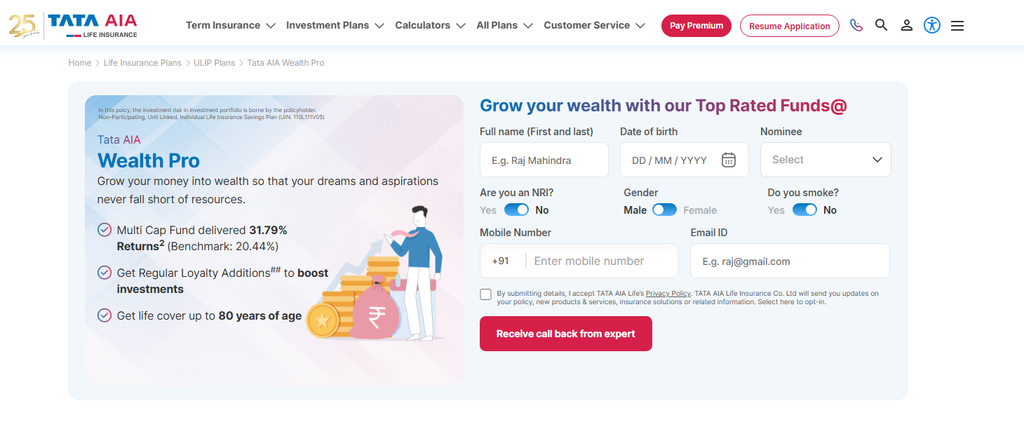
Tata AIA also lists plans that combine life cover with an opportunity to grow wealth, such as Param Raksha Life Pro +, Param Raksha Life Pro, Param Raksha Life Maxima + and Shubh Invest Protect. The wealth part is market-linked, which means returns are not guaranteed, and your money can go up or down.
Who may consider it: people who want life cover and are comfortable with market risk.
3. Tata AIA Savings Plans
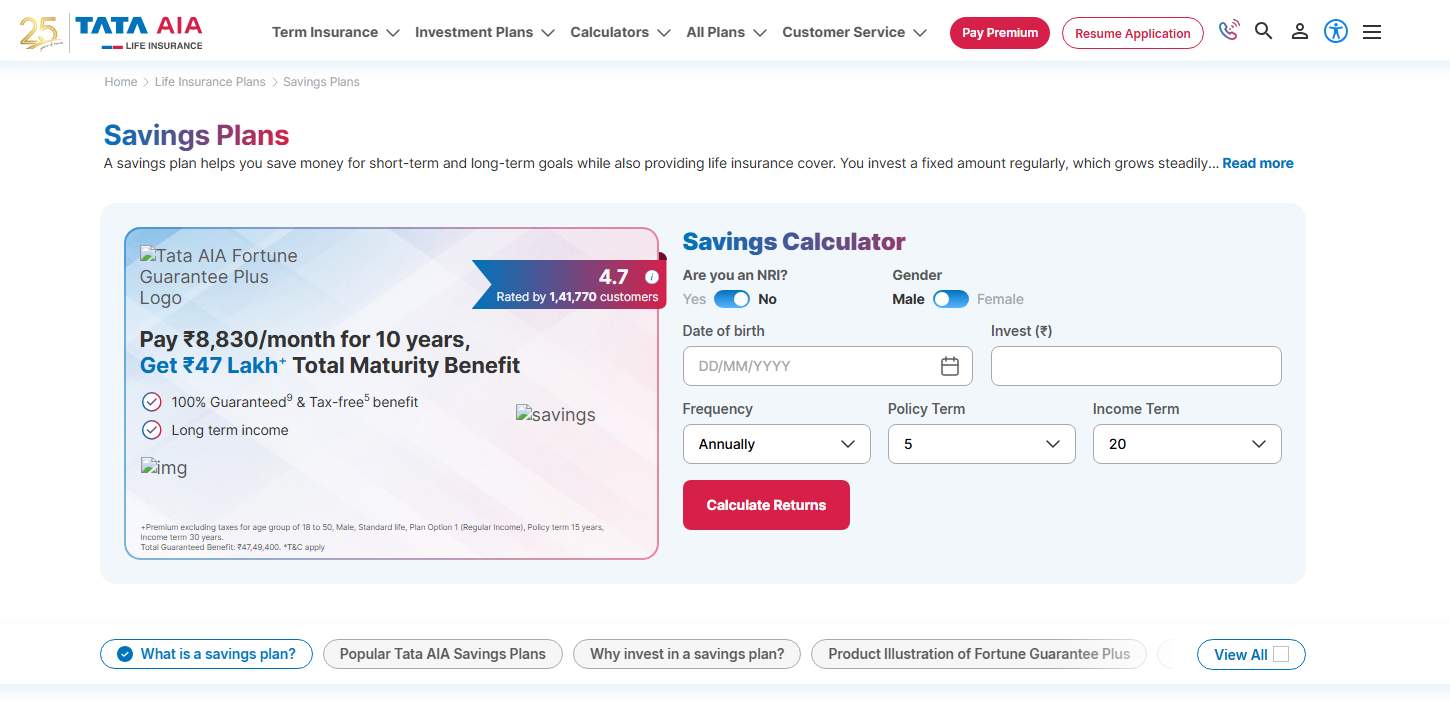
Savings plans combine life cover with a way to save over time. According to Tata AIA, its savings plans offer protection along with long-term savings. Plans in this category include Fortune Guarantee Plus, Shubh Flexi Income Plan, Smart Value Income Plan and Fortune Guarantee Secure.
Some savings plans offer guaranteed benefits, while others may include non-guaranteed bonuses. The two are not the same. Always check the official benefit illustration to see exactly which part of the payout is guaranteed. To understand why saving for the long term works, read how compound interest works. You may also want to see gold vs FDs vs mutual funds to compare where else your savings could go.
Who may consider it: people with a long-term goal, like a child’s education, who prefer lower market risk.
4. Tata AIA ULIPs (Unit-Linked Insurance Plans)

A ULIP combines life cover with investment in market-linked funds. Part of your premium pays for the insurance, and the rest is invested. Tata AIA lists ULIPs such as Smart SIP, Premier SIP, Shubh SIP, Smart Fortune Plus, Fortune Pro and Smart Sampoorna Raksha Supreme.
According to the Tata AIA website, ULIP plans carry a five-year lock-in period. The final value depends on fund performance, and past performance does not guarantee future returns. ULIPs may suit those with a long investment horizon and some comfort with risk. If you are new to market-linked investing, our beginner guide on how to start investing in mutual funds explains the basics.
5. Tata AIA Retirement and Pension Plans
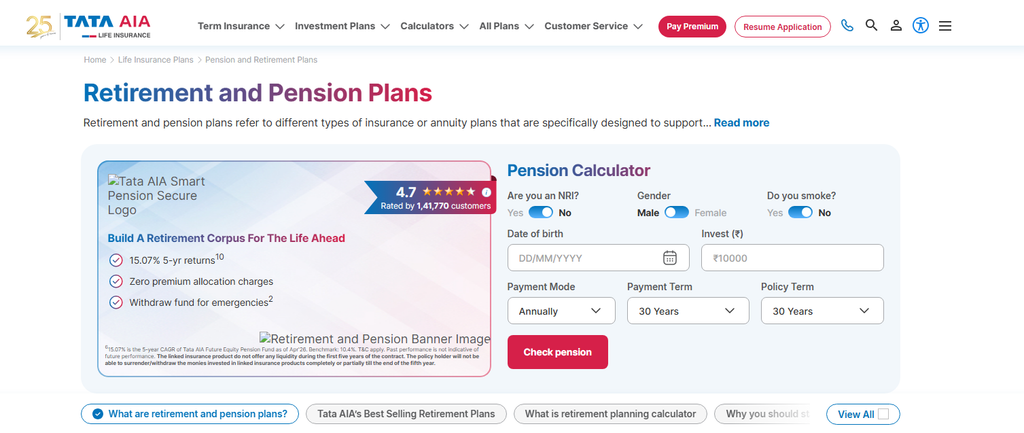
These plans help you plan a regular income for your retirement years. The Tata AIA website lists Smart Pension Secure, Fortune Guarantee Pension, Saral Pension Plan, and Shubh Flexi Pension. Tata AIA says its retirement plans offer options such as immediate and deferred annuities. In a deferred annuity, you receive regular income after a fixed waiting period.
Who may consider it: people in their 30s to 50s who want a steady post-retirement income. For the bigger picture, see our guide on how to save for retirement.
6. Health Plans and Riders
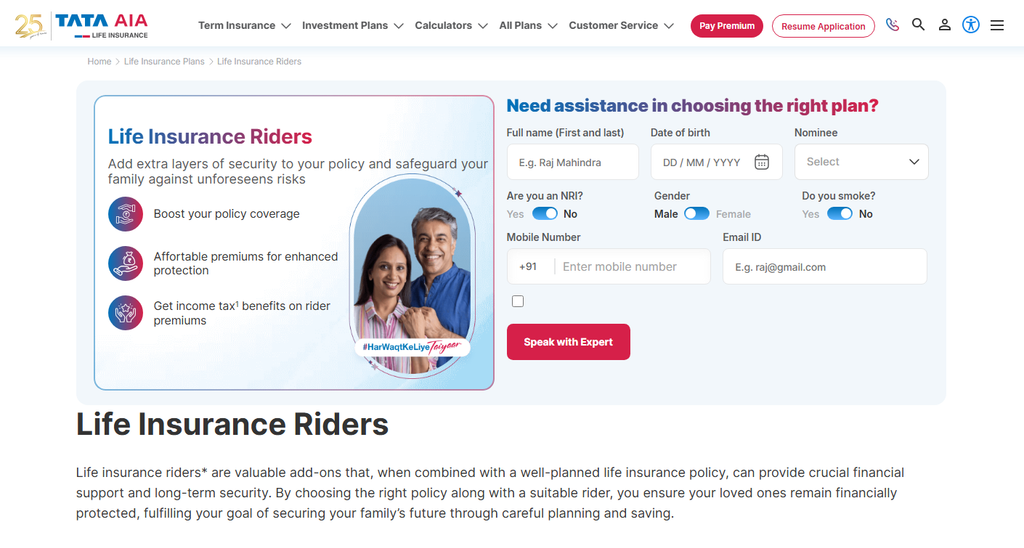
Tata AIA also lists health-related plans, such as Sampoorna Care – Cancer, Pro-Fit and Health Buddy. Separately, you can add riders to some life policies. Examples on the official site include Vitality Protect, Vitality Health and a Comprehensive Protection Rider. Riders usually cost extra and come with their own conditions.
Do not treat a life insurance rider as a replacement for a full health insurance policy. They cover different things.
Tata AIA Policy Benefits: What You May Get
For example, Tata AIA says Sampoorna Raksha Promise lets you choose from four death benefit options. Please read the brochure carefully to understand each one.
Benefits differ from plan to plan. In general, life insurance plans may offer:
- Death benefit: a payout to the nominee if the insured passes away during the policy term (subject to policy terms).
- Maturity or survival benefit: available in savings, ULIP, and similar plans, but not in a pure term plan.
- Flexibility: many plans let you choose the policy term, premium payment term, and payout options.
- Optional riders: extra protection for accidents or illness, for an additional premium.
- Possible tax benefits: tax rules change and depend on your situation, so please check with a qualified tax professional. You can also read PPF vs ELSS for tax saving and how to file ITR for salaried employees for general background.
A Simple Example (Hypothetical)
This example is for explanation only. Actual premiums and benefits depend on age, health, lifestyle, plan, and underwriting.
Rohan is 30, works in a private company, and has a wife, a young child, and a home loan. His family depends fully on his salary.
Rohan thinks about three questions:
- If something happens to me, can my family repay the loan and meet daily expenses?
- For how many years will my family depend on my income?
- How much can I comfortably pay as a premium every year without stress?
If his main worry is protection, a term plan may be a natural starting point because its purpose is simple: a large cover for his family. If he also wants to save for his child’s education, he might separately look at a savings plan or ULIP. The key point is that Rohan decides his goal first and then picks the product, not the other way around.
How to Choose the Right Tata AIA Life Insurance Plan
Step 1: Know Your Goal
Protection, savings, wealth creation, or retirement income? Choose one main goal first.
Step 2: Decide How Much Cover You Need
A common way to think about it is: how many years of expenses and how many loans should your family be able to cover? Remember that costs rise over time, so coverage that looks enough today may fall short later. Our explainer on what is inflation shows why. Tata AIA also offers a Human Life Value Calculator on its website that can help you estimate this.
Step 3: Check Your Budget
Choose a premium you can pay for the entire premium payment term. If you stop paying, the policy may lapse or lose benefits, depending on the plan. A clear monthly budget makes this easier, so revisit how to create a budget step by step if you are unsure.
Step 4: Understand the Risk
Term plans are pure protection. ULIPs are market-linked. Savings plans may have both guaranteed and non-guaranteed parts. Never assume returns are guaranteed unless the policy document says so.
Step 5: Read the Fine Print
Check exclusions, waiting periods, surrender conditions, and claim documents before you pay.
Estimating Your Premium: Tata AIA Premium Calculator
Tata AIA provides online calculators for term insurance, ULIP, savings, and retirement planning on its website. You can use the Tata AIA term insurance calculator to get an idea of the cost.
Your premium generally depends on:
- Your age at entry
- Sum assured and policy term
- Smoking and health status
- The plan type and riders you choose
- How often you pay (monthly, yearly, and so on)
An online estimate is not a final quote. The final premium depends on the insurer’s underwriting.
Important Things to Check Before Buying
- Premium affordability: can you pay it for the full term without trouble?
- Policy term: does the cover last until your major responsibilities end?
- Sum assured: is it enough for your family’s needs?
- Exclusions: some plans do not pay in certain situations. For example, many plans have a suicide exclusion in the early years, so read the policy wording.
- Waiting periods: certain benefits, especially in health-related add-ons, may start only after a waiting period.
- Surrender and lock-in: exiting early can mean lower payouts, and ULIPs have a lock-in period.
- Claim process: know what documents your family will need. Tata AIA publishes its process on its claims page.
- Emergency fund first: do not stretch your budget so far that one surprise bill makes you miss a premium. Learn what emergency funds are and compare a 3-month vs 6-month emergency fund.
- Nominee details: keep nominee information updated.
- Honest disclosure: always disclose your health and habits truthfully. Wrong information can create problems at claim time.
Common Mistakes First-Time Buyers Make
- Buying only for tax savings. Protection should come first.
- Mixing insurance and investment without understanding both.
- Buying too little cover. This matters even more if you carry loans. See why most people never get out of debt.
- Hiding medical history.
- Not reading the brochure and policy wording.
- Ignoring the claim settlement information. You can read what Tata AIA publishes on its claim settlement page, and compare it with other insurers’ official disclosures.
Is Tata AIA Life Insurance Right for You?
It depends on your goals, budget, and comfort with risk. No single plan suits everyone. A young parent, a self-employed professional, and someone nearing retirement all need different things.
It is also smart to compare plans from different insurers using their official brochures. That is how you make a confident decision. For more general money basics, browse our personal finance tips.
Final Thoughts
Life insurance is not about buying a product. It is about making sure the people who depend on you stay financially safe. If you are looking at Tata AIA life insurance, start with your goal, pick a sum assured that makes sense, understand the risks, and read every document before paying.
Choosing life insurance is an important financial decision. Before selecting a policy, understand your family’s requirements, your budget, and the benefits offered by different plans. If you would like help understanding Tata AIA Life Insurance options, feel free to get in touch with me.
Frequently Asked Questions
What is Tata AIA life insurance?
Tata AIA Life Insurance Company Limited is an Indian life insurer offering term, savings, ULIP, retirement, and health plans. Each type serves a different need, such as protection, long-term savings, or retirement income. Always read the brochure of a specific plan to understand its exact features, benefits, and conditions.
Which Tata AIA plan is best for family protection?
For pure protection, people often start with a term plan, because its main purpose is to provide life cover for the family. No plan is best for everyone, though. The right choice depends on your income, loans, dependents, and budget, so compare options and read the policy documents carefully.
What is the difference between term insurance and a savings plan?
A term plan gives life cover for a fixed period and generally has no maturity benefit, unless it has a return-of-premium option. A savings plan combines life cover with a savings component and may offer maturity benefits. Savings plans usually cost more for the same life cover.
Are ULIP returns guaranteed?
No. ULIP returns depend on how the chosen funds perform, so the value can rise or fall. According to Tata AIA, ULIPs come with a five-year lock-in period. Past performance does not promise future results, so consider your risk comfort and time horizon before choosing one.
How can I check the Tata AIA premium?
You can use the premium calculators on the official Tata AIA website, such as the term insurance calculator. The result is an estimate based on details like age, cover, and policy term. The final premium is decided after the insurer completes its underwriting process.
Can I add riders to a Tata AIA policy?
Many Tata AIA plans allow optional riders, such as Vitality Protect or a Comprehensive Protection Rider, usually for an additional premium. Availability and conditions differ by plan, so check which riders are allowed and what they cover before adding them to your policy.
Does life insurance always pay the claim?
A claim is paid when it meets the policy terms. Claims can be rejected if the policy has lapsed, information was hidden, or the death falls under an exclusion. That is why honest disclosure, timely premium payment, and reading the policy wording are so important.
Abhishek Kandir is the founder and lead writer at Paisewaise, a personal
finance publication covering Indian markets, budgeting, and investing since 2023.
Abhishek’s work focuses on making complex financial topics — from RBI
Interventions to SIP strategies — understandable for everyday Indian readers
without a financial background.