
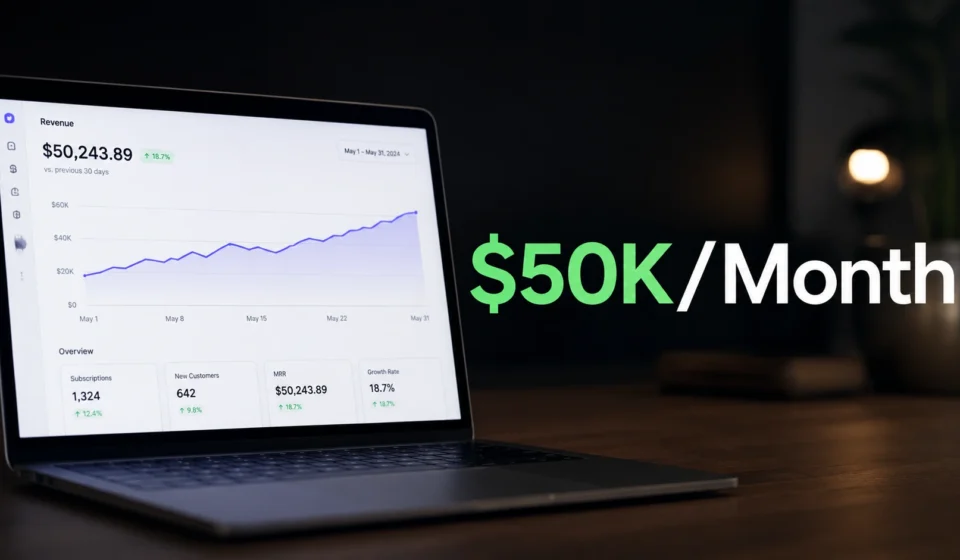
Everyone says every good business idea is already taken. David didn’t buy it.
Instead of chasing something new, he looked at a booming $1B SaaS category and built a scrappy, smaller version of it. A few months later, his bootstrapped company was pulling in $50K/Month.
Here’s exactly how he did it — and why “copy, don’t invent” might be the smartest strategy for indie founders in 2026.
Key Takeaways
- You don’t need a new idea — you need a proven, growing market and a way to niche down inside it
- Study competitors’ reviews, complaints, and support requests to find your differentiation
- Owning just 1% of a massive market (like a $1B SaaS space) can be life-changing revenue
- Building in public (especially on X) can drive explosive, cost-free growth
- Paid-only models (no free tier) can work well for bootstrapped, resource-constrained teams
- Speed beats perfection — ship early, fix fast, and improve based on real user feedback
- Non-technical founders can build serious tech products by leaning on AI tools and lean teams
The Business: Shipper, an AI App Builder
David and his brother Daniel built Shipper, an AI-powered app builder. You describe what you want, and it builds a working app for you — websites, web apps, mobile apps, Chrome extensions, even bots for Discord and Telegram.
They’re both non-technical. Neither of them codes. Yet they built a serious competitor in a space where established players are already valued in the billions.
The Numbers
| Metric | Value |
|---|---|
| Monthly Recurring Revenue (MRR) | $25.6K |
| Gross Monthly Volume | $50K–71K |
| Annual Run Rate (ARR) | $307K |
| Paid Users | ~690 |
| Free Users | 0 |
| Cheapest Plan | $25/month |
Yes — zero free users. Every single customer pays. That’s a deliberate choice, not an accident.
Why Copy a $1B SaaS Instead of Inventing Something New?
In mid-2025, David watched the no-code and AI app-builder space explode. Two examples stood out to him:
- A competitor reportedly reached $3 million ARR within six months
- Another hit $1 million ARR in its first week and is now valued in the billions
David’s logic was simple: if the category is a $1B SaaS opportunity, you don’t need to own the whole market. Owning even 1% of it can be life-changing.
So instead of inventing a new product, he found one massive, proven pain point — and doubled down on solving it better.
The Build: Rough, Fast, and Public
The first version of Shipper was buggy. It broke constantly. They shipped it anyway.
Here’s roughly how the timeline played out:
- Months 1–2: The hardest stretch — lots of breakage, lots of fixes
- Month 3: A stable, working product they trusted
- Month 4: Caught up to competitors
- Months 5–6: Started shipping features competitors didn’t even have yet
They also studied competitors constantly — what worked, what flopped — so they could skip repeating other people’s mistakes.
The Tech Stack Behind the $50K/Month Business
For anyone curious what actually runs a lean, bootstrapped SaaS:
Business tools: Crisp (support), Notion (knowledge base), Frill (roadmap), Chargebee-style tooling for email, Webflow (landing page), WordPress (SEO/blog)
Technical stack: Anthropic’s Claude models, GitHub, Vercel, Railway, Neon (databases)
Marketing tools: Datafast (analytics), X Premium, Typely, plus affiliate management tools
Nothing exotic — just a practical, off-the-shelf stack.
How They Went From $0 to $50K/Month
No paid ads. Not one. Growth came entirely from organic channels:
- Product Hunt launch → first $50 MRR in week one
- Reddit → regular 400-upvote posts pushed them from $50 to $1K MRR
- SEO → targeted high-intent keywords like “alternatives to [competitor].”
- X (Twitter) → the real turning point
Around day 50 of building in public, X started driving real traffic. Within one to two weeks, they added roughly $20K MRR just from documenting the journey publicly.
One growth tip David picked up: always place your product link in the second tweet of a thread, not the first — it reportedly boosts click-through by capturing more attention before the sales pitch lands.
Finding Their 1% Edge in a $1B SaaS Market
Copying a $1B SaaS doesn’t mean copying it exactly. David’s team found their differentiation by:
- Reading competitors’ Trust Pilot reviews
- Studying competitors’ public roadmaps
- Lurking in competitors’ Discord servers
- Listening to their own support chat — one user literally asked to turn a website into a mobile app
That single request became a core feature. While most competitors only build websites or web apps, Shipper expanded into mobile apps, browser extensions, and bots — a gap nobody else was filling.
They also stripped out technical jargon entirely, positioning Shipper as a tool that turns ideas into a live business with zero technical skill required.
The Takeaway: You Don’t Need a New Idea
David’s advice to his younger self is basically the whole playbook:
Look at a big, proven industry and ask what it would look like if it were rebuilt for a specific audience.
A few examples of this pattern in action:
- A language-learning app model applied to cooking
- A workout app rebuilt as a social network
- Simplified versions of tools like Calendly, Typeform, or Intercom
The pattern is consistent: find a massive, validated market — a genuine $1B SaaS category — carve out a specific niche within it, and execute relentlessly.
Why This Strategy Works for Bootstrappers
Inventing something brand new means changing user behavior — a huge, risky bet. Entering a proven, growing market means the demand already exists; you just need to serve it better for a specific slice of users.
As David’s story shows, you don’t need perfect execution. You need a good niche inside a big market, consistent shipping, and genuine engagement with what users are complaining about.
That’s how a two-person, non-technical team turned a page out of a $1B SaaS playbook into a real $50K/Month business — without spending a dollar on ads.

Abhishek Kandir is the founder and lead writer at Paisewaise, a personal
finance publication covering Indian markets, budgeting, and investing since 2023.
Abhishek’s work focuses on making complex financial topics — from RBI
Interventions to SIP strategies — understandable for everyday Indian readers
without a financial background.