
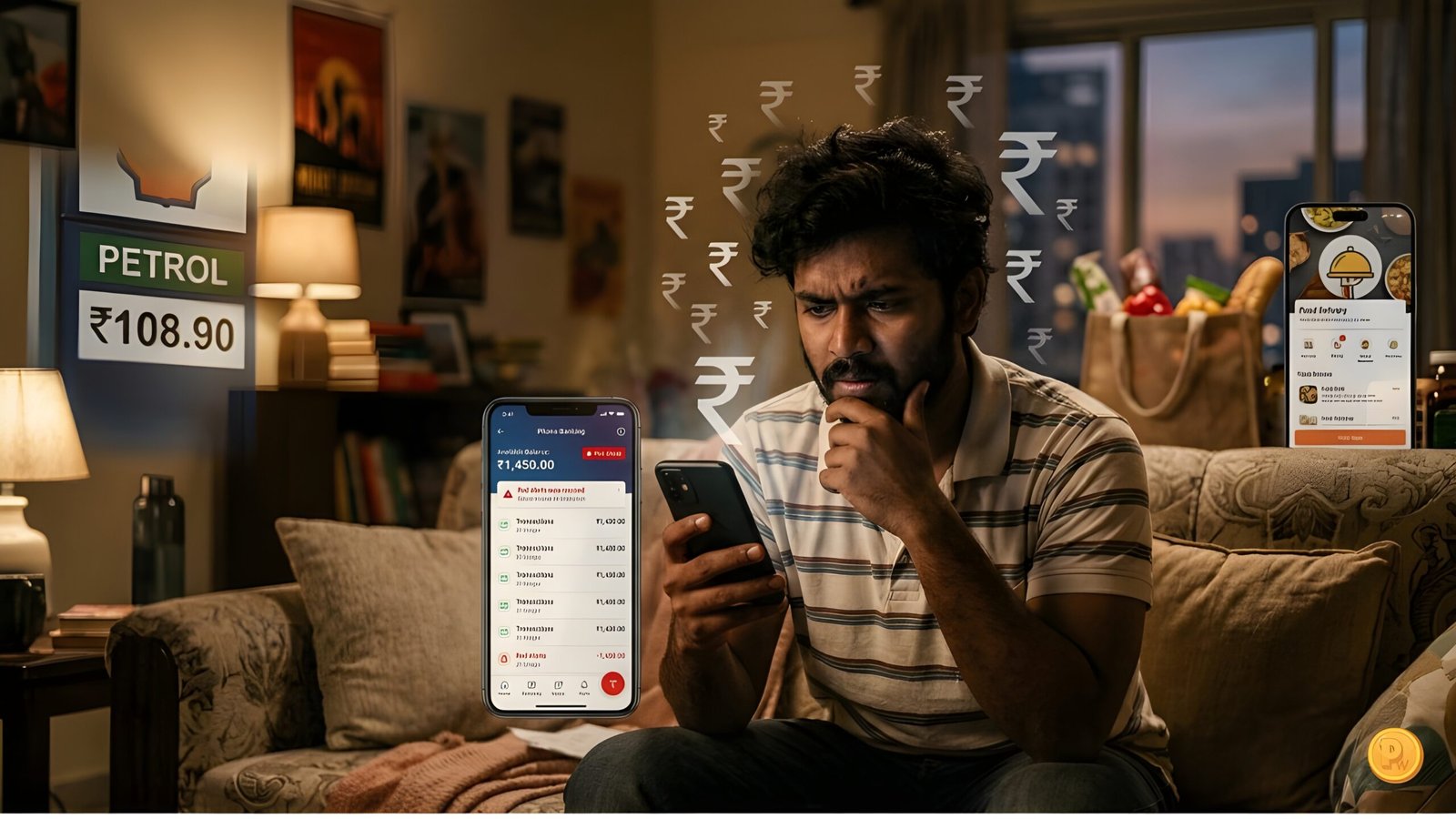
Why Your Salary Feels Less Every Year (Even If It Increases)
You got the hike. HR sent the email. You did a little mental calculation — that’s ₹8,000 more per month.
And yet, three months later, your bank balance looks the same as before.
Maybe even worse.
If you’ve ever felt this way, you’re not imagining things. The reason why your salary feels less despite growing every year is one of the most frustrating financial realities in modern India — and most people never figure it out.
Let’s break it down, honestly.
You’re Not Earning Less — Your Money Is Losing Value Every Year
Here’s the uncomfortable truth: a ₹40,000 salary in 2024 does not buy what a ₹40,000 salary bought in 2019.
The number is the same. The purchasing power is not.
This is inflation — and it works quietly, every single day, without sending you a bill.
Inflation doesn’t steal your money. It slowly shrinks what that money can do.
India’s average retail inflation has hovered between 5–7% over the past several years. That sounds like a small number. But compounded over 4–5 years, it means prices have risen by 25–40% in many categories. Your rent, groceries, fuel, school fees, and medical bills — all of them have silently repriced themselves upward.
If your salary grew by 8% but inflation was 6%, your real raise was just 2%. On a ₹40,000 salary, that’s ₹800 of actual purchasing power gain.
That’s not a raise. That’s a rounding error.
The Silent Killer: How Inflation Is Eating Your Salary Without You Noticing
Let’s make this concrete. Here are everyday items and how their prices have shifted:
| Item | Price ~2019 | Price ~2024–25 | Increase |
|---|---|---|---|
| Petrol (Delhi, per litre) | ₹72 | ₹95 | ~32% |
| Tomatoes (per kg, avg) | ₹20–30 | ₹60–120 | 100–300% |
| 1BHK rent (Tier-2 city) | ₹6,000 | ₹9,000–12,000 | ~50–100% |
| Movie ticket (multiplex) | ₹200 | ₹350–500 | ~75–150% |
| Auto/cab fare (5 km) | ₹60–80 | ₹100–150 | ~65% |
| School fees (pvt, monthly) | ₹2,000 | ₹3,500–5,000 | ~75–150% |
Look at that table and ask yourself: has your salary grown at the same pace?
For most middle-class Indians, the honest answer is no.
The rising prices in India aren’t making headlines every day. They’re absorbed quietly — in the grocery bill that’s ₹200 more than last month, the house rent that went up “just a bit” at renewal, the fuel you fill without checking the price anymore.
You stop noticing not because it stops hurting — but because you get used to the pain.
Where Your Salary Actually Goes Every Month (The Truth Most People Ignore)
Here’s a rough expense breakdown for a single person earning ₹40,000/month in a Tier-1 or Tier-2 Indian city:
| Expense Category | Monthly Cost (Approx.) |
|---|---|
| Rent (1BHK or PG) | ₹8,000–15,000 |
| Groceries + household | ₹3,000–5,000 |
| Transport (fuel/cab) | ₹2,000–4,000 |
| Food delivery (Swiggy/Zomato) | ₹1,500–3,000 |
| Mobile + internet | ₹500–800 |
| OTT + subscriptions | ₹500–1,500 |
| Medical/personal care | ₹500–1,000 |
| Clothes/shopping (avg) | ₹1,000–2,000 |
| Family support/transfers | ₹2,000–5,000 |
| Total (conservative est.) | ₹19,000–37,300 |
On ₹40,000, you’re left with anywhere between ₹2,700 and ₹21,000.
And that’s before any EMIs, before emergencies, before “just this once” purchases.
The income vs savings gap in India isn’t a mystery. It’s math — and the math is becoming harder every year.
From ₹200 to ₹500: How Small Spending Habits Are Quietly Draining You
Think about a typical working weekday.
You wake up, order chai from an app because you’re tired — ₹60. Lunch outside because the office canteen was boring — ₹180. Evening snack delivery because you skipped the canteen again — ₹120. After work, one impulse buy on Amazon because it had a “limited deal” — ₹499.
That’s ₹859 in a single day. On nothing memorable.
₹859 × 20 working days = ₹17,180. Gone. Every month. On habit, not on choice.
These daily expenses in India are the hardest to track because no single transaction feels significant. ₹60 for chai isn’t the problem. The problem is the pattern — the unconscious repetition of small spending that adds up to a large number.
A common list of daily habits that quietly drain your wallet:
- Morning coffee/chai delivery instead of homemade
- Eating out for lunch 4–5 days a week
- Ordering dinner out of convenience, not celebration
- Impulse online shopping triggered by notifications
- Buying bottled water daily instead of carrying a bottle
- Tipping/surge pricing on cabs during peak hours
- Late fees on bills are paid a day after the due date
None of these is a “bad” choice in isolation. All of them together are a slow financial leak.
The Subscription Trap: ₹99 Here, ₹199 There… And Your Money Is Gone
This one deserves its own section because it’s so easy to ignore.
India’s digital economy has turned subscriptions into an addiction. And because they’re auto-debited, most people don’t even notice them leave the account.
A typical subscription stack for a 25–30-year-old Indian:
| Subscription | Monthly Cost |
|---|---|
| Netflix | ₹149–499 |
| Amazon Prime | ₹179 (or ₹1,499/year) |
| Hotstar / JioCinema | ₹149–299 |
| Spotify / Wynk | ₹119 |
| LinkedIn Premium | ₹1,600–2,400 |
| Cloud storage (Google/Apple) | ₹130–220 |
| Gym membership (unused) | ₹800–2,000 |
| News app subscription | ₹99–199 |
| Monthly total | ₹3,225–6,935 |
That’s potentially ₹7,000/month in subscriptions — ₹84,000/year.
And the worst part? Most people are using maybe 40% of what they’re paying for.
Your subscriptions aren’t the enemy. Your inattention to them is.
A quick audit: go through your bank statement right now and highlight every auto-debit. You’ll likely find at least 2–3 services you forgot you subscribed to.
Lifestyle Inflation: The Biggest Reason Your Salary Hike Feels Useless
Here’s the most dangerous pattern on this list — and the most human one.
You get a raise. Naturally, you feel richer. So you upgrade slightly. New phone. Better apartment. More eating out. Occasional weekend trips. A little more Uber, a little less bus.
None of these upgrades feels extravagant. Each one feels earned.
But here’s what’s actually happening — this is lifestyle inflation in India at work:
- Your salary went up by ₹8,000
- Your rent upgrade cost ₹3,000 more
- Your new phone EMI costs ₹2,000/month
- Your food spending increased by ₹2,000 because “I can afford it now”
- Your savings increase: ₹1,000
You raised your lifestyle by ₹7,000 to pocket ₹1,000.
This is why income increase spending increase is almost always true — not because people are irresponsible, but because the upgrade instinct is completely natural. We evolved to improve our circumstances when resources increase.
The problem isn’t that you spend more when you earn more. The problem is spending all of it.
Convenience Is Costing You More Than You Think (And You Don’t Notice It)
Urban India has a convenience economy now, and it’s genuinely expensive.
Here’s a quick comparison that most people never actually calculate:
| Action | Convenience Option | Cost | Frugal Option | Cost | Monthly Difference (20 days) |
|---|---|---|---|---|---|
| Commute 5 km | Ola/Uber | ₹120 | Metro/bus | ₹20 | ₹2,000 saved |
| Lunch | Zomato delivery | ₹220 | Home-packed | ₹50 | ₹3,400 saved |
| Groceries | 10-minute delivery | ₹800 (markup+fees) | Local market | ₹600 | ₹200 saved |
| Water | Bisleri daily | ₹20 | Refillable bottle | ₹0 | ₹600 saved |
Across just these four habits: ₹6,200/month in potential savings.
That’s ₹74,400 a year. The cost of a decent vacation, a stock portfolio start, or six months of emergency fund.
The point isn’t to live uncomfortably. It’s to recognise that the cost of living increase in India isn’t just inflation — it’s also the convenience premium you’re voluntarily paying, every single day.
₹30,000 vs ₹40,000 Salary: Why You’re Still Saving the Same Amount
This is the part that genuinely shocks people.
Studies and financial surveys consistently show that savings rates in India don’t scale proportionally with income at the middle-income level. Here’s a stylised version of what that looks like:
| Monthly Salary | Typical Expenses | Savings |
|---|---|---|
| ₹25,000 | ₹22,000 | ₹3,000 |
| ₹35,000 | ₹32,000 | ₹3,000 |
| ₹50,000 | ₹46,000 | ₹4,000 |
| ₹75,000 | ₹68,000 | ₹7,000 |
Notice the pattern. As income grows, expenses grow almost in lockstep. The savings number barely moves.
This is the income vs savings India problem in one table.
The math works against you at every step — inflation shrinks your purchasing power, lifestyle inflation expands your expenses, and the subscription/convenience economy takes a silent cut from what remains.
A ₹10,000 salary hike that results in ₹1,000 in extra savings is not financial growth. It’s an illusion of it.
Your Brain Thinks You’re Richer… But Your Reality Says Otherwise
There’s a psychological element here that almost nobody talks about.
When your salary increases, your brain registers a sense of abundance — even if the real increase (adjusted for inflation) is small. This mental shift changes how you make spending decisions for the next few weeks or months.
The “I deserve this” mindset kicks in.
You worked hard. You got the raise. Why not celebrate a little? New phone, better restaurant, a weekend trip. These aren’t moral failures — they’re human.
But the “I deserve this” spending habit has a compounding problem: it doesn’t end. Every new income level creates a new reference point. You adjust upward. You never adjust back down.
A few psychological patterns that keep people financially stuck:
- Present bias — Valuing immediate pleasure far more than future security
- Social comparison — Spending to match or signal status relative to peers
- Mental accounting — Treating a salary hike as “bonus money” separate from your actual finances
- Normalcy bias — Assuming your current income is permanent and stable
Understanding these patterns doesn’t make them disappear. But it makes them easier to catch in the moment.
How Social Media Is Quietly Increasing Your Expenses Every Day
There’s one external force that none of the traditional financial advice accounts for: the 3–5 hours a day most Indians spend on Instagram, YouTube, and Reels.
Every scroll is a curated showcase of upgraded living. Unboxing videos. Travel vlogs. Restaurant reviews. “What I eat in a day” at ₹3,000/meal. “My morning routine” with ₹800 skincare.
The Instagram lifestyle pressure in India is real, measurable, and expensive.
Research consistently shows that social media exposure increases spending, especially on:
- Food and dining experiences
- Fashion and personal appearance
- Travel and “experiences”
- Electronics and gadgets
- Home décor and aesthetics
You don’t even feel the influence. You see a café, save it to Instagram, visit it on Saturday, spend ₹1,200, and post a story. It felt like your choice. It was engineered content that turned into a purchase.
Social media doesn’t just sell you products. It sells you a lifestyle standard you’re unconsciously trying to meet.
The Simple 3-Step Reality Check Most People Never Do
This doesn’t have to be complicated. Most people who get a handle on their money do three basic things:
Step 1: Track your expenses for 30 days — every single rupee.
Use any app (Money Manager, Walnut, Spendee) or a plain notes app. The goal isn’t to judge yourself. It’s to see where the money actually goes, not where you think it goes. Most people are shocked.
Step 2: Calculate your actual savings rate.
Formula: (Monthly savings ÷ Monthly income) × 100
If you earn ₹40,000 and save ₹2,000, your savings rate is 5%. The generally recommended target is 20%+. If you’re far below that, you now have a number to improve — not a vague feeling.
Step 3: Identify your top 3 expense leaks.
After tracking 30 days, look for the categories where you spent more than you’d planned or expected. Food delivery? Subscriptions? Impulse shopping? Pick the top 3 and set a specific cap for next month.
Budgeting tips in India don’t need to be elaborate. The basics — awareness, measurement, targeted reduction — are almost always enough to start.
It’s Not About Spending Less — It’s About Spending Smarter
Here’s the final shift that changes everything:
Smart spending in India isn’t about becoming cheap. It’s about becoming intentional.
The goal is not to stop ordering Zomato. It’s to notice when you’re ordering out of convenience vs. genuine enjoyment — and to make that choice consciously.
The goal is not to cancel all subscriptions. It’s to keep only the ones you actually use, not the ones you forgot you had.
The goal is not to ignore lifestyle upgrades. It’s to make sure your savings rate upgrades first — before your lifestyle does.
A practical framework:
| Decision Type | Ask Yourself |
|---|---|
| Impulse purchase | “Will I still want this in 48 hours?” |
| Subscription renewal | “Have I used this in the last 30 days?” |
| Lifestyle upgrade | “Has my savings rate improved first?” |
| Eating out | “Is this a choice or a habit?” |
| Convenience spend | “What am I actually paying for?” |
Three questions before every significant purchase: Do I need it? Can I afford it without reducing savings? Will I still care about this in a month?
If the answer to all three is yes, spend without guilt. Financial awareness doesn’t mean financial misery.
Your Salary Isn’t the Problem — Your Financial Awareness Is
Let’s come back to where we started.
Your salary increased. Your bank balance stayed the same.
Now you know why. Inflation quietly raised the price of everything around you. Lifestyle inflation silently expanded your spending to match your new income. The convenience economy took a daily cut. Subscriptions are auto-debited in the background. Social media influenced purchases you didn’t even register as influenced.
None of this makes you irresponsible. It makes you normal.
But “normal” in India’s middle class right now means saving very little, feeling perpetually stretched, and wondering why you can’t get ahead despite doing everything right.
The reason why salary feels less every year isn’t one thing. It’s ten small things compounding quietly, year after year.
The solution isn’t a bigger salary. It’s a sharper awareness of where the money goes — and a decision, each month, to make savings non-negotiable before everything else.
You can’t control inflation. You can’t fully control the cost-of-living increase in India. But you can control the lifestyle inflation you accept, the subscriptions you keep, and the habits you build around money.
That’s where the gap between “always broke” and “finally building wealth” actually lives.
Not in the salary. In the choices around it.
Frequently Asked Questions (FAQs)
Q: Why does my salary increase, but my savings stay the same every month?
- This happens because of a combination of inflation and lifestyle inflation. When your salary increases, your expenses tend to rise at the same pace — you upgrade your lifestyle, spend more on convenience, and take on new subscriptions. Meanwhile, inflation quietly increases the cost of rent, food, and fuel. The result is that your higher salary gets absorbed before it can become savings.
Q: How much of my salary should I be saving every month?
- A commonly recommended benchmark is the 20-30% rule — saving at least 20% of your take-home income every month. If you earn ₹40,000, that’s ₹8,000 in savings before any discretionary spending. Most financial experts suggest automating this by transferring savings on the same day your salary arrives, so you spend what’s left rather than saving what’s left.
Q: Is inflation really that big a reason why my salary feels less in India?
- Yes, and it’s more significant than most people realise. India’s retail inflation has averaged 5–7% annually in recent years. If your salary grew by 8% but inflation ran at 6%, your real purchasing power only grew by 2%. Over 4–5 years, this gap compounds — prices rise 25–40% while salaries often don’t keep up, especially in mid-level roles.
Q: What is lifestyle inflation, and how do I stop it?
- Lifestyle inflation is the tendency to increase your spending every time your income increases — better apartment, newer phone, more eating out, more travel. It feels natural and earned, but it means your savings rate never improves. The simplest way to counter it is to increase your SIP or savings amount before you adjust your lifestyle after every raise. Save the increment first, then spend what remains.
Q: What is the easiest first step to take control of my money?
- Track every expense for 30 days without changing your spending habits. Use any app or even a notes file. Most people are genuinely surprised by where their money actually goes versus where they think it goes. Once you have real data, identifying your top 3 spending leaks becomes obvious — and fixing just those three categories is usually enough to meaningfully improve your monthly savings.
Start small. Track one month. Run the numbers. The awareness alone will change how you see every rupee — and that changes everything.

Abhishek Kandir is the founder and lead writer at Paisewaise, a personal
finance publication covering Indian markets, budgeting, and investing since 2023.
Abhishek’s work focuses on making complex financial topics — from RBI
Interventions to SIP strategies — understandable for everyday Indian readers
without a financial background.