

AI Budgeting Experiment: I Let AI Control My Budget for 30 Days — Here’s What Happened

AI Budgeting Experiment I: Let AI Control My Budget for 30 Days — Here’s What Happened
Personal Finance Experiment | 10 min read
⚠️ Disclaimer: This article documents a personal experiment and is not financial advice. All figures are illustrative examples based on real budgeting patterns. Consult a licensed financial advisor before making changes to your financial plan.
Why I Let AI Control My Money
Rent up. Groceries up. Subscriptions are quietly multiplying in the background. If you’re an American navigating finances in 2024–2025, that sentence probably hit close to home. With inflation reshaping household budgets across the country and the average U.S. household carrying over $103,000 in debt, it’s no wonder people are searching for a smarter way to manage money.
I was no different. Despite earning a decent income, I found myself hemorrhaging cash every month — not on one big thing, but on a hundred small things. A streaming service here, a takeout order there, an impulse buy I’d “deal with later.” The problem wasn’t income. It was emotion-driven spending.
That’s when I had an idea: What if I removed emotion from my finances entirely? What if, instead of trusting my gut, I handed the decision-making wheel to an AI — cold, logical, data-driven — for a full 30 days?
“With rent, groceries, and subscriptions eating into my paycheck, I wondered: what if I removed emotion from my finances entirely? So I handed control of my budget to AI for 30 days.”
This is the honest account of that AI budgeting experiment — what worked, what didn’t, how much I saved, and whether I’d do it again. Spoiler: the results surprised me.
My Financial Situation Before the Experiment
Before diving into the AI budgeting experiment, let’s establish the baseline. My monthly after-tax income was $4,800 — roughly in line with the U.S. median household income range. On paper, this should be workable. In practice, it evaporated fast.
| Expense Category | Monthly Amount | % of Income |
|---|---|---|
| Rent | $1,450 | 30.2% |
| Utilities | $180 | 3.8% |
| Car Payment + Insurance | $520 | 10.8% |
| Subscriptions (Netflix, Spotify, Hulu, etc.) | $145 | 3.0% |
| Groceries | $380 | 7.9% |
| Dining Out | $340 | 7.1% |
| Miscellaneous / Impulse | $385 | 8.0% |
| Credit Card (minimum payment) | $120 | 2.5% |
| Total Spending | $4,200 | 87.5% |
| Monthly Savings | $600 | 8% |
At an 8% savings rate, I was marginally above the U.S. personal savings rate average, which has hovered between 4–8% in recent years. But I carried a $3,000 credit card balance, had zero emergency fund, and was contributing only $300/month to my 401(k). By most personal finance benchmarks, I was treading water.
My goals entering this AI budgeting experiment:
- Increase savings rate from 8% to at least 18–20%
- Reduce credit card balance below $2,000
- Cut discretionary spending by at least 25%
- Build a starter emergency fund of $2,000+
The Rules of the 30-Day AI Budget Experiment
For this experiment to work, I needed a clear structure. Here’s exactly how I set up my AI budgeting experiment framework:
Tools Used:
- ChatGPT: Primary AI advisor — used to analyze spending, set limits, and generate weekly budget summaries
- Mint: Automated transaction categorization and real-time expense tracking
- YNAB (You Need A Budget): Zero-based budgeting execution and weekly envelope allocation
The Non-Negotiable Rules:
- AI sets all spending category limits — no manual adjustments
- AI decides how much gets moved into savings each week
- AI recommends all investment contribution changes (executed manually by me)
- No override unless genuine emergency (medical bill, car breakdown, etc.)
- Weekly check-in: share all transactions with AI for analysis and recalibration
- AI is advisory only — no direct bank account access; all actions executed manually
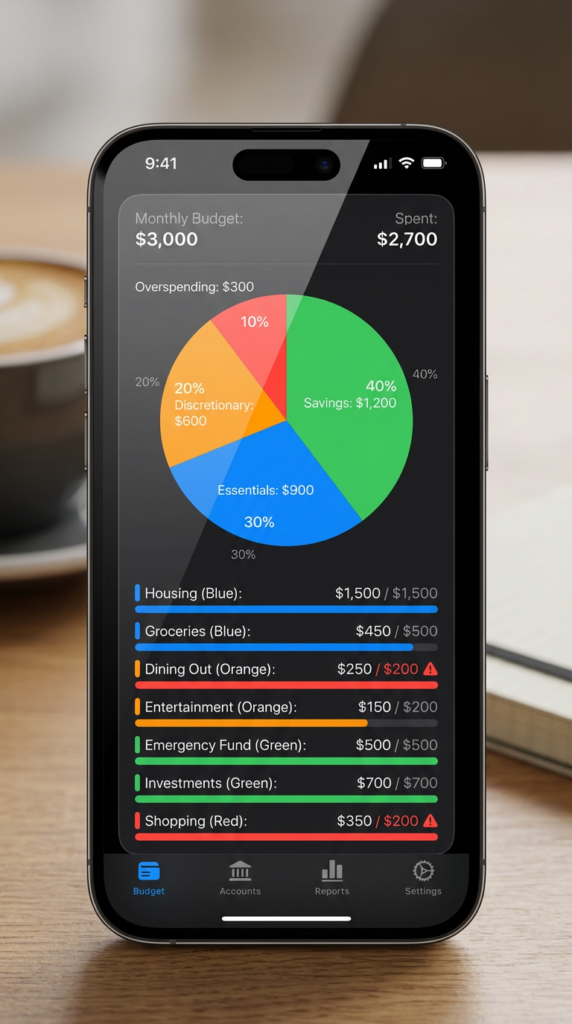
A critical clarification: AI was not directly accessing or controlling my bank account. Every recommendation was reviewed and manually executed by me — creating a safety net while still holding myself fully accountable to the algorithm’s logic.
What AI Did to My Budget
Once I fed the AI my complete financial picture — income, expenses, debts, goals — it got to work. Here’s a category-by-category breakdown of every major change the AI recommended during this budgeting experiment.
A. Subscription Audit
The AI cross-referenced my subscription list against actual usage patterns pulled from three months of bank statements. Its recommendations were direct:
- Cancel Hulu — watched less than twice per month
- Downgrade Spotify from Premium Family ($16.99) to Individual ($10.99)
- Cancel unused fitness app ($12.99/month — logged in 3 times in 90 days)
- Consolidate two overlapping cloud storage plans into one
Total subscription savings: $47/month → $564/year
B. Food & Dining Changes
Food was the biggest behavioral battleground of the entire AI budgeting experiment. The AI set firm, data-backed caps with zero sentimentality:
- Weekly grocery budget capped at $85 (structured around a meal prep plan the AI generated)
- Monthly dining out limit set at $150 (down from $340)
- Meal prep is recommended 4 nights per week to reduce weeknight takeout dependency
Result: Food and dining category reduced by 44% — saving $190/month alone.
C. Emergency Fund Prioritization
The AI immediately flagged zero emergency fund as a critical financial risk. It redirected 15% of monthly net income ($720) into a high-yield savings account (HYSA) before any other allocation.
| Account Type | APY (Approx. 2024–2025) | AI Verdict |
|---|---|---|
| Traditional big bank savings | 0.01–0.50% | ❌ Not recommended |
| Marcus by Goldman Sachs HYSA | ~4.50% | ✅ Recommended |
| Ally Bank HYSA | ~4.35% | ✅ Recommended |
| SoFi Savings | ~4.60% | ✅ Recommended |
| Money Market Fund (Fidelity SPAXX) | ~4.95% | ✅ Recommended |
The difference between a 0.01% and 4.50% APY on a $5,000 emergency fund is roughly $224/year in passive interest — not life-changing, but not nothing.
D. Investment Reallocation
With the emergency fund underway, the AI turned to long-term wealth building. It recommended increasing my 401(k) contribution from $300 to $600/month and opening a Roth IRA with an additional $300/month. Total investment jump: 3x in one month.
Suggested asset allocation for a 30–35-year-old:
- 70% — S&P 500 Index Fund (Vanguard VFIAX / Fidelity FXAIX)
- 20% — Total International Index Fund (VXUS)
- 10% — U.S. Bond Index Fund (BND)
💡 Case Study — The “Latte Factor” Quantified by AI: When I mentioned buying coffee out 4–5 times per week (~$6/cup), the AI ran the math without judgment: $120/month → $1,440/year → $36,000 over 25 years at a 7% average annual market return. No shaming. Just data. That single output changed my behavior more than any budget spreadsheet ever had.
The Hardest Part: Psychological Impact
Nobody talks about this part enough. The practical changes in the AI budgeting experiment were logical. The psychological rewiring was hard.
Week one was genuinely difficult. I walked past a restaurant I love on a Friday night and had to remind myself: the AI had set a $150 dining total for the month, and I’d already spent $80. What made it psychologically unique was that it wasn’t a person telling me no — it was an algorithm. That made it feel both more objective and strangely easier to accept.
What I lost:
- Spontaneity — no more “let’s just order pizza” nights
- The habit of “treating myself” after a hard workday
- The comfortable illusion that small purchases don’t accumulate
What I gained:
- Dramatically lower decision fatigue (the AI decided the limit, I just followed it)
- Genuine financial awareness — for the first time, I could name where every dollar went
- A surprising sense of control, not restriction
- Dramatically reduced impulse buying — I started pausing at checkout and asking: “Is this in the plan?”
“I realized most of my spending wasn’t driven by need or even strong desire — it was boredom, stress, and habit. The AI had no way to know that, but just having a system broke the cycle.”
This may be the most underrated outcome of the AI budgeting experiment: not the savings figures themselves, but the behavioral awareness it forces. Research in behavioral economics consistently shows that external accountability — even non-human accountability — meaningfully reduces impulsive financial decisions.
30-Day Financial Results
Numbers don’t lie. Here’s the complete before-and-after data from the AI budgeting experiment:
| Metric | Before (Month 0) | After (Month 1) | Change |
|---|---|---|---|
| Monthly Total Spending | $4,200 | $3,450 | ▼ $750 saved |
| Savings Rate | 8% | 22% | ▲ +14 percentage points |
| Credit Card Balance | $3,000 | $2,200 | ▼ $800 paid down |
| Investment Contribution | $300/mo | $900/mo | ▲ +$600/month |
| Emergency Fund Balance | $0 | $720 | Built from zero |
| Monthly Dining Spending | $340 | $148 | ▼ 56% reduction |
| Monthly Subscription Costs | $145 | $98 | ▼ $47 saved |
Key takeaways:
- Total monthly savings increased by $750 — without any income change
- At this pace, $9,000 more is saved per year compared to before the experiment
- Credit card debt on track to be fully cleared within 4 months
- Investment contributions tripled — compounding impact over 20–30 years is significant
A 22% savings rate places this well above the average American personal savings rate. For context, this aligns with what many financial planners call the “20% Rule” — the widely recommended benchmark of saving at least 20% of take-home pay. The AI got me there in 30 days.
Where AI Got It Wrong
Credibility requires honesty. The AI budgeting experiment was not perfect. Here’s where the algorithm genuinely missed:
- Over-aggressive savings rate: Jumping from 8% to 22% in a single month is financially sound but psychologically brutal. The AI didn’t build in a transition period or emotional runway.
- Ignored seasonal expenses: A birthday dinner, a tire replacement, and an unexpected vet bill all landed in Month 1 — none were accounted for in the initial AI plan. An emergency buffer was flagged after the fact, not before.
- No social life weighting: The AI categorized every restaurant visit as discretionary waste. In reality, some dinners are relationship investments — colleagues, dates, family — that carry value no algorithm can price.
- Missed tax optimization nuance: The AI recommended a Roth IRA without knowing my marginal tax bracket. Depending on income, a Traditional IRA with a current-year deduction may have been the smarter move.
The core limitation: AI lacks long-term strategic context and the ability to assign weight to human emotional priorities. It processes transactions, not lives. That gap is real and matters.
Can AI Replace a Financial Advisor?
This is the central question of every AI budgeting experiment conversation. The honest answer: not fully — and probably not ever entirely.
| Dimension | AI Budgeting Tools | Human Financial Advisor (CFP) |
|---|---|---|
| Budget optimization | ✅ Excellent | ✅ Good |
| Real-time expense tracking | ✅ Excellent | ❌ Limited |
| Complex tax planning | ❌ Limited | ✅ Excellent |
| Estate planning | ❌ Not capable | ✅ Excellent |
| Behavioral coaching | ❌ No | ✅ Core strength |
| Retirement projections | ⚠️ Basic only | ✅ Detailed |
| Cost | Free – $15/month | $200–$400/hour or 1% AUM/year |
| Availability | 24/7 | Scheduled appointments |
It’s also important to distinguish between robo-advisors (like Betterment or Wealthfront, which automatically invest your money algorithmically) and AI chat tools (like ChatGPT, which provide analysis and advice but don’t execute). Both have a role, but neither replaces a human CFP for complex financial lives.
For most Americans under 40 with uncomplicated W-2 finances, AI budgeting tools deliver roughly 80% of the value at 5% of the cost. For complex situations — business ownership, divorce, inheritance, early retirement — a licensed CFP remains essential.
Who Should (and Shouldn’t) Try AI Budgeting?
Great fit for:
- Young professionals (22–38) building wealth from scratch
- People with chronic overspending or impulse buying patterns
- Side hustlers and freelancers managing variable monthly income
- Tech-comfortable savers who want data-driven spending accountability
- Anyone who’s tried traditional budgeting and abandoned it for emotional reasons
Not ideal for:
- People with complex multi-stream tax situations
- Small business owners with personal and business finances intertwined
- High-net-worth individuals requiring estate and legacy planning
- Those needing deep behavioral or therapeutic financial coaching
The sweet spot for the AI budgeting experiment approach is a single-income or dual-income household with relatively straightforward finances, some bad spending habits, and a genuine desire to change — but without the discipline to do it alone.
Final Verdict: Would I Let AI Control My Budget Again?
Yes — but as a co-pilot, not the captain.
The AI budgeting experiment proved that algorithmic thinking can radically sharpen financial discipline. I saved $750 more in one month, paid down $800 of debt, tripled my investment contributions, and built my first emergency fund — all without a raise, a side hustle, or a lottery win. Just better decisions made with better data.
But I also learned that the best financial life isn’t one stripped of human judgment. It’s one where data and intuition operate in partnership. Going forward, I’m adopting a hybrid model: AI handles the analysis, pattern recognition, and spending limit-setting. I handle the strategic priorities, life events, and the occasional Friday dinner that no algorithm can properly value.
“AI didn’t replace my financial judgment — it sharpened it.”
If you’ve been meaning to get your finances together “someday,” this is a low-risk, high-reward place to start. Open YNAB. Feed your data to ChatGPT. Give it 30 days. The worst outcome is that you learn exactly where your money goes.
FAQ: AI Budgeting Experiment — Your Questions Answered
Q: Can AI really manage your budget?
- Yes, with important caveats. AI tools like ChatGPT, Mint, and YNAB can analyze spending patterns, flag waste, and set category limits faster and more objectively than most people manage manually. The AI budgeting approach works best as a structured framework and advisor — not as an autonomous financial controller. You still execute every decision and provide the human context that the AI cannot see.
Q: Is ChatGPT good for budgeting?
- ChatGPT is surprisingly effective when given complete financial data. It can generate personalized spending plans, identify inefficiencies, recommend savings targets, and explain investment options in plain English. Its main limitation is session-based memory — it has no persistent recall of your finances unless you re-provide the data each time. Pair it with a dedicated tracking app like Mint or YNAB for optimal results.
Q: What are the best AI budgeting tools in the U.S.?
- The top three for most Americans are: Mint (free, excellent auto-categorization), YNAB (~$14.99/month, best-in-class for zero-based budgeting discipline), and Empower (free, outstanding for investment tracking and net worth monitoring). For AI-enhanced analytical guidance, ChatGPT or Claude works well as a reasoning layer on top of these tools.
Q: Does AI help you save more money?
- Based on this AI budgeting experiment: yes, meaningfully so. Savings rate jumped from 8% to 22% in a single month — a $750/month improvement — purely through AI-guided behavioral changes with no income increase. The mechanism isn’t magic; it’s removing the emotional friction that causes most budgets to fail. AI gives you a system. The system does the heavy lifting.
Have you tried an AI budgeting experiment of your own? The tools are free, the data is yours, and 30 days is all it takes to find out.
Abhishek Kandir is the founder and lead writer at Paisewaise, a personal
finance publication covering Indian markets, budgeting, and investing since 2023.
Abhishek’s work focuses on making complex financial topics — from RBI
Interventions to SIP strategies — understandable for everyday Indian readers
without a financial background.


[…] years. After Mint shut down in early 2024, millions of users were suddenly left without their go-to budgeting tool, scrambling for alternatives. That void accelerated the rise of a new generation of AI […]