

How People Are Traveling More While Spending Less
Flights feel expensive. Hotels look unaffordable. Vacation packages seem out of reach for most budgets. Yet airports are fuller than ever, Instagram feeds overflow with travel content, and your colleagues somehow just returned from their third trip this year.
So what’s happening? How are people traveling more often while spending less overall?
The answer isn’t found in secret discount codes or extreme budget hacks. It’s rooted in a fundamental shift in how modern travelers approach trips. Traveling more while spending less isn’t about deprivation—it’s about strategic decision-making, flexibility, and prioritizing what truly matters.
This article reveals the real strategies, mindset shifts, and practical examples from travelers who’ve cracked the code on frequent, affordable travel.
What Has Changed in the Way People Plan Trips?
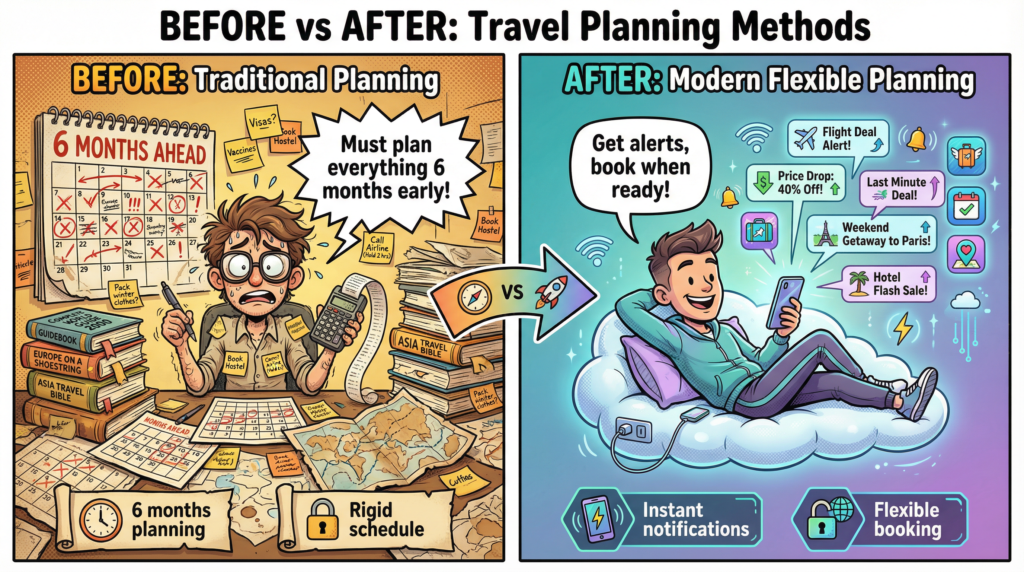
Five years ago, most people planned travel the same way: pick a destination, choose dates months in advance, book everything, and hope for the best. Today’s travelers have flipped this model entirely.
The shift is from rigid to flexible, from destination-first to price-first planning.
Modern travelers use fare calendars, price tracking apps, and flexible booking tools that alert them when deals appear. Instead of deciding “We’re going to Paris in July,” they’re asking “Where can we go affordably in the next three months?”
This approach leverages technology that wasn’t widely accessible before:
- Google Flights’ price tracking and flexible date calendars
- Hopper’s price prediction algorithms
- Scott’s Cheap Flights (now Going) email alerts
- Skyscanner’s “Everywhere” search function
Real Example: Sarah, a marketing manager from Chicago, set up price alerts for five destinations she wanted to visit. When a mistake fare to Lisbon appeared at $312 roundtrip (normally $800+), she booked immediately and requested time off afterward. Her flexibility saved her $488 and allowed her to take a trip she wouldn’t have otherwise afforded.
The psychology has shifted too—FOMO (fear of missing out) on deals now drives booking decisions as much as FOMO on destinations.
Are People Traveling More Frequently or Just Taking Shorter Trips?
Both trends are happening simultaneously, but the rise of micro-trips is the real game-changer for traveling more while spending less.
Traditional annual vacations—one or two long trips per year—are giving way to multiple shorter getaways:
| Traditional Approach | Modern Micro-Trip Approach |
|---|---|
| One 10-day vacation | Three to four 3-4 day trips |
| $3,500-5,000 total cost | $800-1,200 per trip |
| Heavy planning required | Spontaneous opportunities |
| Significant time off needed | Long weekends + 1-2 days |
| High burnout between trips | Consistent travel rhythm |
Why shorter trips cost less overall
- Accommodation savings: Four nights cost less than proportional rates for ten nights
- Reduced dining expenses: Fewer meals eaten out
- Transportation efficiency: Regional destinations within driving distance
- Activity selectivity: Focus on 2-3 main experiences rather than exhaustive itineraries
Case Study: The Martinez family from Austin used to take one annual beach vacation costing $4,500. They switched to three long-weekend trips—San Antonio (driving distance), New Orleans (cheap direct flight), and a cabin in Arkansas. Total annual spending: $3,200, with more diverse experiences and less vacation debt.
The frequency model also reduces psychological pressure. When you know another trip is just weeks away, you’re less tempted to overspend on the current one.
Which Travel Expenses Are People Cutting First?
Smart travelers aren’t cutting travel expenses randomly—they’re prioritizing ruthlessly.
The hierarchy of cuts looks like this:
First to Cut
- Premium hotel locations (central business districts, beachfront)
- Hotel resort fees and amenities they won’t use
- Airport parking (using rideshares or off-site lots)
- Paid guided tours that duplicate free experiences
- Airport meals and snacks (bringing food from home)
Protected at All Costs
- Authentic local dining experiences
- Unique activities unavailable elsewhere
- Quality time and memories with travel companions
- Comfortable (not luxury) accommodations
- Experiences that create stories
Real-World Example: Marcus, a teacher from Portland, stopped booking hotels in downtown cores. By staying 15-20 minutes outside city centers via public transit, he saves $80-120 per night. That savings funds, cooking classes, wine tastings, and local food tours—experiences he values far more than a lobby with marble floors.
The key insight: It’s prioritization over deprivation. People aren’t suffering through terrible accommodations; they’re choosing perfectly adequate options that free up budget for what they actually remember from trips.
How Much Does Flexibility in Travel Dates Really Reduce Costs?
The flexibility advantage isn’t just marketing hype—the numbers are substantial and measurable.
Average savings by flexibility type
| Flexibility Level | Typical Savings | Example |
|---|---|---|
| Fixed dates (weekend) | Baseline ($450) | Friday-Sunday, peak season |
| Midweek flexibility | 25-35% less ($300-340) | Tuesday-Thursday flights |
| Shoulder season | 30-45% less ($250-315) | April instead of June |
| Red-eye/early morning | 15-25% less ($340-380) | 6 AM departure vs. 10 AM |
| Full date flexibility | 40-60% less ($180-270) | Any dates in a 3-month window |
Case Study Comparison
Traveler A (Fixed): Books Austin to New York for a specific weekend in October
- Round-trip flight: $487
- Hotel (Friday-Sunday): $420 for 2 nights
- Total: $907
Traveler B (Flexible): Same route, willing to travel Tuesday-Thursday in September or October
- Round-trip flight: $247 (Tuesday morning, Thursday red-eye)
- Hotel (Tuesday-Thursday): $240 for 2 nights
- Total: $487
Savings: $420 (46% reduction)
The flexibility dividend compounds when applied to accommodations, activities, and dining. Restaurants offer better deals midweek, attractions have fewer crowds Tuesday-Thursday, and some museums have free admission days.
Pro Tip: Use Google Flights’ calendar view to visualize price differences across dates. The color-coded system shows at a glance which dates offer the best value.
How Are Travelers Finding Cheaper Flights in 2025?
The “book exactly 6 weeks in advance” rule is dead. In 2025, savvy travelers use a multi-tool approach for traveling more while spending less on airfare.
The Modern Flight-Finding Toolkit
1. Fare Tracking Services
- Going (formerly Scott’s Cheap Flights): Monitors mistake fares and flash sales
- Secret Flying: International deal alerts
- AwardFlight: Points redemption availability
2. Strategic Search Techniques
- Clear browser cookies and search in incognito mode
- Search one-way legs separately (often cheaper than round-trip)
- Check alternate airports within 50-100 miles
- Use the “nearby airports” feature religiously
3. Timing Patterns That Actually Work
- Tuesday-Thursday departures average 20% cheaper
- Red-eye flights save 15-30% on popular routes
- Booking sweet spot: 3-8 weeks for domestic, 2-5 months for international (but flexibility matters more than timing)
4. Regional Airport Advantage
| Major Hub | Regional Alternative | Average Savings |
|---|---|---|
| LAX | Long Beach (LGB) | $75-150 |
| NYC (JFK/LGA) | Newark (EWR), Islip (ISP) | $50-120 |
| Chicago (ORD) | Midway (MDW) | $40-90 |
| San Francisco (SFO) | Oakland (OAK), San Jose (SJC) | $60-130 |
Real Example: Jennifer from Seattle set up alerts for Japan flights. When a pricing error offered Seattle to Tokyo for $350 roundtrip (normal price: $1,100), she received the notification within 30 minutes, booked for her family of three, and saved $2,250. The deal lasted only 6 hours.
The key shift: Stop searching constantly and start letting deals come to you. Set up alerts and be ready to act quickly when opportunities appear.
Are Alternative Accommodations Replacing Traditional Hotels?
The lodging landscape has transformed dramatically, and traditional hotels are losing market share to alternatives that offer better value propositions.
The Alternative Accommodation Spectrum
Short-Term Rentals (Airbnb, VRBO)
- Best for: Groups, families, stays over 4 nights
- Value drivers: Kitchen access, multiple bedrooms, washer/dryer
- Cost comparison: Often 20-40% less per person than equivalent hotel rooms
Modern Hostels
- Best for: Solo travelers, couples okay with shared spaces
- Value drivers: Private rooms available, social atmosphere, and included breakfast
- Cost savings: 50-70% less than budget hotels
Guesthouses and B&Bs
- Best for: Travelers wanting local connections
- Value drivers: Personal recommendations, home-cooked meals, unique character
- Cost comparison: 30-50% less than boutique hotels
House-Sitting and Home Exchanges
- Best for: Long-term stays, adventurous travelers
- Value drivers: Free or nearly free accommodation
- Trade-off: Less flexibility, more responsibility
Case Study: The Thompson family (2 adults, 2 kids) compared accommodation options for a 6-night trip to Charleston:
| Option | Total Cost | Cost per Person/Night | Kitchen Access | Space |
|---|---|---|---|---|
| Hotel (2 rooms) | $1,800 | $37.50 | No | 500 sq ft |
| Airbnb (3-bedroom house) | $1,200 | $25.00 | Yes | 1,600 sq ft |
| Savings | $600 | $12.50 | – | – |
By cooking breakfast and lunch in their rental, they saved an additional $400 on dining, bringing total savings to $1,000—enough for an extra trip later in the year.
The hidden value beyond price: Kitchens reduce food costs by 50-60%, laundry facilities eliminate packing stress, and extra space makes longer stays comfortable rather than cramped.
How Are People Using Credit Card Points and Rewards More Effectively?
The credit card rewards game has matured from obsessive optimization to practical strategy. Modern travelers treat points as travel currency, not lottery tickets.
The Shift from Hoarding to Strategic Spending
Old Mindset
- Accumulate points indefinitely for “dream trips.”
- Only redeem for maximum theoretical value
- Multiple cards for every category bonus
- Complex transfer partner strategies
New Mindset
- Use points to offset regular travel costs
- Redeem when it makes practical sense
- Focus on 2-3 cards maximum
- Apply points to necessities, fund experiences with cash
Practical Redemption Strategies
1. The “Free Domestic Flight” Strategy: Most travel rewards cards earn 2x points on travel. Spending $25,000 annually on regular expenses = 50,000 points = 2-3 free domestic round-trip flights.
2. The Hotel Night Offset: Use points for accommodation, spend cash on experiences. A 5-night trip might cost:
- Hotels: Free (60,000 points)
- Dining, activities, transport: $800 cash
- Effective trip cost: $800 instead of $1,400
3. The Business Expense Hack: Freelancers and small business owners put legitimate business expenses on travel cards, earning points on spending that would happen anyway.
Real Example: David, a consultant from Miami, uses the Chase Sapphire Preferred for all business expenses (average $3,000/month). Annual points earned: ~80,000. He uses these points for:
- Four round-trip domestic flights for personal travel
- Three hotel nights per trip
- Annual travel savings: $2,400-3,000
Simple Three-Card Setup for Maximum Value
| Card Type | Best For | Annual Value |
|---|---|---|
| Travel rewards card | Flights, hotels, general travel | $500-800 in redemptions |
| Cashback card | Non-category spending | $300-500 cashback |
| Category bonus card | Groceries, gas, dining | $400-600 in bonus value |
The key insight: You don’t need 12 credit cards and a spreadsheet. Strategic use of 2-3 good cards by putting normal expenses on them yields enough rewards to offset significant travel costs annually.
Why Are Experiences Being Prioritized Over Luxury Spending?
A cultural shift is reshaping travel values, moving away from status-driven luxury toward memory-driven authenticity.

The Luxury Fatigue Phenomenon
Travelers, especially millennials and Gen Z, increasingly report that luxury accommodations and fine dining don’t create memorable travel experiences. What they remember years later:
- Unexpected conversations with locals
- Trying unfamiliar foods at street markets
- Getting lost and discovering hidden neighborhoods
- Challenging experiences (hiking, cooking classes, adventure activities)
- Cultural immersion moments
The Experience Priority Hierarchy
High Priority (What People Remember)
- Local food tours and cooking classes ($50-100)
- Walking tours with knowledgeable guides ($15-30)
- Museum admissions and cultural sites ($10-25)
- Outdoor activities and nature experiences ($30-80)
- Local transportation passes for exploration ($20-40)
Low Priority (Quickly Forgotten)
- Hotel thread count and bathroom marble
- Resort fees for unused pools and gyms
- Business class short-haul flights
- Hotel breakfast buffets ($25-35 per person)
- Turndown service and room upgrades
Case Study Comparison
Couple A (Luxury Focus): 5-night Paris trip
- 5-star hotel: $2,200
- Fine dining restaurants: $800
- Luxury experiences: $600
- Total: $3,600
- Memorable moments: “The hotel was nice, the food was good.”
Couple B (Experience Focus): 5-night Paris trip
- Comfortable Airbnb: $700
- Mix of bistros, cafés, and markets: $400
- Cooking class, wine tasting, walking tours: $500
- Food market visits, neighborhood exploration: $200
- Total: $1,800
- Memorable moments: “We learned to make croissants, discovered amazing wine, talked to winemakers, explored hidden courtyards, and ate incredible street food.”
The authenticity preference drives travelers toward experiences that feel real rather than curated for tourists. Street food tours consistently rank higher in post-trip satisfaction than Michelin-starred dinners.
Are Travelers Choosing Nearby or Lesser-Known Locations to Save Money?
The rise of “second cities” and regional destinations represents one of the most significant trends in traveling more while spending less.
The Second City Advantage
Instead of visiting major tourist hubs, travelers are discovering nearby alternatives that offer:
- 40-60% lower accommodation costs
- Fewer crowds and more authentic experiences
- Lower dining and activity prices
- Unique regional culture and attractions
Popular Destination vs. Alternative Comparison
| Tourist Hub | Alternative Destination | Savings | Unique Benefits |
|---|---|---|---|
| Venice, Italy | Bologna, Italy | 50% on hotels | Food culture, porticos, and authentic Italian life |
| Barcelona, Spain | Valencia, Spain | 45% overall | Beaches, paella, and futuristic architecture |
| Paris, France | Lyon, France | 40% on hotels | Gastronomy capital, historic sites |
| Kyoto, Japan | Kanazawa, Japan | 35% overall | Traditional crafts, gardens, samurai district |
| Reykjavik, Iceland | Akureyri, Iceland | 50% on hotels | Northern lights, nature access |
The Nearby Destination Strategy
For Americans, exploring within driving distance eliminates the largest expense (flights) while still providing novel experiences:
Regional Gems Within 3-5 Hours
From New York
- Hudson Valley, Berkshires, Vermont, small towns
- Savings vs. European trip: $2,000-3,000 per person
From Chicago
- Milwaukee, Madison, Door County
- Savings vs. West Coast trip: $800-1,200 per person
From Denver
- Southern Colorado towns, Wyoming dude ranches
- Savings vs. ski resort trip: $600-1,000 per person
Real Example: Instead of their usual $5,000 trip to popular European cities, the Anderson family explored smaller towns in their own state and neighboring regions—Asheville instead of Paris, Chattanooga instead of Barcelona, Door County instead of coastal Maine. Five trips throughout the year cost $4,200 total, with more variety and no passport stress.
The discovery factor: Lesser-known destinations often surprise travelers with quality that rivals famous counterparts—without the crowds, inflated prices, and tourist traps.
Can Traveling More Actually Cost Less Annually Than One Luxury Vacation?
The math is counterintuitive but compelling: multiple budget-conscious trips can cost less than one luxury vacation while providing more total travel experiences.
Traditional Approach: One Luxury Vacation
Destination: Caribbean Resort, 7 nights
| Expense Category | Cost |
|---|---|
| Round-trip flights (2 people) | $1,200 |
| All-inclusive resort | $3,200 |
| Excursions and activities | $600 |
| Spa, extras, tips | $400 |
| Transportation | $200 |
| Total Annual Travel | $5,600 |
Travel days: 7 Destinations visited: 1 Cost per travel day: $800
Modern Approach: Five Strategic Trips
Trip 1: Long weekend driving trip (3 days)
- Accommodation: $240
- Food and activities: $200
- Gas: $60
- Subtotal: $500
Trip 2: Budget airline deal to Southwest (4 days)
- Flights: $220
- Airbnb: $300
- Food and activities: $280
- Subtotal: $800
Trip 3: Shoulder season mountain getaway (3 days)
- Accommodation: $270
- Food and activities: $180
- Gas: $50
- Subtotal: $500
Trip 4: Mistake fare to Mexico (5 days)
- Flights: $280
- Accommodation: $350
- Food and activities: $320
- Subtotal: $950
Trip 5: Regional city exploration (4 days)
- Accommodation: $320
- Food and activities: $240
- Gas: $80
- Subtotal: $640
| Total Annual Travel | $3,390 |
| Annual Savings | $2,210 |
Travel days: 19 Destinations visited: 5 Cost per travel day: $178
Additional Value Beyond Dollar Savings
- Variety: Five different environments, cultures, and experiences
- Reduced burnout: Regular breaks throughout the year instead of waiting 11 months
- Lower financial pressure: Smaller trips are easier to budget monthly
- Flexibility: Can skip or adjust trips based on circumstances
- Accumulated memories: More stories, photos, and experiences
Case Study: Rachel, a nurse from Phoenix, tracked her travel spending for three years:
- Year 1 (Traditional): One 10-day Hawaii trip = $4,800
- Year 2 (Transition): Two trips (San Diego + Portland) = $2,600
- Year 3 (Optimized): Five trips using all strategies = $3,100
“I thought traveling more would cost more,” Rachel explains. “But shorter trips mean I’m not bleeding money on hotels and restaurants for 10 straight days. I plan around deals instead of picking random dates. And honestly? I remember way more from five different trips than one long vacation where days blur together.”
The counterintuitive reality: Frequency and strategic planning beat duration and luxury spending for both cost-effectiveness and overall travel satisfaction.
Conclusion: The New Definition of Affordable Travel
The people traveling the most in 2025 aren’t wealthy—they’re strategic. They’ve embraced a fundamental truth: traveling more while spending less isn’t about deprivation, extreme budgeting, or sacrificing quality.
It’s about being intentional.
The new traveler optimizes three key elements
1. Timing
- Flexible dates unlock 30-50% savings
- Midweek and shoulder season travel reduces costs without reducing quality
- Patience for deals beats impulsive booking
2. Flexibility
- Price-first planning opens destinations you wouldn’t have considered
- Alternative accommodations provide better value than hotels
- Regional airports and second cities eliminate tourist premiums
3. Experience Value
- Memories come from authentic interactions, not marble lobbies
- Street food tours beat fine dining for both cost and stories
- Local exploration trumps paid tourist attractions
The travelers filling airports aren’t spending less on travel—they’re spending smarter. They’ve rejected the narrative that meaningful travel requires luxury price tags. They’ve discovered that the best trip isn’t the most expensive one—it’s the one that happens.
Start small. Set up one price alert. Book one flexible trip. Choose experiences over amenities.
The world is more accessible than the travel industry wants you to believe. You don’t need to be rich to travel frequently. You just need to be intentional about how, when, and where you go.
Your next adventure is cheaper than you think—if you know where to look.
FAQs
Q. Is traveling during ofthe f-season really cheaper?
- Yes. Off-season and shoulder-season travel can reduce flight and hotel costs by 30–50% compared to peak travel periods.
Q. Are shorter trips more affordable than long vacations?
- Shorter, more frequent trips often cost less overall because they reduce accommodation, food, and activity expenses.
Q. How much can flexible travel dates save on flights?
- Being flexible with dates can lower airfare significantly—sometimes by hundreds of dollars—especially when flying midweek.
Q. Are alternative accommodations better than hotels for saving money?
- In many cases, yes. Rentals, hostels, and guesthouses often cost less and reduce food expenses by offering kitchens.
Q. Can traveling multiple times a year be cheaper than one luxury trip?
- Yes. Several well-planned budget trips can cost less annually than a single luxury vacation when expenses are spread and optimized.

Abhishek Kandir is the founder and lead writer at Paisewaise, a personal
finance publication covering Indian markets, budgeting, and investing since 2023.
Abhishek’s work focuses on making complex financial topics — from RBI
Interventions to SIP strategies — understandable for everyday Indian readers
without a financial background.